
REVIEW: Goodbye to Language 3D

auldog

Goodbye to Language 3D
Directed by: Jean-Luc Godard
Written by: Jean-Luc Godard
Starring: Héloise Godet, Kamel Abdeli, Richard Chevallier and Zoé Bruneau

Goodbye to Language is an intimidating assault on the senses, a free-form barrage of intense political and philosophical musings combined with the most jaw-dropping and maddening use of 3D imagery I’ve ever seen. It doesn’t feel right writing about Jean-Luc Godard’s 43rd feature after only seeing it once, but one viewing is likely all I will have for the foreseeable future because of the singular way it needs to be seen.

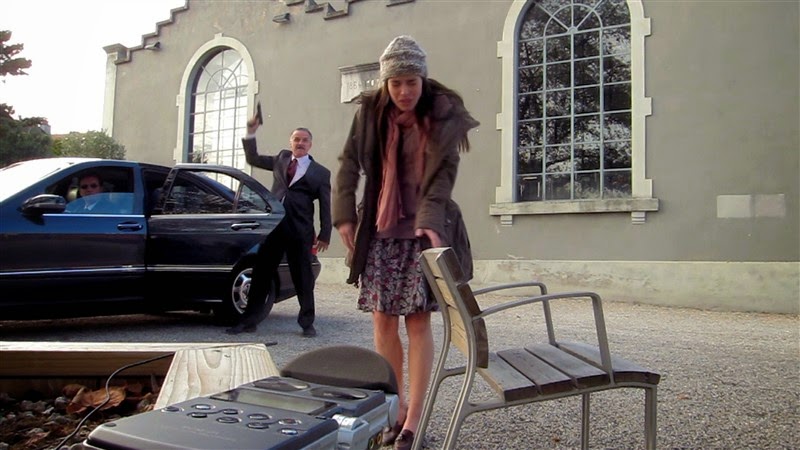
Godard’s use of 3D has been heralded far and wide since the movie’s debut at Cannes earlier this year.  In two similarly jaw-dropping sequences, the shot begins normally, then splits two images as a man and a woman separate and then reunites them again.  Though those are the two images that immediately illustrate Goodbye to Language’s singularity, much of Godard’s focus in this movie, at least visually, is on a dog.  His dog, named Roxy.

In typical dog fashion, Roxy wanders through countryside, sleeps on couches and writhes in the snow.  The couple that shares the movie if rarely the screen with him are often just as naked, though Godard chronicles them clinically rather than lovingly. He never holds onto any single shot, song or visual tone for very long; in addition to standard color images, Roxy (and the others) are sporadically black and white, hyper-saturated or grainy.
Goodbye to Language

On almost every level, Goodbye to Language 3D is a collage of miscommunication. As Richard Brody noted in the New Yorker (and as title indicates), the big idea in the movie is Godard’s own use of 3D. The two shots I mentioned earlier are indeed earth-shattering, but the simpler shots, of a woman washing her hands in a leafy tub, or a man’s head being pushed into bloody water by a similar hand, have a depth and clarity that is itself awe-inspiring.  Other images, like distorted shots of autumn trees or a speeding car speedometer foregrounded in front of a dark highway, may twist and annihilate your eyes.

Goodbye to Language’s breadth of artistic and historical references would be dense and overwhelming in a movie three times its length, let alone one that is only 71 minutes.  There are musings about capitalism, philosophy and sex in the digital age, Mary Shelly (who pops up in a reenactment) and Hitler (who doesn’t); a couple also discusses gender equality while the man grasps his wife’s bare hips and takes a shit.  Though many of those discussions become a disorienting blur, especially after only one viewing, the images are burned directly onto my brain, and it took about 20 minutes for my eyes to totally readjust afterward.  I’d love to see it again some day.

Grade: A

Short Takes: Mockingjay Part 1, Whiplash, Force Majeure & more

Hunger Games Mockingjay

The Hunger Games: Mockingjay Part 1 – The premiere dystopian young adult franchise continues its gradual steps forward in quality in this third installment, which is slightly more above average than the second.  In Mockingjay Part 1, Katniss (Jennifer Lawrence) is at the center of a propaganda machine for a rebel group attempting to overthrow the sinister, Donald Sutherland-led central government.

This set-up, whether intentional or not, makes this third Hunger Games at times feel like a commentary on franchise filmmaking.  The rebellion’s leaders critique Katniss’ blank, disinterested performance in the propaganda in the same way Lawrence was picked apart for her apathy in the first film (to her credit she has vastly stepped up her game since then).  That’s the most interesting thing about Mockingjay, aside from seeing Philip Seymour Hoffman and Julianne Moore share the screen as those scheming rebel leaders.  Director Francis Lawrence choreographs the uprising with just enough ferocity to make it resonate while still restraining it enough for a PG-13 rating.  Grade: C+

Continue reading

Short Takes: Birdman, Nightcrawler & St. Vincent

3386992

Birdman: or (The Unexpected Virtue of Ignorance) – Alejandro González Iñárritu’s Birdman is a stale, one-note show biz satire with an ambitious and occasionally dazzling formal design. Led by a manic performance by Michael Keaton as a washed-up super hero movie star attempting a comeback on the stage, Birdman weaves in and out of his Raymond Carver adaptation with a string of impressively executed tracking shots.

Birdman is more about executing and fusing those long takes than about saying anything exciting or fresh about theater or performance, though.  Iñárritu’s images are sleek but ultimately bland and empty, and the story about a middle-aged man reclaiming his glory is too.  Keaton’s performance as Riggan is the loudest, but I was moved more by Andrea Riseborough as his co-star and Lindsay Duncan as a bitter New York Times theater critic.  The two actresses have an irrepressible screen presence, and they quietly steal scenes from the self-parodying turns by Keaton and Edward Norton.  Grade: D+

Continue reading

REVIEW: Interstellar

Interstellar

Interstellar
Directed by: Christopher Nolan
Written by: Jonathan Nolan and Christopher Nolan
Starring: Matthew McConaughey, Anne Hathaway, Jessica Chastain and Bill Irwin

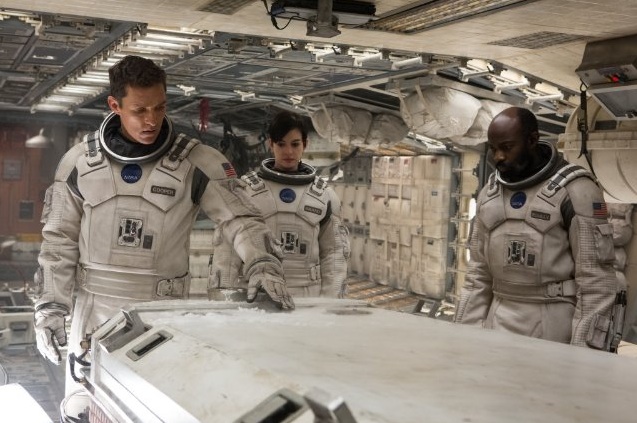
It was only a matter of time before Christopher Nolan made a space epic. In Interstellar, he treats the universe in a similar way he treated dream-space in Inception; that is, he plays boundless absurdity with such straight-faced showmanship and serious sense of purpose that the movie feels much bigger and more important than it actually is.

Interstellar is about Matthew McConaughey saving humanity from the dry near-apocalypse of climate change.  He plays Cooper, a widower engineer-turned-farmer who lives in the Dust Bowl of the future with his father-in-law (John Lithgow) and two children.   It’s easy to tell that Cooper’s daughter Murph (Mackenzie Foy) is his favorite, though we’re not with her or her brother Tom (Timothée Chalamet) as children long enough to really understand their relationship.

Continue reading

REVIEW: Fury

Brad Pitt;Logan Lerman

Fury
Directed by: David Ayer
Written by: David Ayer
Starring: Brad Pitt, Shia LaBeouf, Logan Lerman and Michael Peña

There are a lot of despicably violent images in David Ayer’s Fury, a World War II movie set in the scorched-Earth Germany at the end of the conflict.  It begins with a majestic white horse carrying an anonymous soldier through a battlefield, though it’s not long before he’s identified as the enemy when we see Don Collier (Brad Pitt) jump out from a tank and stab him in the neck and eyes.  He lets the horse run off.

Not long after that moment, Collier tells a newbie named Norman (Logan Lerman)  to clean out his seat in their tank, which includes plenty of blood and the upper quadrant of a human face, eye and all.   Norman vomits, and you may want to too.  Not only are the images in Fury grotesque, but much of the behavior is too.  At first, Collier’s tough-but-fair-ness is insisted upon by the script, but then it’s slowly chipped away.   There are times when he seems at risk of transforming into Colonel Kurtz.

Continue reading

REVIEW: Abuse of Weakness

Abusodedebilidad

Abuse of Weakness
Directed by: Catherine Breillat
Written by: Catherine Breillat
Starring: Isabelle Huppert, Kool Shen, Laurence Ursino and Christophe Sermet

Catherine Breillat’s Abuse of Weakness is the semi-autobiographical story of a struggling director whose latest film is impeded by pseudo-romantic entanglement and a debilitating stroke.  The first 20 or so minutes of this movie are profoundly horrifying, as Breillat hovers over Maud (Isabelle Huppert) being jolted out of sleep by that stroke.  “Half of my body is dead!” she yells to an emergency dispatcher on the phone.

Huppert’s intensely physical performance in this moment and in the rest of the film are crucial to its success, and Breillat films her agony at an often disturbingly close proximity. Abuse of Weakness doesn’t feel intrusive, though, because it is fused with Maud’s subjectivity and not simply a chronicle of her gradually losing her dignity.

Continue reading

REVIEW: Gone Girl

gone-girl-DF-01826cc_rgb Gone Girl
Directed by: David Fincher
Written by: Gillian Flynn (screenplay & novel)
Starring: Ben Affleck, Rosamund Pike, Carrie Coon and Tyler Perry

There are many, many spoilers in this review.

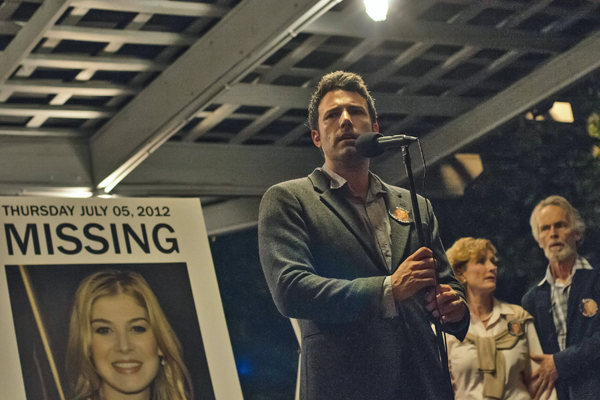
Amy is missing, yes.  Her blood is at her and her husband’s home along with a shattered glass table and an open front door.  Her porcelain skin, glowing smile and flowing golden hair is plastered desperately on “Missing” billboards and posters by her loved ones.  The media quickly catches Missing White Woman Syndrome and flocks to the scene to revel in and exploit the spectacle.  They want more blood, her husband’s blood, and the police are gradually running out of reasons not to give it to them.

None of them seem willing (or able) to fathom that Amy (Rosamund Pike) would flee on her own free will, let alone her other, more sociopathic impulses. It takes her clumsy, baffled husband Nick (Ben Affleck) a while to realize he’s ensnared in an intricate, sadistic web by his wife.  However, she’s also caught in a different but equally sinister web with everyone else in the movie, one woven by David Fincher and Gillian Flynn.

Continue reading

Short Takes: The Skeleton Twins, The Drop & The Hundred-Foot Journey

skeletontwinsmain900

The Skeleton Twins- Any enthusiasm I have for Bill Hader and Kristen Wiig’s dramatic and comedic chemistry in The Skeleton Twins is drowned out by the rest of this unrelentingly sloppy movie.  Hader plays Milo, who returns home to live with his unhappily married sister Maggie (Wiig) after attempting suicide.  There are, of course, dark family secrets, vast pools of resentment, a dead parent, a shitty parent and plenty of other dysfunctional family cliches.  The script, co-written by Mark Heyman and the director Craig Johnson, shifts tone so abruptly that it’s impossible to be invested in the story they’re trying to tell.

Hader and Wiig have undeniable chemistry and cast a wide net of emotions to try and make this script work.  A couple of times they are successful.  There’s an absolutely hysterical scene where Milo goes to the dentist’s office where Maggie works and they get high on laughing gas and ramble.  It’s also one of the few times where the movie’s deep undercurrent of sadness actually contributes something to the story and doesn’t seem overdone. When they talk to each other in this scene, their problems seem unforced because Johnson lets it unfold organically.  The other conflicts largely stem from sex, which Milo has with his old high school English teacher and Maggie has with her scuba instructor.  It’s aggressive, unearned, empty misery.  Grade: C-

Continue reading

REVIEW: The Giver

meryl-streep-jeff-bridges-giver-weinstein

The Giver
Directed by: Phillip Noyce
Written by: Michael Mitnick and Robert B. Weide (screenplay), Lois Lowry
Starring: Brenton Thwaites, Jeff Bridges, Odeya Rush and Meryl Streep

The Giver is a bad movie, but it’s not generically bad like many of its other teen dystopia kin.  It tries to recreate the world of Lois Lowry’s middle school reading staple almost too precisely, creating a totalitarian community that feels like a futuristic Pleasantville without any humor or personality.  Color floods the black and white town as Jonas (Brenton Thwaites) experiences more and more new, human things, but the movie’s pulse rarely participates in that awakening.

Unfortunately, The Giver’s script has only a small fraction of Pleasantvilles humor, though it produces many unintentional laughs.  The way the characters talk, like programmed robots taught not to say things like “love,” just doesn’t translate well to the screen.  This is largely a failure of performance, with cast members either going way over the top (Jeff Bridges) or comically flat (Katie Holmes, Alexander Skarsgaard).  Brenton Thwaites, despite being much older than Jonas is in the book, finds the right tone for his emerging personality even if he feels slightly out of place.

Continue reading

REVIEW: Boyhood

Best-Boyhood

Boyhood
Directed by: Richard Linklater
Written by: Richard Linklater
Starring: Ellar Coltrane, Patricia Arquette, Lorelei Linklater and Ethan Hawke

The last shot of Richard Linklater’s 1993 film Dazed and Confused is the open road from the point of view of a high school senior-to-be. He’s one of the dozens of characters weaving in and out of that sprawling recreation of a single Texas day in 1976, maybe even the closest the movie has to a main character.  And like so many other characters in the movie, I remember things about him, and not his name (I had to look up that it was Randall).

I remember how he slings his arm around an incoming freshman and treats him like a little brother, and how that freshman’s wide eyes take everything in as he tries to figure out how to act cool around the big kids. Then there’s the moment where Randall “Pink” Floyd hangs out on a football field drunk and stoned with his friends, enveloped by the stars in the sky. His journey in the movie is deciding whether or not to embrace being labeled a slacker.

Continue reading