REVIEW: Melancholia

Melancholia
Directed by: Lars von Trier
Written by: Lars von Trier (screenplay)
Starring: Kirsten Dunst, Charlotte Gainsbourg, Kiefer Sutherland and Alexander Skarsgard

When Lars von Trier announced “No more happy endings,” after the premiere of his last film, Antichrist, people were a little dismayed.  Had any of his movies actually had a happy ending in the traditional sense?  Bjork dangling from a rope at the end of Dancer in the Dark, an entire village (and America by extension) facing a woman scorned at the end of Dogville, a man walking through the woods and then being overcome by persecuted female ghosts (or something like that) in Antichrist- he’s not exactly Disney material.

His latest, Melancholia, certainly contains a grim conclusion whether or not you subscribe to the “more” part of his proclamation.  This is a film in which the world ends and everyone on it perishes, but not before a young woman succumbs to crippling depression during her wedding.

Continue reading

REVIEW: 50/50

50/50
Directed by: Jonathan Levine
Written by: Will Reiser (screenplay)
Starring: Joseph Gordon-Levitt, Seth Rogen, Anna Kendrick and Anjelica Huston

As you may have guessed, 50/50 has a series of choices with two possible outcomes, the most prominent of which is whether the young cancer patient played by Joseph Gordon-Levitt will live or die.  The movie also presents a choice that is unexpected given the subject matter: will it lean more heavily on comedy or drama?

The latter choice is more interesting because an audience will have to grapple with it. Once you get to know Adam (Gordon-Levitt), you’ll want him to live, and Will Reiser’s screenplay assures that you will never have mixed feelings about that.  You will about the comedy, though.  Should a movie about this be funny?  Showtime’s The Big C has proven that it is indeed possible, as long as there is a distinct human element. Thanks to the well-cast ensemble, 50/50 is mostly successful at walking the tightrope.

Continue reading

REVIEW: Moneyball

Moneyball
Directed by: Bennett Miller
Written by: Steven Zaillian & Aaron Sorkin (screenplay)
Starring: Brad Pitt, Jonah Hill, Philip Seymour Hoffman and Chris Pratt

Moneyball is a movie preordained to be an Oscar contender simply by the marketing.  Brad Pitt is in a sports movie, and he’s at his Brad Pittiest.  The odds are in this movie’s favor to be a contender, though, not to win (yet).

Billy Beane (Pitt) would not like that.  He is a man who needs to have the last word, to win the last game.  As the manager of The Oakland A’s, one of the poorest teams in professional baseball, he’s willing to grapple with a new strategy: play by the numbers, not the players.  Along with Yale economics alum Peter Brand (Jonah Hill), they shift the focus of recruiting new players to computer-generated results to acquire overlooked players on the cheap.

Continue reading

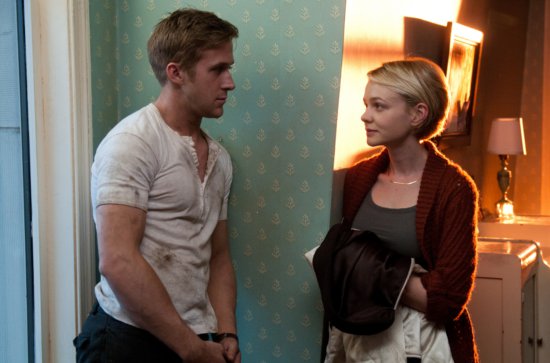
REVIEW: Drive

Drive
Directed by: Nicolas Winding Refn
Written by: Hossein Amini (screenplay), James Sallis (book)
Starring: Ryan Gosling, Carey Mulligan, Bryan Cranston and Albert Brooks

Violence comes and goes with Ryan Gosling’s unnamed driver.  Like Clint Eastwood’s Man With No Name, there’s no indication where he came from or where he’s going.  However, you get the feeling he’s been traveling place to place causing the same kind of chaos.

Drive doesn’t initially appear to be a movie of such violence.  The almost serene first half is stylistic perfection, with director Nicolas Renf tracking the driver from behind the wheel of a suspenseful, sneaky heist escape (in a Chevy Impala), to a movie set where he flips a car and to his initial meeting with his neighbor Irene (Carey Mulligan) and her son.  He stumbles on the mob second hand, when Irene’s unfortunately named husband Standard (Oscar Isaac) needs to pull off a robbery to get some thugs off his back.

From that heist on, Renf holds no prisoners with the blood-letting.  It wouldn’t work if Gosling approached it with the same semi-charmed apathy he gives the character in the first half.  He trembles as the body count stacks up.

What makes Drive a film to remember at the end of 2011 is the moody, gorgeous cinematography and the first-rate score.  The brooding visuals mesh together with the electronic beat of Cliff Martinez’s music to create a neo-noir with an 80s synth rhythm.  Even when Renf and screenwriter Hossein Amini hack and slash these characters to bits, it never feels out of place.

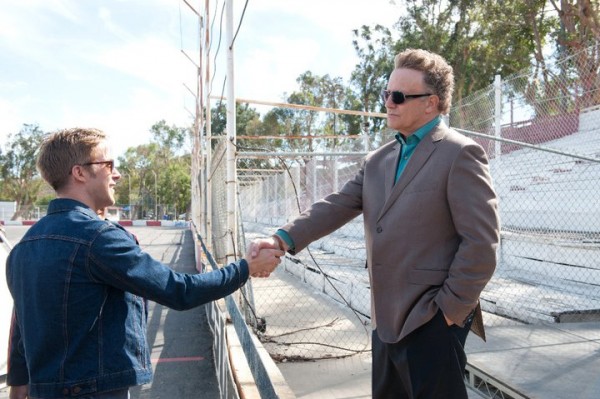
There is a scene fairly early on in the movie where the driver sits with Irene’s son and watches a cartoon about sharks.  He asks the boy how he knows the shark is bad, and the boy says “Because he looks bad.”  This scene is important to understanding not just Gosling’s driver, but the principle villain as well.  While Ron Perlman is all-too at home in the campy role of a crime boss, Albert Brooks seems a little off-beat as a mob kingpin.  He delights in the role, though, going over the top without losing sight of the consequences of all the killing.

Drive is also unique as a noir in that it doesn’t let either of the attractive female characters (Mulligan or Christina Hendricks) expand into a femme fatale or even really expand much at all.  Irene is accustomed to tacking on a smile for her son, and Mulligan is perfect at conveying happiness and sadness with contrasting expressions in her smile and deep, dark eyes.

At the end, though, this is ultimately a man-made world of corruption and violence, and the driver is left to eliminate it to keep Irene and her son safe.  He works as a car repairman for a schmuck with a limp (a terrific Bryan Cranston).  Brooks’ Bernie Ross puts up the money to have the driver race a car for him.  He and Perlman’s Nino are so opposite that their scenes together in the garage and in their front of a pizzaria are one of the few things that detract from the movie’s mood.

You could split Drive down the middle for its nearly bloodless first half and its gory second act, but it also fits together as a convincing whole.  This is because Renf never loses sight of his characters.  Though the villains are undeniably evil, the hero isn’t all that good.  We’re left to root for him because we see him from all angles and see that his heart is ultimately in the right place.  He’s the good shark.

Grade: B+

REVIEW: Meek’s Cutoff

Meek’s Cutoff
Directed by: Kelly Reichardt
Written by: Jon Raymond (screenplay)
Starring: Michelle Williams, Bruce Greenwood, Paul Dano, and Shirley Henderson

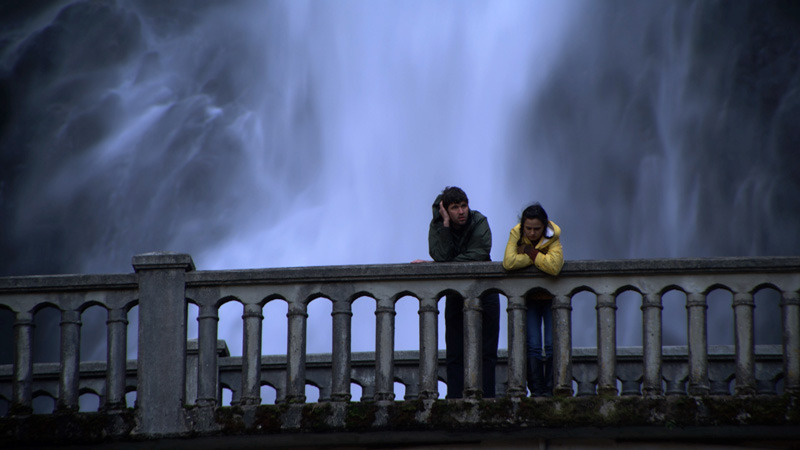
The post-modern western Meek’s Cutoff, the latest from minimalist director Kelly Reichardt, operates with two things in mind: people are indecisive, and the Oregon Trail is beautiful.  In this quiet, contemplative film we find an American allegory set against the Western Expansion in the 1800s.

A group of settlers is led by a guide named Meek (Bruce Greenwood), a bearded troubadour who prefers to burn through the plains rather than accept their dominance.  The whole film rotates around the settlers’ mounting uncertainty, especially that of Emily (Michelle Williams).  

Meek’s Cutoff acknowledges the intolerance of the time period, and uses it as a mirror to today.  Screenwriter Jon Raymond has written some beautifully expressive dialogue  in this film, especially considering how little overall talking there is.  The back-and-forth Meek and Emily share when he asks her if she hates him is one of the most well-written exchanges of the year.

The role of Emily does not mark the first time Williams has operated in the low-key films of Ms. Reichardt.  The two brilliantly collaborated in 2008’s Wendy and Lucy, another earnest American folktale set in Oregon.  That film was better, and Williams was better in it, but this one is still quite good.  It has more in common with Reichardt’s 2006 film Old Joy with its picturesque nature setting and many unspoken implications.  This is not the bombastic Western setting of John Ford or Sergio Leone.  There are no grandiose shootouts or even any cowboys (It’s rated PG).

Instead of typical Western conventions that directors like the Coen Brothers have subverted to their own post-modern ends, Reichardt favors a mood of near-tranquility.  There are outbursts, as when Meek and another settler played by Paul Dano bring back a Native American captive.  Fear of the unknown seeps to the surface, but Emily’s whispering into the ear of her husband (Will Patton) turns the “savage” into their guide instead of a corpse.

Muttering is largely how Emily and the other women silently get their way in this movie.  There are several instances where the men mutter to themselves about what it is the camp should do.  Reichardt almost always pans to the women, silently gathered to the side and watching their lives being decided for them. They recall the nuns of Doubt, albeit with more colorful garments, in more ways than one.

This is important to note because it clearly establishes Reichardt’s vision of the film and her identity as one of the few female directors working today.  Had a male director been behind the camera, those scenes may have been shot quite differently. The most revolutionary thing about Meek’s Cutoff may be that it confronts gender without sacrificing any of the realism in the time period.  When Emily takes up arms against Meek in the film’s climax it’s, as the New York Times also noted, more than a gun she’s wielding.

Just because Meek’s Cutoff is not as masterful as Wendy and Lucy does not dismiss it from discussion.  In fact, it is still a very fine film, one that has a clearly defined worldview and cinematography that is absolutely striking given the budget.  The early images of a vast empty field and the howling wind striking a lone Emily behind the other wagons is a perfect visual metaphor for its themes. On this journey they are all together but separate, moving forward with no direction at all.

Grade: B
REVIEW: Poetry

Poetry
Directed by: Lee Chang-dong
Written by: Lee Chang-dong (screenplay)
Starring: Yun Jeong-hie, Ahn Nae-song, Lee Da-wit, and Hira Kim

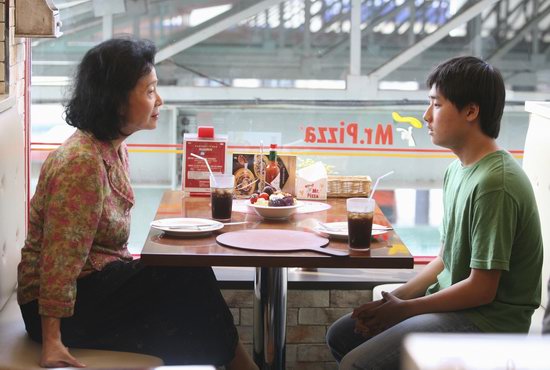
What good are our memories to us if one day they can evaporate like river water?  What good is a younger generation that grows increasingly dehumanized?

The initial shots of Poetry set up the movie to answer these questions.  We watch as a couple of young children stand by the river, and then we follow what we eventually pick out as the body of a young girl float up to them.  For the rest of the movie, that murder will reverberate through the life of Mija (Yun Jeong-hie) in a blur.

Continue reading

REVIEW: Contagion

Contagion
Directed by: Steven Soderbergh
Written by: Scott Z. Burns (screenplay)
Starring: Laurence Fishburne, Kate Winslet, Matt Damon, and Marion Cotillard

Steven Soderbergh utilizes his big name cast with Contagion, but he does it in a different way than his past movies like Ocean’s 11 or Traffic.  He casts famous stars, then lets a deadly virus loose to kill them alongside the unknowns and the extras.

It’s a familiar strategy, though not to Soderbergh.  Terrence Malick famously used it in The Thin Red Line, though to different, less contagious ends.  We see people like Kate Winslet, Matt Damon, and Jude Law, and we assume they won’t die, but some of them do.

Continue reading

REVIEW: Win Win

Win Win
Directed by: Tom McCarthy
Written by: Tom McCarthy (screenplay)
Starring: Paul Giamatti, Amy Ryan, Alex Shaffer, and Melanie Lynskey

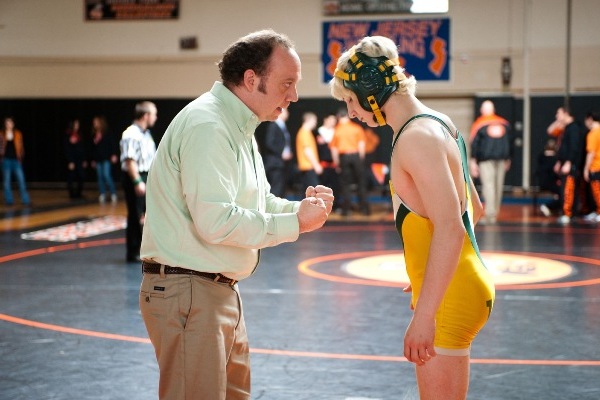
Tom McCarthy’s Win Win reminds you that even a genre labeled “independent” can succumb to endless cliches.  This is not because it is predictable, but because you are lead to believe that it will be from the beginning.

Armed with a mordant wit (what successful indie comedy filmmaker isn’t?) and a sly sense for what a movie with Paul Giamatti is supposed to be like, McCarthy dismantles the sports genre and the midlife crisis movie from the inside out.  We follow Mike Flaherty (Giamatti) a down-on-his luck New Jersey lawyer with a tough-but-loving wife (Amy Ryan, who else?) and two children.

Continue reading

REVIEW: The Debt

The Debt
Directed by: John Madden
Written by: Matthew Vaughen, Jane Goldmen, & Peter Straughan (adapted screenplay) Assaf Bernstein & Ido Rosenblum (original screenplay)
Starring: Jessica Chastain, Helen Mirren, Sam Worthington, and Marton Csokas

Basic themes of guilt and revenge last a lifetime in The Debt.  It deliberately doesn’t want to be that movie that lets its characters move from one body to the next and forget their brutality.  Nobody is let off the hook; no matter how justified their actions seem in the beginning, at the end your feelings for all of them will likely be mixed.

There are few causes more justified than tracking down an escaped Nazi so they can be put on trial for their crimes.  This is the goal of three young Mossad agents, Rachel (Jessica Chastain), Stephen (Marton Csokas) and David (Sam Worthington), sent to track down an evil Nazi doctor (Jesper Christensen) who performed cruel experiments on prisoners during the war.

Continue reading

REVIEW: Cold Weather

Cold Weather
Directed by: Aaron Katz
Written by: Aaron Katz (screenplay)
Starring: Cris Lankenau, Trieste Kelly Dunn, Raúl Castillo and Robyn Rikoon

At the beginning of Aaron Katz’s Cold Weather, it seems like there will be no way through it.  The main characters, a brother and a sister wandering Portland, are not interesting enough to sustain interest in a movie where nothing happens narratively.  Thankfully, this emerges as the point as the movie becomes more and more clever without sacrificing its realism.

A sense of being with Doug (Cris Lankenau) and Gail (Trieste Kelly Dunn) as they improvise a missing person’s investigation is Cold Weather‘s most crucial element.  The meandering first third hints at several different directions that it may take but not the one it does take.  Doug gets a job bagging ice with Carlos (Raúl Castillo) and the two engage in casual banter about events in their lives and, most importantly, Sherlock Holmes.

Continue reading