REVIEW: Django Unchained

Django Unchained movie still

Django Unchained
Directed by: Quentin Tarantino
Written by: Quentin Tarantino (screenplay)
Starring: Jamie Foxx, Christoph Waltz, Leonardo DiCaprio and Kerry Washington

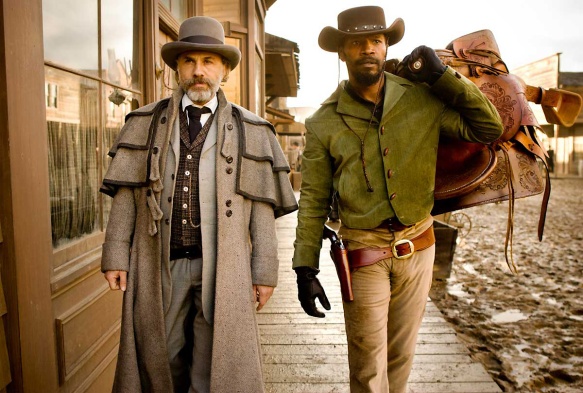
Django, like the ‘D’ at the beginning of his name, is silent.  This is no small feat, given that he is the main character in a Quentin Tarantino movie, and should be stopping to yak at any given opportunity, preferably before a burst of ultra-violence.

Of course there is plenty of bloodshed in Django Unchained, so much in fact that it paints a white plantation red, mostly with the blood of its owner and his employees.  It is Tarantino’s second historical revenge fantasy in a row, following the revisionist WWII epic Inglourious Basterds.  Here, though, he crucially refuses to revise the horrors of American slavery, and depicts them in ways that are startling and horrific.  The blood from the shootouts may be gratuitous and expressionistic, but it’s the beating, dog mauling and whipping that feel brutally real even if the movie they are in is often highly stylized.
Continue reading

REVIEW: Silver Linings Playbook

silver-linings-playbook-review

Silver Linings Playbook
Directed by: David O. Russell
Written by: David O. Russell (screenplay), Matthew Quick (novel)
Starring: Bradley Cooper, Jennifer Lawrence, Robert De Niro and Jacki Weaver

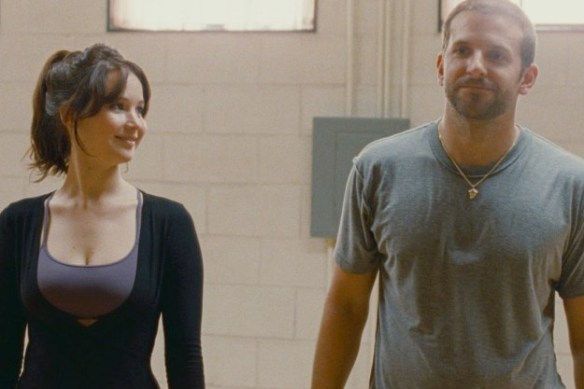
Silver Linings Playbook ends on the thrillingly odd culmination of a dance competition and an NFL football game, the result of a high stakes parlay bet between an obsessive compulsive Philadelphia Eagles fan (Robert De Niro) and a rival gambler who favors the Dallas Cowboys (Paul Herman).  It is a fitting conclusion given that the rest of the movie, for all its seeming narrative conformity, is a rampant, lively piece of work that does what it wants, when it wants.

Part of the reason for this is that its two main characters, two damaged, mentally unstable people played by Bradley Cooper and Jennifer Lawrence, do that as well and director David O. Russell is just trying to keep up with them. It could also be the other way around, though.  Russell has such a lively way with camera movement and atmosphere that the constant sense of motion and organized chaos seems exhausting. For the most part the performers, especially Lawrence, are more than up to the task.  She makes Tiffany such a force of nature that the miscasting of Bradley Cooper is barely noticeable.

Like in Russell’s last movie, The Fighter, this is more of an ensemble effort than based off of a single performance.  It is about Pat Jr. (Cooper) recovering from a mental breakdown after catching his wife cheating and beating the other guy within an inch of his life, but it is also about his dad (De Niro) and mom (Jacki Weaver) coming to terms with his condition.  It forces an American family to confront mental illness, a bold thing to do in a country that increasingly resists that confrontation to its own detriment.

Continue reading

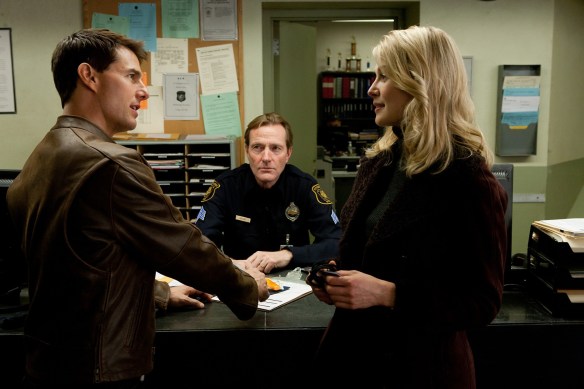
REVIEW: Jack Reacher

jack-reacher07

Jack Reacher
Directed by: Christopher McQuarrie
Written by: Christopher McQuarrie (screenplay), Lee Child (novel)
Starring: Tom Cruise, Rosamund Pike, Richard Jenkins and Werner Herzog

Tom Cruise, despite his kooky off-screen shenanigans, is a reliably lively screen presence.  He is a relentlessly physical actor, which is why franchises like Mission: Impossible have become his bread and butter.  With Jack Reacher he attempts, with varying degrees of success, to heighten his on-screen persona into that of a morally vague vigilante.

Reacher is a solid R-rated (or at least it should be) detective story based on a popular series by Lee Child.  Christopher McQuarrie, who adapted the script as well as directed, has some nice action set pieces to work with, but the movie is mostly built around making the star look good.  Action stars like Cruise, like the many cars his character here drives, are fast becoming vintage in the CGI era.  Here he is a blunt, no-nonsense “drifter,” a man who comes to the aid of those who need him and deals out justice how he sees fit.

Continue reading

REVIEW: The Kid With a Bike

kid with a  bike

The Kid With a Bike
Directed by: Jean-Pierre Dardenne & Luc Dardenne
Written by: Jean-Pierre Dardenne & Luc Dardenne
Starring: Thomas Doret, Cécile de France, Jérémie Renier and Egon Di Mateo

The Kid With a Bike is the first encounter I’ve had with Jean-Pierre and Luc Dardenne, the Belgian auteurs who seem to take the art house world by storm with each new movie.  This film, their latest, is an emotionally rich story of Cyril (Thomas Doret), a young foster child trying to find his way in a world with increasingly closed doors.

As there often is in movies like this, one person is shamelessly on Cyril’s side even though he is stubborn and rage-filled.  Samantha (the fantastic Cécile de France) is at the same medical clinic that Cyril storms through in an attempt to evade officials from the foster home he has escaped from.  He clings to her with such force that it takes two men to pry him off of her, though she makes no concerted effort to help them.  “You can hold me, but not that tight,” she says to him.

Continue reading

REVIEW: Amour

amour-535x376

Amour
Directed by: Michael Haneke
Written by: Michael Haneke (screenplay)
Starring: Jean-Louis Trintignant, Emmanuelle Riva, Isabelle Huppert and William Shimmell

Michael Haneke’s latest film is a good poster child for why mainstream movie audiences fear and avoid many foreign films; it is quiet, slow and relentlessly depressing.  After winning the Palme d’Or in 2009 for The White Ribbon, Haneke officially established himself as a “Cannes auteur,” a director whose latest work would forever and always have a place in the festival’s cannon.

Amour is wondrously, deliberately hopeless.  Its depiction of an elderly woman’s slow, painful crawl toward death after suffering a series of strokes is not peppered with melodrama or any sort of dramatic flourish.  Haneke seems to think this would make the situation too comfortable, too much like a movie.  The goal of this film is to show the situation in as realistic light as possible, but from a removed distance.

Continue reading

REVIEW: This Is 40

this_is_40_a_l

This Is 40
Directed by: Judd Apatow
Written by: Judd Apatow (screenplay)
Starring: Paul Rudd, Leslie Mann, Maude Apatow and Iris Apatow

Paul Rudd is the only main character in Judd Apatow’s latest movie who isn’t part of the comedy auteur’s actual nuclear family.  The wife (Leslie Mann) and two children (Maude and Iris Apatow) are basically playing out better-written scenarios of their lives with a cuter dad.

This makes everything about This Is 40 feel both a little weirder and a little more alive; it’s like making your family relive an awkward Christmas on camera.  Apatow is a keen observer of white upper middle class life, though his considerable success as writer, director and producer over the past few years has made his class standing considerably higher than that.  This movie is his best since his other movie with 40 in the title, albeit much more pensive and mature.

Continue reading

REVIEW: The Hobbit: An Unexpected Journey

the-hobbit

The Hobbit: An Unexpected Journey
Directed by: Peter Jackson
Written by: Fran Walsh, Philippa Boyens, Peter Jackson & Guillermo del Toro (screenplay), J.R.R. Tolkien (novel)
Starring: Martin Freeman, Ian McKellen, Richard Armitage and Andy Serkis

Peter Jackson established himself so well with his take on The Lord of the Rings books that he became indistinguishable from them.  After the ill-received mix bag that was 2009’s The Lovely Bones, he has retreated back to J.R.R. Tolkien’s first Middle Earth novel, The Hobbit.  Jackson’s storytelling confidence has returned to him in spades here, though drawing out one book into three separate movies that clock in at close to three hours seems like a money grab, especially after viewing this somewhat bloated first installment.

Much like the last film in Lord of the Rings, this first Hobbit segment, called An Unexpected Journey, doesn’t quite know when to end, so it just keeps going.  It is full of the scenic New Zealand grandeur and sweeping camera motions that made the earlier movies so visually thrilling, but the tone is much more slapstick.  This is because the dwarves, which were largely comic relief in Lord of the Rings, are front and center here, along with the hobbit Bilbo Baggins (Martin Freeman) and the wizard Gandalf (Ian McKellen).  Freeman and McKellen are both excellent, but there are few stoic, serious elves or gritty rangers to balance out the obnoxious dwarves.  When contrasted with the brutal fantasy series of HBO’s Game of Thrones, it’s almost child’s play at times.

Continue reading

REVIEW: Dark Horse

full_cropped_08DARK_SPAN-articleLarge

Dark Horse
Directed by: Todd Solondz
Written by: Todd Solondz (screenplay)
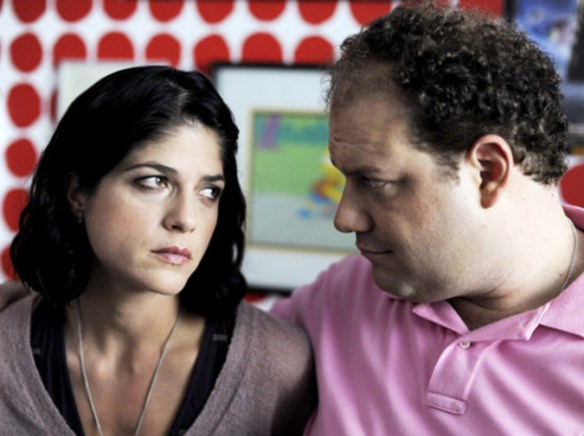
Starring: Jordan Gelber, Selma Blair, Mia Farrow and Christopher Walken

Todd Solondz is a master of the sad laugh.  He has a fascination with depressing losers and societal taboos, the miscreants we don’t want to see in real life, let alone the movies.  By refusing to blatantly mock these people (which have included sex addicts and pedophiles), he establishes worlds that are both darkly comic and unflinchingly honest and complicated.

Dark Horse is one of Solondz’s gentler efforts.  Its worst (and main) character is Abe (Jordan Gelber), a nauseating, obnoxious schmuck who still lives with his parents (Mia Farrow and Christopher Walken) and blames everyone else for his problems even though he was given every advantage upper middle class white life afforded him.  There is an undercurrent of loneliness and insecurity behind all of Abe’s outbursts, though, which is what connects him to the other, quieter outcasts in Solondz’s movies.

Continue reading

REVIEW: The Queen of Versailles

jackie-siegel

The Queen of Versailles
Directed by: Lauren Greenfield
Written by: N/A
Starring: Jaqueline Siegel & David Siegel

Lauren Greenfield’s documentary The Queen of Versailles has images that perfectly define post-2008 recession America.  In the wake of the massive layoffs of most of their maid staff, the once impossibly rich Siegel family live in an immaculate 26,000 square foot mansion littered with old food plates, dozens of misplaced toys and covered in dog shit.

Documentaries like this are a product not just of skillful filmmaking and probing insight, but also luck.  Greenfield started filming two years before the financial meltdown that nearly crumbles David Siegel’s time share empire, Westgate Estates.  Him, his wife Jackie, their eight children (seven of which they made and one who is a niece they took in) and their pets were preparing to move into what would’ve been the biggest home in America.

Continue reading

REVIEW: Killing Them Softly

Killing Them Softly
Directed by: Andrew Dominik
Written by: Andrew Dominik (screenplay), George V. Higgins (novel)
Starring: Brad Pitt, Scott McNairy, Ray Liotta and Richard Jenkins

Killing Them Softly is a blunt critique of modern American society set against the backdrop of the 2008 elections.  It takes place inside an organized crime syndicate whose true power is never really revealed.  What is revealed is that Brad Pitt is an enforcer, and that he is very good with a shotgun and telling people he’s going to kill them.

This movie is directed by Andrew Dominik, who also collaborated with Pitt in the much better 2007 movie The Assassination of Jesse James by the Coward Robert Ford.  Their latest endeavor is too vague to be revelatory and enjoys showing violence too much to say something with it.  It is highly stylized and wonderfully filmed, but ultimately empty.  It hinges on Pitt’s on-screen charisma, which is as in tact and tongue-in-cheek as always.

James Gandolfini, Richard Jenkins and especially Ray Liotta provide terrific supporting characters in an otherwise weak men’s club of a cast.  Liotta takes one of the most brutal beatings in recent movie memory after it is suspected that he set up the robbery of one of his own illegal poker games.  In fact, it was two beginning lowlifes (Scott McNairy and Ben Mendelsohn) looking for a quick pay day, as it often is in these kinds of movies.

Injecting snippets from coverage of the 2008 elections does little to heighten the story above its own self-made constraints.  Once the initial robbery occurs and the major characters are set up, it turns into Brad Pitt killing the various people involved with reckless abandon.  The only time the political angle pays off is in the terrific last conversation between Pitt and Richard Jenkins, where they discuss his payment for all the killing. Sure this scene ties together plot strands rather recklessly, but the whole thing seems thrown together rather recklessly.

Grade: C-