REVIEW: Maps to the Stars

Maps_To_The_Stars_Film_still

Maps to the Stars
Directed by: David Cronenberg
Written by: Bruce Wagner
Starring: Julianne Moore, Mia Wasikowska, John Cusack and Evan Bird

Maps to the Stars, David Cronenberg’s latest nightmare, is an emotionally violent, incestuous drama staged in the Hollywood Hills.  Like Paul Schrader’s recent The Canyons, this film’s Los Angeles has a radioactive glow; its bleached-out skies make it impossible to see where the sun is during the day, and neon colors pop during the few night scenes.  Its characters are an equally disturbed group of frigid psychopaths and tortured narcissists.  Some are both.

For how often the movie is dominated by daylight, many of the characters look (and behave) like vampires trapped in the sun, or ants being fried by a magnifying glass.  One of them, Agatha (Mia Wasikowska), even has visible burn marks on her neck and the left side of her face.  Her brother, troubled teen star Benjie Weiss (Evan Bird), is the only noticeably tan one, and he’s also the most well-adjusted to the movie’s world of tormented excess.

Continue reading

REVIEW: Fifty Shades of Grey

FIFTY-SHADES-OF-GREY-2Fifty Shades of Grey
Directed by: Sam Taylor-Johnson
Written by: Kelly Marcel (screenplay), E L James (book)
Starring: Dakota Johnson, Jamie Dornan, Jennifer Ehle and Eloise Mumford

There is not nearly enough sex in this movie.  Or, I guess I should say, not enough fun sex.  The film adaptation of E L James’ kinky, possessive bestseller Fifty Shades of Grey is just as sleek, safe and occasionally steamy as I thought it was going to be.  

It has one scene of standard, well-choreographed heterosexual thrusting, a scene of intensely erotic bedroom foreplay (with ice cubes and Beyonce) and then two audacious but boringly staged BDSM sequences (only one of which has Beyonce).  Its biggest enemy is that it practices the wrong kind of restraint, and avoids engaging with the very thing that sold tens of millions of books and sparked a seemingly endless conversation about inner goddesses and troubling relationship dynamics.

Set mostly in Seattle and Portland and shot with a color palate that both honors its title and imbues the movie with seductive, red and blue-tinted shadows, Fifty Shades is about trying to turn romance into a one-sided business transaction.  Broody billionaire Christian Grey (Jamie Dornan) finds himself enchanted by Anastasia Steele (Dakota Johnson), a soon-to-be-graduating lit student who shows up at his office to interview him about how amazing he is for the school newspaper.

Armed with a nervous demeanor and, like her Twilight ancestor before her, a penchant for gnawing on her lower lip, Anastasia fumbles into the tycoon’s life with enough earnestness to soften even the coldest, most vaguely troubled of hearts.  Christian is so enamored by her that he almost seems willing to give up his singularly dominant sexual lifestyle and try something resembling traditional intimacy.

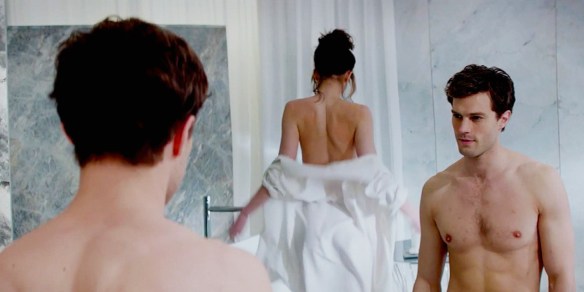
That’s not to say he still doesn’t want to strap her down in his elaborate, dimly lit sex dungeon, though. Anastasia calls it the Red Room of Pain, though Christian insists it’s much more about pleasure. Like everything else in the movie, this room looks ornate and untouched by human hands. It consists of a mattress and several tables surrounded by a seemingly endless supply of whips, paddles and ropes, none of which are ever really shown being used.When the passion doesn’t involve Christ, you can’t really get away with showing these things being used and keep an R rating, I suppose.  You can see Christian’s hand hover over and select one of the tools, and Ana’s body writhe in anticipation as he approaches, but director Sam Taylor-Johnson relies on implication rather than illustration. Fifty Shades 2 The scenes in this room seem trapped inside a porn that’s never allowed to be truly pornographic.  The camera lavishes attention on Johnson’s breasts and her orgasmic moans, but rarely at the same time that it shows anything sexual happening to her. (Sadly, not nearly the same amount of attention is given to Dornan). Sex and pleasure are isolated here, and rarely do the two meet in the same frame.  Instead, there are cringe-inducing slow motion shots of Christian teasing her with a whip and wide shots of her exposed body prior to experiencing anything.

Taylor-Johnson is at her best as a director when hinting at the story’s kink instead of clumsily trying to film around it to satisfy the MPAA.  From what I have heard and read about the books (I haven’t actually read any of them), she also has no intention of fully succumbing to its depictions of domestic violence and sexual assault. Her movie focuses on laying the groundwork for a troubling relationship and backing away from it more than it romanticizes any of Grey’s behavior.

There are a couple of creepy instances where he shows up unexpectedly to visit Anastasia; she turns the corner at work and he’s standing there with a far away grin, or he texts her about what she’s drinking while she’s at a bar with her mom. Both of these scenes are edited as if they’re in a horror movie and Grey is the smiling, psychotic killer.  Other scenes, where he shoves one of Anastasia’s college classmates who tries to kiss her at a party or probes her about having a boyfriend, chip away at the mystique of his character.  Taylor-Johnson acknowledges his disturbing behavior formally, but then sadly attempts to isolate those moments from the charming, seductive Christian instead of making the character own up to all of his behavior.  At times it seems as if her movie is trying to figure out whether to be seduced or repelled by him, just like Ana.

Seduction wins out in the end, at least until the movie devolves into an incredibly ineffective melodrama in the last few minutes before the sequel-baiting ending. However, the most fascinating thing about Fifty Shades of Grey is how much it holds back, how a major studio dances around a story with numerous sex scenes driven by bondage and sadomasochism. For all its witless, asinine dialogue, it is an oddly engaging two-hour exercise in lip-biting, furrowed eyebrows and exposed armpits.  It could have used a little more Romance, though. Grade: C-
Short Takes: A Most Violent Year, Blackhat & The Imitation Game

A-Most-Violent-Year_612x380

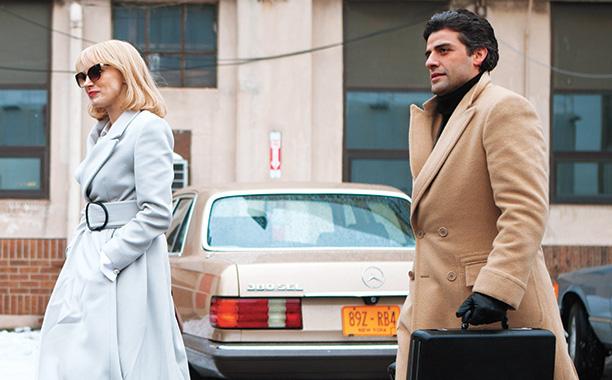
A Most Violent Year – After a somewhat intriguing debut with 2011’s Margin Call,  J.C. Chandor has made two miserably dull follow-up features, All Is Lost and his latest, A Most Violent Year.  That year is 1981, and Chandor’s crime drama chronicles an up-and-coming oil supplier (Oscar Isaac) trying to make it big in New York City without caving in to (too many) illegitimate business practices.

Isaac resembles young Al Pacino in the first two Godfather films in both look and manner here, a high compliment to be sure.  There is a clear spark between him and Jessica Chastain, whose scenery-chewing performance as his wife balances well with his restrained, slow-burning intensity. However, the movie itself drowns in its own austere predictability.  The production design is excellent and absorbing and Bradford Young’s cinematography gives New York an amber, menacing glow, but the movie still never comes alive.  The script is full of vague, uninsightful musings on American life imbued with tired machismo, but it isn’t interested in showing anyone really living. Grade: D+

Continue reading

REVIEW: Inherent Vice

Inherent Vice

Inherent Vice
Directed by: Paul Thomas Anderson
Written by: Paul Thomas Anderson (screenplay), Thomas Pynchon (book)
Starring: Joaquin Phoenix, Katherine Waterston, Josh Brolin and Owen Wilson

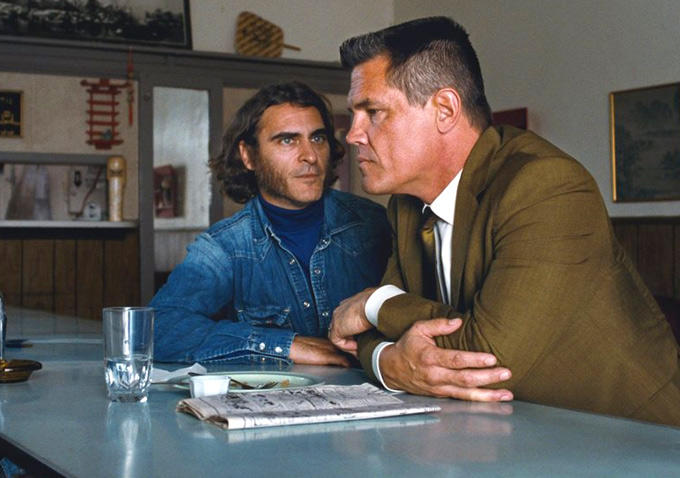
Paul Thomas Anderson’s Inherent Vice, like the Thomas Pynchon book it’s based on, is a peace sign followed by a middle finger.  Toward the end of the movie, private Investigator and relentlessly chill dude Doc Sportello (Joaquin Phoenix) flashes both of those to a mother and her children in a vacant parking lot as they carry away several kilos of cocaine from his vehicle to theirs.  They’re members of the Golden Fang, which during the course of the long and winding narrative evolves from the name of a boat to the name of a drug syndicate to a warped, corporate state of mind.

Doc is placed on this perpetually confusing road by an ex-girlfriend, Shasta Fay Hepworth (Katherine Waterston), who tells him of a wife’s plot to throw a wealthy realtor into the loony bin and make off with all his money.  From there the movie trapezes through an intricate and head-spinning web of other similarly bizarre set-ups — a brothel very poorly disguised as a massage parlor, a Hippy Last Supper with musicians and Nazis (and probably some who are both), a mental institution called “Straight Is Hip.”

Continue reading

REVIEW: American Sniper

American Sniper closeup

American Sniper
Directed by: Clint Eastwood
Written by: Jason Hall (screenplay), Chris Kyle, Scott McEwen and James Defelice (book)
Starring: Bradley Cooper, Sienna Miller, Kyle Gallner and Jake McDorman

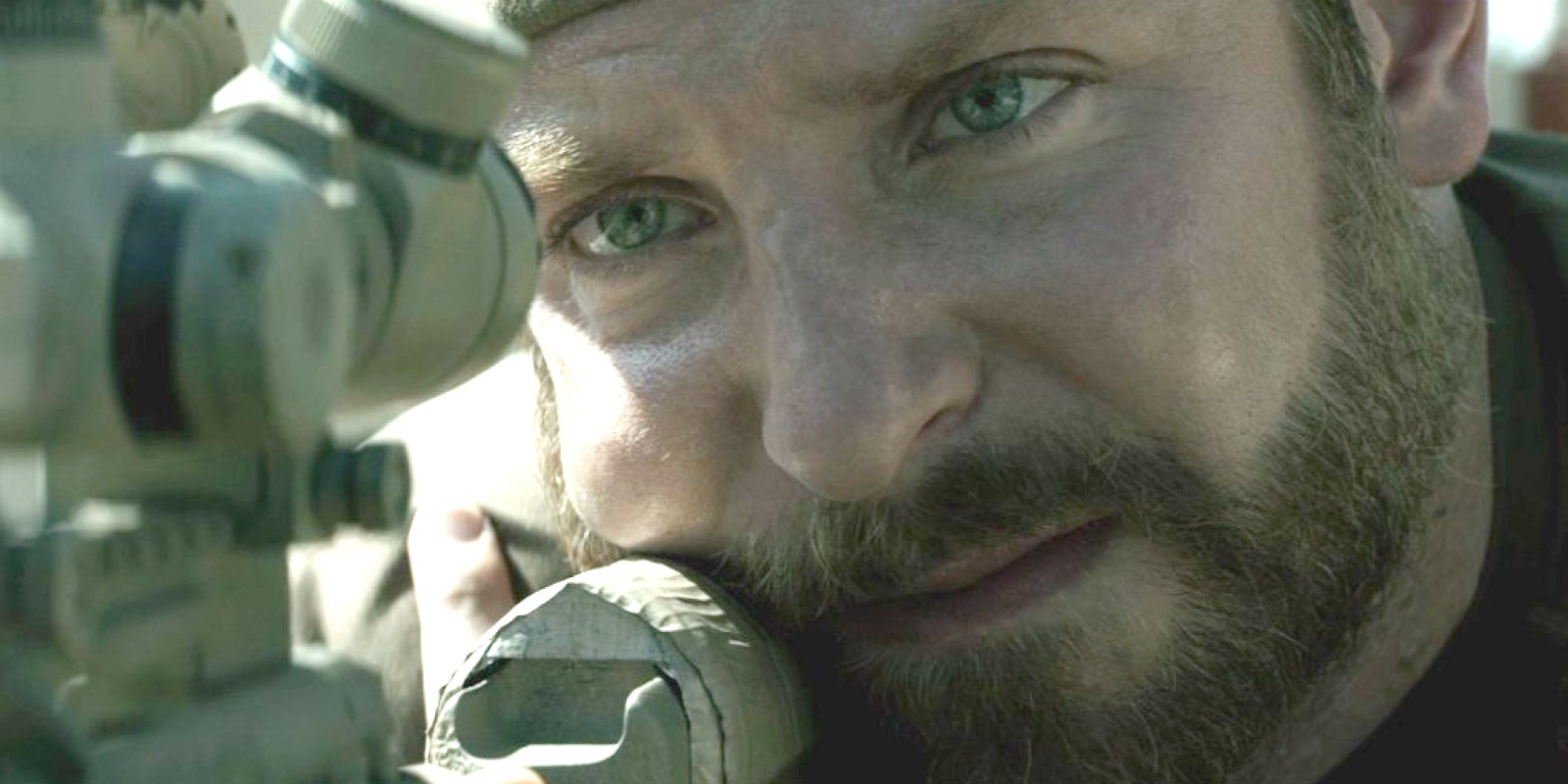
A recurring theme in Clint Eastwood’s films is the intersection of an individual with their public image and the scrutinies that follow it.  American Sniper is another rumination on this theme, a weary dissection of the American soldier dressed up as a chest-thumping defense of the War on Terror.  Adapted from a 2012 memoir of the same name, Eastwood’s latest tells the story of Navy SEAL Chris Kyle (Bradley Cooper), the deadliest sniper in U.S. military history who participated in nearly every major phase of the post-9/11 war in Iraq.

We first see Kyle as we saw him in the movie’s nail-biting trailer, examining a Marine convoy from a rooftop and watching as a child and his mother exit a building with an explosive device.  She hands it to him, and Kyle has to make the call on whether or not to pull the trigger.  He does, not once but twice, shooting the child and then the woman right as she prepares to toss the device.  It explodes inches from the convoy he was protecting.

Continue reading

REVIEW: Foxcatcher

Foxcatcher

Foxcatcher
Directed by: Bennett Miller
Written by: E. Max Frye and Dan Futterman
Starring: Steve Carell, Channing Tatum, Mark Ruffalo and Vanessa Redgrave

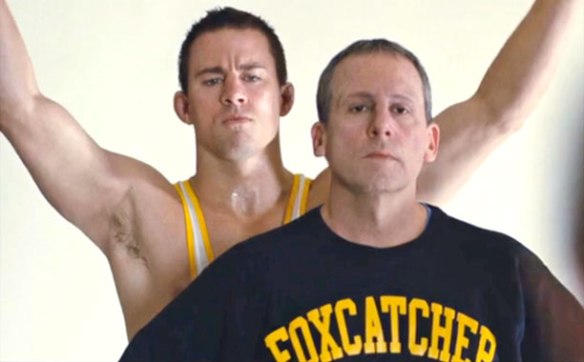
I have major issues with Foxcatcher’s portrayal (or maybe I should say its incredibly vague non-portrayal) of homosexuality.  One of the lead characters, John du Pont (Steve Carell), is a deeply closeted man who cloaks his shame in patriotism. This should sound familiar to anyone who watched Clint Eastwood’s biopic J. Edgar, a much better film that balances the intolerable pain of the closet with the unforgivable decisions J. Edgar Hoover made as director of the FBI.

As with Bennett Miller’s two previous features, Capote and MoneyballFoxcatcher is based on a true story and filmed with a restrained, melancholy stillness. The main crux of the plot is that du Pont uses his vast wealth to lure gold-medal-winning wrestling brothers Mark and Dave Schultz (Channing Tatum and Mark Ruffalo, respectively) to his compound to train for the 1988 Olympics in Seoul.

Continue reading

REVIEW: Selma

Selma movie

Selma
Directed by: Ava DuVernay
Written by: Paul Webb
Starring: David Oyelowo, Carmen Ejogo, Tom Wilkinson and Oprah Winfrey

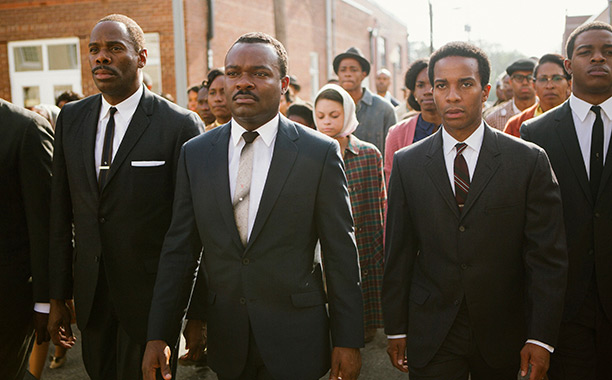
Selma, Ava DuVernay’s stirring, forceful chronicle of the campaign for equal voting rights in Alabama, is one of the great political dramas in recent years.  Its greatness lies in its compassionate and nuanced portrayal of that struggle on all levels, from frustrated but determined residents of that Southern town to the activists who flocked there hoping to force a reluctant president to act.

The horrifying scenes of police brutality during Bloody Sunday that were broadcasted on TVs around the world are ferociously recreated here, and informed by the raw, intimate stories of the brave men and women involved in that march.  DuVernay wrests those historical images from the past and creates a totally immersive and shocking sequence here.   The Edmund Pettus Bridge becomes shrouded in a thick cloud of tear gas as police smash, whip and otherwise brutalize the peaceful demonstrators.

Continue reading

Short Takes: Into the Woods, Wild & The Babadook

into-the-woods3

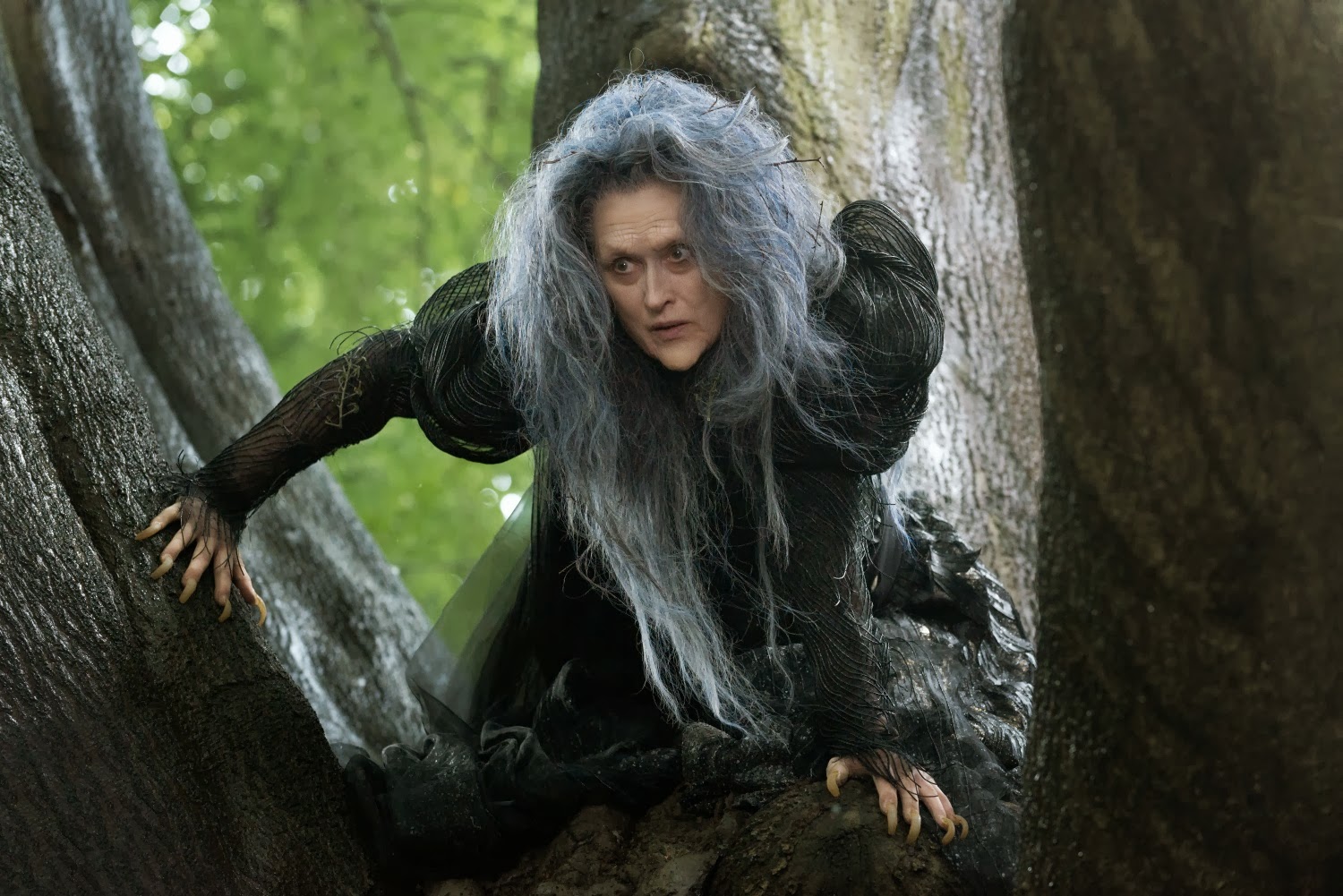
Into the Woods – Rob Marshall’s screen adaptation of the stage musical Into the Woods does one very smart thing: it lets the Stephen Sondheim music take precedence over its ridiculously compacted story.  It does other smart things too, like casting Meryl Streep and Emily Blunt as, respectively, a bitter witch and a baker’s wife trying to lift her curse so she and her husband can have a baby.

It’s hard to engage with the movie as a whole though, because although it has a few great scenes, it’s wildly inconsistent.  The more than two-and-a-half hour play is cut down to about two here, but the story still packs in an overabundance of fairy tale mainstays.  Key plot points, and several character deaths, either happen off screen or are too rushed to have any real resonance.  Still, when Marshall lets scenes play out with several characters in the same location instead of cutting sporadically between story lines, the movie version is occasionally thrilling.  Grade: C

Continue reading

REVIEW: Big Eyes

bigeyes1

Big Eyes
Directed by: Tim Burton
Written by: Scott Alexander and Larry Karaszewski
Starring: Amy Adams, Christoph Waltz, Krysten Ritter and Jason Schwartzman

Is it art or is it trash?

Tim Burton’s latest poses this hyperbolic question about the paintings of Margaret Keane several times, but he isn’t (I’m sorry) too keen on exploring it.  Instead, he renders the answer unimportant and focuses on a more generic conflict: Keane (Amy Adams) finding the courage to fight her husband Walter (Christoph Waltz) for the right to her artwork after years of letting him take credit for it so it would sell. Walter uses traditional 1960s gender roles against his wife so he can pretend her work is his, at the same time pretending like he’s doing her a favor by getting her paintings out to the public.  That doesn’t sound more generic, but when the movie introduces questions that would make it more interesting and then ignores them, the narrative’s single-mindedness becomes annoying.

Burton also doesn’t allow Keane to grapple with anything that would make her character anything other than a saint.  There’s a brief shot where she reads a brutal pan by a New York Times critic (Terence Stamp), and shame convincingly washes over Adams’ face for a split second before it cuts away to Walter’s theatrical rampage about the article.  The inspiration for her lawsuit against Walter is her joining the Jehovah’s Witnesses, but the script doesn’t delve into it beyond a couple of simple verses; it becomes a way to take the story to its anti-climatic courtroom climax, and little else.

Continue reading

Short Takes: The Homesman, Theory of Everything, Happy Christmas & more

The Homesman

The Homesman – Three women driven mad by life on the American frontier are transported hundreds of miles to be cared for by Meryl Streep; that is the set-up of Tommy Lee Jones’ strange, melancholy mid-Western The Homesman.  Jones and Hilary Swank co-star as the unlikely duo driving the women from Nebraska to Iowa.  She is Mary Bee Cuddy, a tough but lonely woman who steps up to transport the women when none of their husbands will, and he is George Briggs, the man she rescues from a hanging after making him swear to help her.

Jones’ vision of the frontier is a fairly common one, the smallness of their wagon is conveyed through steady, distant shots that show a stark, endless flatland, and bursts of violence impede their progress.   The movie’s only encounter with Native Americans is a squeamish one, but it’s built more on Briggs’ fear of the unknown rather than giving in to more racist Western tendencies that seek to justify that fear.  When he defiles a burial site to steal a buffalo skin blanket, Cuddy is appropriately outraged.

The most interesting thing about The Homesman is its attempt at an overt feminist narrative, which keep it afloat over some awkward pacing issues; Cuddy rescues Briggs, and her distress is internalized, and unable to be saved. One of the women’s madness is linked directly to the repeated sexual assaults she suffered from her husband, and the movie treats them all seriously instead of using them as background noise.  There is a shot at a saloon with prostitutes decorating the background while men speak and play poker, but it’s the only time the movie fully succumbs to more misogynistic genre trappings.  Grade: C+

Continue reading