REVIEW: Her

bestshots2013_15

Her
Directed by: Spike Jonze
Written by: Spike Jonze
Starring: Joaquin Phoenix, Scarlett Johansson, Amy Adams and Rooney Mara

Her is a beautifully realized and often moving story of an impossible relationship.  It’s not just about a man who falls in love with his operating system, but instead uses that premise to springboard into a vast array of heady topics.  Spike Jonze dares to imagine an absurd romance with sincerity and depth of feeling, and in doing so makes the physical world of the future seem like a limited if beautiful place.

Theodore (Joaquin Phoenix) at first seems like a typical protagonist in a modern male-centered romance like (500) Days of Summer or Garden State.  He is a sensitive writer whose skills with women demand a Manic Pixie Dream Girl to set things right. His new fully aware OS Samantha (voiced by Scarlett Johansson) seems to be that “girl” but instead becomes a sly critique of the archetype.

Samantha’s worldview transforms so thoroughly beyond Theodore’s comprehension by the end that her “human” traits and relationships are a miniscule part of what she is.  At first he is her window into the world, as he carries her around in his dress shirt pocket and lovingly answers her every question.  She is not a real woman, though, just like the women in those other previously mentioned movies.  However, Samantha is intangible not because of the male flimmaker’s narrow vision but because her intelligence is very nearly limitless and far surpasses the limitations of humanity.

A fully-functioning and feeling AI is right at home in the movie’s glossy take on future Los Angeles.  This is a place where computers can effortlessly copy penmanship and every interior looks like a modern art museum.  It’s also a world where relationships, conventional or not, don’t work.  Theodore buys the OS seemingly out of the blue.  He’s going through a divorce, and when his ex-wife (Rooney Mara) finds out about Samantha, she doesn’t hesitate to stick the knife in.

“You always wanted a wife without the challenges of dealing with anything real, I’m glad that you found someone” she says through her teeth.

Her-Movie-siri-operating-system-ftr-1024x640

And yet, for all its gentle lecturing, Theodore and Samantha’s relationship is more emotionally and sexually charged than in most movies where you see both parties.  Many on-screen romances, largely because of the audience-friendly PG-13 rating, rarely bother with actual sex.  Her is rated R, because even though the sex scene is told from Samantha’s point of view (black screen), you can hear everything.

It’s impossible not to see Scarlett Johansson when she’s talking as Samantha.  It’s a sly joke to cast the woman who is so often used as eye candy (ahem, The Avengers) as a sexy Siri.  Her voiceover, which she nails, is so crucial to the movie’s success, as is the chemistry with Joaquin Phoenix, who gives an off-kilter, emotionally rich performance in the lead.  Amy Adams is also excellent as Theodore’s supportive friend.

Jonze starts to tread water with the premise in the last third of the movie, and though the theme “only humans can be human” is beaten to death in science fiction, it doesn’t feel stale in such a funny, moving film like this.  The future he and his crew have created is also far and away one of the most optimistic I’ve ever seen in a movie, a far and welcome cry from the generic dystopian nightmares that seem to be released every weekend.

Several changes of scenery don’t completely save the monologue-heavy screenplay, though.  I have a feeling if Jonze had again collaborated with Charlie Kaufman and have him run away with this idea, it would have been a masterpiece. That’s not to say what’s here is even remotely close to bad, though.  This is a perceptive, engaging and completely sincere romance, a rarity in American movies before you add on its amazingly realized near-future L.A.

Grade: B
REVIEW: August: Osage County

movie-reviews-Osage-County

August: Osage County
Directed by: John Wells
Written by: Tracy Letts (screenplay & play)
Starring: Meryl Streep, Julia Roberts, Chris Cooper and Ewan McGregor

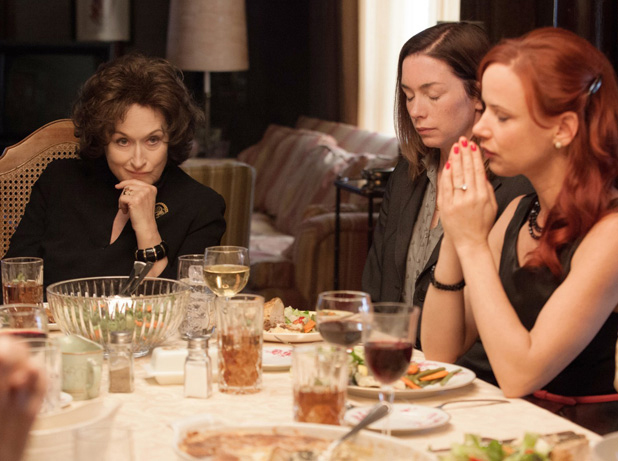
There’s more capital ‘A’ Acting per minute in August: Osage County than in any movie I’ve seen in recent years.  It’s as if instead of holding the Oscars this year, they’ve decided to lock a bunch of award-hungry famous people in a house and let them fight to the melodramatic death for the trophies.  That isn’t necessarily a good thing, especially when the script (adapted by Tracy Letts from his Pulitzer-winning play) is a more vulgar version of nearly every hateful, generic family drama ever created.  Bruised souls, past wrongs, marital turmoil, generational gap humor and a handful of “gasp!” revelations don’t form a story as much as scattered scenes meant to highlight the various thespians.

In that regard Meryl Streep practically swallows the movie whole as Violet Weston, the pill-addicted, “truth-tellin'” matriarch of this emotionally volatile clan.   Director John Wells lavishes so much attention on her darting eyes and fading-but-indignant pride that the actress takes center stage even when it’s not her turn.  Watching any Streep movie in the past few years this isn’t really a surprise.  The Iron Lady was practically a one-woman show, and the very capable Amy Adams got engulfed in both Julie and Julia and Doubt.  The only one to really hold their own against her in recent years is Philip Seymour Hoffman as the embattled priest in the latter.

Continue reading

REVIEW: The Wolf of Wall Street

The Wolf of Wall Street movie

The Wolf of Wall Street
Directed by: Martin Scorsese
Written by: Terrence Winter (screenplay), Jordan Belfort (book)
Starring: Leonardo DiCaprio, Jonah Hill, Margot Robbie and Kyle Chandler

There was a man sitting in front of me during The Wolf of Wall Street who was in such anguish during the entire three hours that he asked his girlfriend multiple times if they could leave “this foolishness.” She sat almost entirely in silence, whispering something along the lines of “If you wanna leave, leave,” a couple of different times.

Loud bursts of hysterical laughter also popped up throughout the theater during the movie as well, as a bunch of white collar Wall Street crooks in the ’80s and ’90s made a debauched spectacle of their privileged lives in ways that nearly transcend vulgarity.  Several people walked out, though the agonized boyfriend/husband sat it out until the end.

Continue reading

Short Takes: Saving Mr. Banks, Anchorman 2 and More

Saving-Mr-Banks1

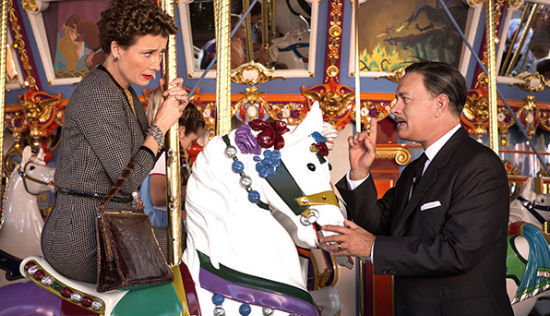
Saving Mr. Banks- A Disney propaganda film intent on making the definitive statement on how Walt came to pry the movie rights for Mary Poppins from the claws of its author, P.L. Travers.  It’s surprisingly nimble and entertaining propaganda, though, leaning heavily on the dry wit of Emma Thompson, who plays Travers, and the natural charm of Tom Hanks, whose casting as Disney is a huge indicator of the movie’s slanderous intentions.

Despite the sour taste the movie’s historical rewrite leaves, there are many funny and well-directed sequences involving Travers combating the Disney crew over the Poppins film adaptation.  I felt like I was being forced not to identify with her, though.  Like director John Lee Hancock did in The Blind Side, he overplays the fairly decent hand the story and actors gave him by suffocating it with Disney sugar.  Thompson is fantastic here, but the movie never misses an opportunity to make her seem like a shrew who needs taming. Grade: C-

anchorman-fros

Anchorman 2: The Legend Continues- For a movie that tries desperately for two hours to elicit laughs at any cost, Anchorman 2 isn’t nearly funny enough.  Ron Burgundy (Will Ferrell) goes global on a CNN spinoff with the rest of his news team, played again by Paul Rudd, Steve Carell and David Koechner, and their idiocy is a natural fit.

The script gets a few good jabs in about the ridiculousness of the 24-hour news cycle, but most of the jokes that don’t involve the comedic anarchy of Carell’s weather guy Brick are just stale.  It exists more as an SNL episode with a bunch of celebrity cameos than a movie.  Grade: D

Upstream-color

Upstream Color- Shane Carruth’s second feature is a wondrous creation.  Unlike his first, Primer, it thrills more on a sensory level, and he surpasses what’s in the script instead of just presenting it.  The story focuses on a woman named Kris (Amy Seimetz) who is subjected to mind control and stripped of her identity, but he keeps the narrative in constant limbo by being more interested in examining the experience than stopping to explain it.

Kris meets a man (played by Carruth) who also seems to have undergone the same procedure as her, and the two fall in confused love, their identities and memories eventually clashing but not getting in the way.  Describing the movie’s story does little justice to the spontaneous beauty Carruth sustains throughout.  Its meaning unfolds for the audience at the same time as the characters, though to apply any concrete meaning trivializes the breadth of its power.  Grade: B+

movie43

Movie 43- I’m offended that this movie exists.  Grade: F

REVIEW: American Hustle

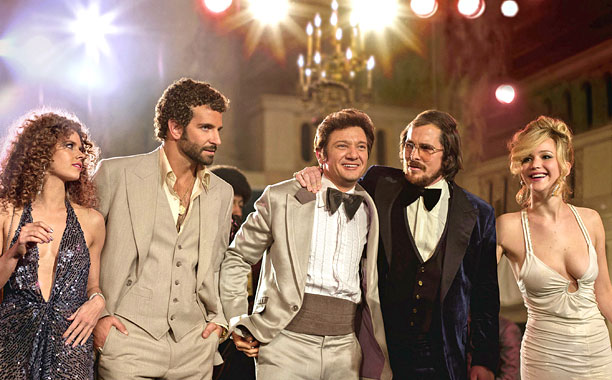
Christian Bale;Jeremy Renner;Bradley Cooper

American Hustle
Directed by: David O. Russell
Written by: Eric Singer & David O. Russell
Starring: Christian Bale, Amy Adams, Bradley Cooper and Jennifer Lawrence

Two cartoonishly ’70s-looking men stand in an art gallery gazing at a Rembrandt painting, or at least what one of them thinks is a Rembrandt painting.  The other guy, a con man played by Christian Bale, explains with his thick Brooklyn accent that it’s a fake.

“The guy who made this was so good, that it’s real to everybody.  Now, who’s the master: the painter or the forger?” he asks.

It’s as if director David O. Russell is speaking through Irving Rosenfeld (Bale) at this moment, pondering the question a little too sincerely.  American Hustle, his sleek and contagiously energetic latest endeavor, is also somewhat of a forgery. It’s being released nationwide the week before The Wolf of Wall Street, and I’m curious to see which one is more widely praised, the original Scorsese or this loving knockoff.

Continue reading

REVIEW: Nebraska

nebraska

Nebraska
Directed by: Alexander Payne
Written by: Bob Nelson
Starring: Bruce Dern, Will Forte, June Squibb and Bob Odenkirk

The most endearing image of Alexander Payne’s Nebraska is of an old man stubbornly trudging along the highways and sidewalks of rural America.  The camera is placed a patient distance in front of him, not sighing at his pace but simply waiting for him to catch up.  That distance is indicative of the relationship that that man, Woody Grant (Bruce Dern), has with the rest of the world.  He’s quietly stubborn, wearing a look of defeat as his default expression.  His son David (Will Forte) sees that and pities him.

Pity is the main engine that drives Nebraska’s sparse story, which Payne makes incidental to character and landscape.  Woody is walking from Montana to Lincoln, Nebraska to cash in a $1 million slip he got from a sham marketing company.  His wife Kate (June Squibb) can do little but throw her hands up in the air in exasperation at his repeated attempts to walk there (his license was revoked).

“I didn’t know the son of a bitch wanted to be a millionaire.  He should have thought of that years ago and worked for it,” she says in one of the movie’s best lines.

What makes Woody’s painful-looking shuffle resonate is not that he is aimless but that his goal is unattainable.  David eventually indulges him, embarking on a road trip that lands them, almost too conveniently, in Woody’s hometown. Hawthorne is a small Nebraskan village that seems forgotten by time.   Payne’s decision to shoot the movie in black and white only enhances this, adding a tinge of melancholy to the wide open plains and quaint, vacant streets.

Word spreads quickly about Woody’s million-dollar jackpot.  Despite David’s attempts to quell any celebration of it his father soon becomes the talk of the town, for better and worse.  He is envied and celebrated for a while, until family and old friends start to subtly bring up past debts.  Woody is oblivious to almost all of this, and Dern gives the impression that his character’s journey is so single-minded because it’s all he has the energy to focus on.

nebraska-movie

Nebraska’s weakest link is in the way the story forces itself together.  There is no real reason why Kate and her and Woody’s oldest son Ross (Bob Odenkirk) need to join them in Hawthorne.  After Woody hits his head after a fall, Bob Nelson’s script seems determined to pin him and his family in that town for much longer than Woody would ever actually stay there.

Payne balances the somewhat sloppy story with the most emotionally delicate direction he’s done so far.  The Descendants, his previous feature, also had a contrived story, and it felt like it did.  Nebraska doesn’t.  It unfolds more spontaneously, never a slave to its central plot and much better off for it.  It’s an elegiac, bitterly funny examination of the Grants rather than a father/son bonding narrative.

The best scene happens in Hawthorne’s cemetery right after Kate arrives from Montana.  She, David and Woody are surrounded by the stumps of countless modest graves.  Kate talks blatantly about the people buried beneath them, her crass observations offset by her son’s discomfort and her husband’s weary obliviousness.

Kate’s brazen manner thankfully softens as the movie goes on, creating more than a castrating caricature.  Squibb slowly reveals the kindness inside her without failing to skillfully execute many of the script’s best comedic moments.  Her and Dern show us a couple hardened by a less-than-ideal life, but still trying to make a go at it.

Nebraska is just as funny and humane as Payne’s best movies.  He offers a view of rural America that the Coen brothers might have made if they were (just a little) less condescending.  Working with cinematographer Phedon Papamichael, he has also created his most visually accomplished work to date.  In films like Sideways and About Schmidt, I remembered the terrific dialogue and the richly conceived characters, and the way Payne found a way to understand them when they seemed unreachable.  There weren’t images as memorable as what he has here, though.  It is a fairly big leap for him as a filmmaker, with all the imperfection that often comes with such risks.

Grade: B-

Short Takes: Out of the Furnace, Kill Your Darlings and Drug War

out-of-the-furnace-interview-1089277-TwoByOne

Out of the Furnace- This unremittingly bleak drama centers on deeply flawed brothers in Pittsburgh.  Russell (Christian Bale) is a heavy drinker who kills a woman and her kid drunk driving and lands in jail while his brother (Casey Affleck) serves several tours in Iraq.  Once he is out of jail, his brother goes missing after a series of increasingly brutal organized fistfights to pay off debt.

Director Scott Cooper makes no effort to give the audience a payoff.  The (plentiful) violence is treated as deeply troubling and is never without consequences.  Although a lot of the story is absurd and simplistic, there is an honest humanity that makes it surprisingly effective. Grade: C

Kill-your-darlings_2757661b

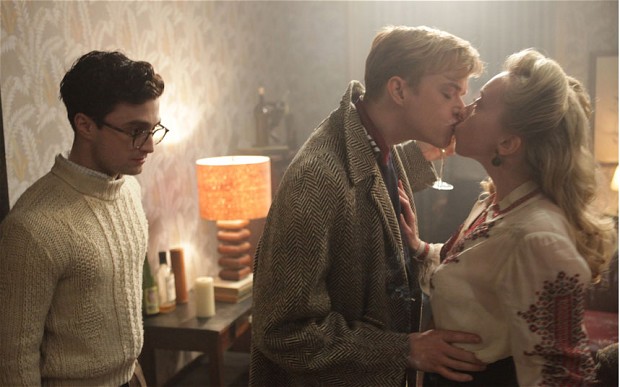
Kill Your Darlings- An uneven but thrilling attempt to capture Beat writers in the act of inventing themselves.  The story centers on Allen Ginsberg (Daniel Radcliffe) leaving a turbulent home life for an even more turbulent time at Columbia.  He is drawn to Lucien Carr (Dane DeHaan), and the two form the chaotic, and ultimately tragic, core of the movie.  Jack Kerouac (Jack Huston) and William Burroughs (Ben Foster) also show up in drug-fueled flashes.

Kill Your Darlings treats the period with much affection, but director John Krokidas also injects crucial visual flare as well as modern music.  There is too much repetitive literary quoting underlining the theme over and over, but Krokidas brings an exhilaratingly reckless, chaotic vision to material that would otherwise seem stuffy and pretentious.  Grade: C+

drugwar

Drug War- One of the most intense and entertaining movies of the year.  Drug War is an action movie examination of China’s obscene drug policy.  Rather than overcrowd their prisons with drug offenders (like in America), people who possess more than a certain amount are just executed.

Johnnie To’s movie is about a meth dealer caught in between the police and those higher-up in the trade than him.  He offers to help the cops take down the others in exchange for prison time instead of a death sentence.  To creates organic, often breathtaking action sequences throughout, shaming most Hollywood releases on a fraction of the budget.  Grade: B+

REVIEW: Philomena

Philomena2

Philomena
Directed by: Stephen Frears
Written by: Steve Coogan & Jeff Pope (screenplay), Martin Sixsmith (book)
Starring: Judi Dench, Steve Coogan, Sophie Kennedy Clark and Mare Winningham

Though Philomena is about a journalist writing a human interest story, it is thankfully absent the easy emotional payoff that such stories are often intended to have.  That reporter, Martin Sixsmith (Steve Coogan), hates the idea of writing a fluff piece, but he’s looking to occupy his time after being canned from a job as a government mouthpiece. (Ironically, that involves quite a bit of fluff).

Director Stephen Frears wastes little screen time before thrusting Sixsmith and the movie’s real protagonist, Philomena Lee (Judi Dench), together for the article.  Philomena is a cheery old Irish Catholic woman looking to connect with a son that she had out of wedlock.  Her family dropped her off at a convent, where she was held in servitude and only allowed to see her son for one hour a day.  Then, he was sold to an American family for adoption.

Continue reading

Short Takes: Hunger Games: Catching Fire, Oldboy and More

With 2013 winding down and noteworthy releases pummeling theaters in droves hoping for awards attention, here are a few movies I saw recently that I either didn’t have time to write about or didn’t have enough to say to merit a full review.

the-hunger-games-catching-fire-comic-con-trailer

The Hunger Games: Catching Fire- A big improvement over the first film.  The second half in particular is visceral and engaging.  Jennifer Lawrence actually looks like she wants to be here this time around too, turning Katniss into a full-fledged character instead of her deadly-but-lifeless turn in the original.

Catching Fire also feels more thoroughly alive and consistent.  Director Francis Lawrence revels in the excesses of Suzanne Collins’ dystopian nightmare but doesn’t lose sight of its dread.  He plunges right into the story from the get-go, which meant a somewhat rocky start.  By the time Katniss and Peeta are plunged back into a second round of Hunger Games, though, he paces it exceptionally well.  Grade: C+

oldboy-image03

Oldboy- Spike Lee’s adaptation of Oldboy is better than the cult classic Korean film by Park Chan-wook.  Although it is more awkwardly stylized between an homage to that 2003 original and Lee’s own aesthetic sensibilities, it is driven by a mapped-out worldview that that movie sorely lacked.  It doesn’t come off as a revenge fantasy as much as a nihilistic journey into bottomless torment.

Oldboy is set in 2013, but the past seeps into nearly every scene.  As Joe Doucett (Josh Brolin) sifts desperately through his life for the key to a torturous mystery, I was reminded more of David Cronenberg’s underrated 2002 film Spider than anything else.  The movie falters most when it tries to reenact scenes from the original instead of standing on its own bold feet. Grade: B-

all-is-lost-trailer-0812013-144250

All Is Lost- This movie is almost completely dependent on an audience’s on-screen history with Robert Redford.  After a brief letter reading at the beginning, he doesn’t speak hardly at all for the rest of the movie, nor do we really get any sense of who this man is.

J.C. Chandor may have meant for this vagueness to convey an existential journey, but I left it feeling like I did after Gravity: admirable and efficient filmmaking driven by its own concept instead of any idea or purpose.  Redford is a weary, sometimes captivating old man at sea, but the movie is otherwise empty and dull.  Grade: C-

enders-game-tv

Ender’s Game- This movie will likely be eclipsed by all the glory being lauded on Katniss and company.  It’s actually a much more consistent and thrilling final product, and one of the best big budget studio releases of the year.

However idiotic and creepy the author’s views on gay people are, this (from what I understand) very loose adaptation is a terrifically conceived, well-acted spectacle. The action scenes are well-orchestrated without hovering over the violence, and the movie never loses sight of the fact that these are children being trained for war.  It also features several young stars who have given great performances in recent years, from Hugo’s Asa Butterfield to True Grit’s Hailee Steinfeld and Little Miss Sunshine. Grade: B

Bastards

Bastards- Claire Denis’ latest is an unremittingly bleak neonoir about, among other things, sex trafficking.  She is a master of using expressive close-ups with her talented crew of performers; however, that humanity is in the service of a bleak and often overly-callous story. I walked away from Bastards not really feeling anything for the characters, but there are sequences so grotesque and haunting that the movie is undeniably effective.  I look forward to seeing it again and (hopefully) appreciating it a little more.  Grade: B-

06-enough-said

Enough Said- Nicole Holofcener has directed some of my favorite episodes of Parks and Recreation and Enlightened.  That being said, both of the movies I’ve seen by her (this and Please Give) are pretty unbearable.  Though there are a pair of excellent performances from Julia Louis-Dreyfuss and the late James Gandolfini, Enough Said feels half-conceived and lazily executed.  The conflict, that a woman is dating a friend’s ex and starts seeing his flaws the more she gossips about him, could be resolved in three minutes.  The story is so enthralled by a condescending upper middle class whiteness that it never seems to grasp that.  Grade: D+

passion04

Passion- See Brian De Palma’s latest instead of the remake of Carrie.  It has a very, very uneven first half but by the time the corporate revenge narrative double and triple reversed I was enthralled at the spectacle.  The ballet/murder split-screen is among the finest and most beautifully done sequences this director has ever done, which is saying quite a bit.  Grade: C

carrie-2013

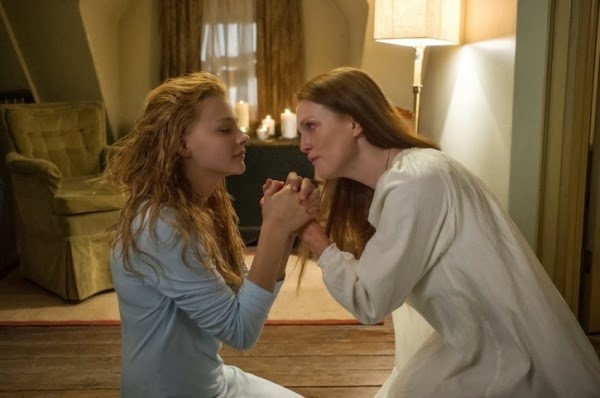
Carrie- De Palma’s Carrie is easily one of my favorite horror movies of all time, so I was extremely skeptical about a remake.  Kimberly Pierce seemed like the right choice to tap into the isolation of Carrie White, but the final product has none of the outcast humanity or grit of her other films.  Sadly, it felt like Stephen King’s story had been adapted to the world of an uninteresting CW show.  The crucial prom scene goes off without a hitch, and Julianne Moore is dementedly over-the-top as Carrie’s religious nut mother, but the movie is stale and uninteresting. Grade: D

REVIEW: Dallas Buyers Club

Dallas-buyers-club

Dallas Buyers Club
Directed by: Jean-Marc Vallée
Written by: Craig Borten and Melisa Wallack
Starring: Matthew McConaughey, Jared Leto, Jennifer Garner and Denis O’Hare

Matthew McConaughey and Jared Leto play polar opposites brought together by the horrors of AIDS in Dallas Buyers Club, an unsettling message movie that doesn’t want to admit it’s a message movie.

As the unsparing homophobe Ron Woodroof, McConaughey takes his natural on-screen charm to a demented new register here.  First seen at the center of a sweaty threesome at a rodeo, it’s not long before he’s slinging the word “faggot” in a locker room with his pals.  It’s also only a matter of minutes before he’s sitting in a hospital, being told that his T-cell count is so low he has 30 days to live.  When his doctor asks him if he’s had gay sex, he goes into a fit of rage.

Continue reading