REVIEW: Inherent Vice

Inherent Vice

Inherent Vice
Directed by: Paul Thomas Anderson
Written by: Paul Thomas Anderson (screenplay), Thomas Pynchon (book)
Starring: Joaquin Phoenix, Katherine Waterston, Josh Brolin and Owen Wilson

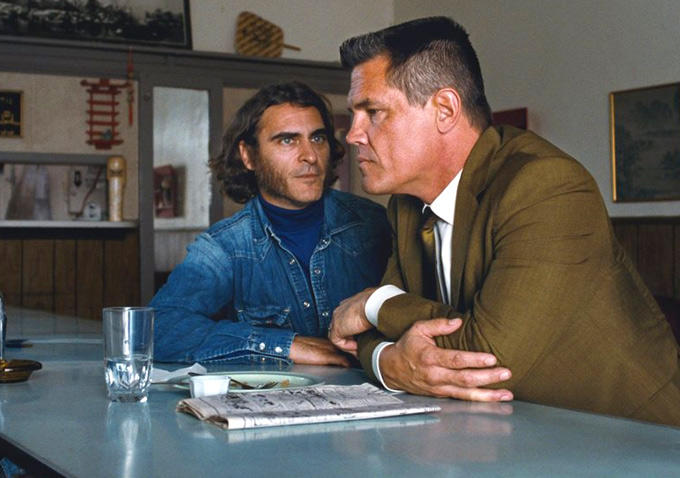
Paul Thomas Anderson’s Inherent Vice, like the Thomas Pynchon book it’s based on, is a peace sign followed by a middle finger.  Toward the end of the movie, private Investigator and relentlessly chill dude Doc Sportello (Joaquin Phoenix) flashes both of those to a mother and her children in a vacant parking lot as they carry away several kilos of cocaine from his vehicle to theirs.  They’re members of the Golden Fang, which during the course of the long and winding narrative evolves from the name of a boat to the name of a drug syndicate to a warped, corporate state of mind.

Doc is placed on this perpetually confusing road by an ex-girlfriend, Shasta Fay Hepworth (Katherine Waterston), who tells him of a wife’s plot to throw a wealthy realtor into the loony bin and make off with all his money.  From there the movie trapezes through an intricate and head-spinning web of other similarly bizarre set-ups — a brothel very poorly disguised as a massage parlor, a Hippy Last Supper with musicians and Nazis (and probably some who are both), a mental institution called “Straight Is Hip.”

Continue reading

REVIEW: American Sniper

American Sniper closeup

American Sniper
Directed by: Clint Eastwood
Written by: Jason Hall (screenplay), Chris Kyle, Scott McEwen and James Defelice (book)
Starring: Bradley Cooper, Sienna Miller, Kyle Gallner and Jake McDorman

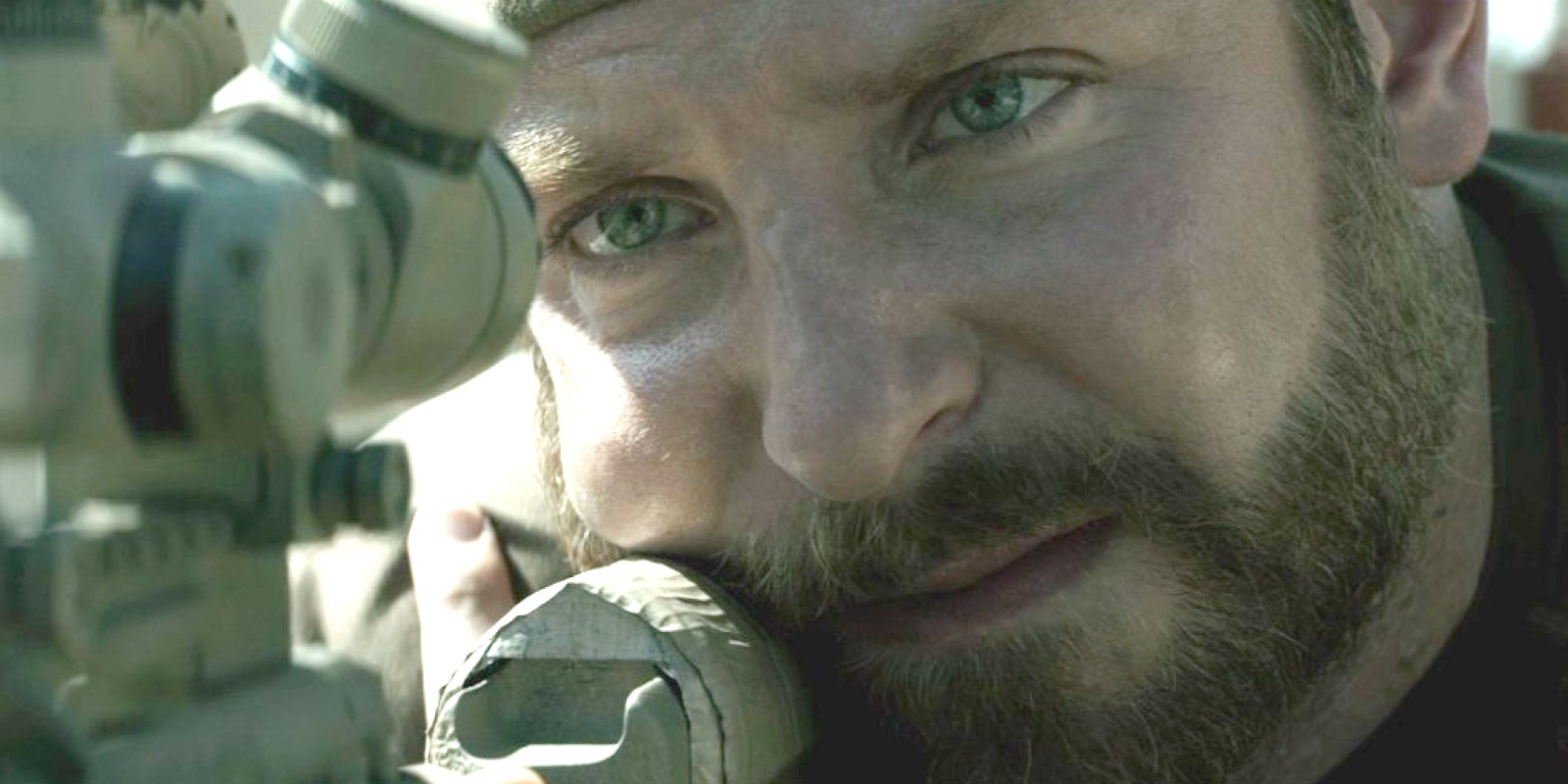
A recurring theme in Clint Eastwood’s films is the intersection of an individual with their public image and the scrutinies that follow it.  American Sniper is another rumination on this theme, a weary dissection of the American soldier dressed up as a chest-thumping defense of the War on Terror.  Adapted from a 2012 memoir of the same name, Eastwood’s latest tells the story of Navy SEAL Chris Kyle (Bradley Cooper), the deadliest sniper in U.S. military history who participated in nearly every major phase of the post-9/11 war in Iraq.

We first see Kyle as we saw him in the movie’s nail-biting trailer, examining a Marine convoy from a rooftop and watching as a child and his mother exit a building with an explosive device.  She hands it to him, and Kyle has to make the call on whether or not to pull the trigger.  He does, not once but twice, shooting the child and then the woman right as she prepares to toss the device.  It explodes inches from the convoy he was protecting.

Continue reading

REVIEW: Foxcatcher

Foxcatcher

Foxcatcher
Directed by: Bennett Miller
Written by: E. Max Frye and Dan Futterman
Starring: Steve Carell, Channing Tatum, Mark Ruffalo and Vanessa Redgrave

I have major issues with Foxcatcher’s portrayal (or maybe I should say its incredibly vague non-portrayal) of homosexuality.  One of the lead characters, John du Pont (Steve Carell), is a deeply closeted man who cloaks his shame in patriotism. This should sound familiar to anyone who watched Clint Eastwood’s biopic J. Edgar, a much better film that balances the intolerable pain of the closet with the unforgivable decisions J. Edgar Hoover made as director of the FBI.

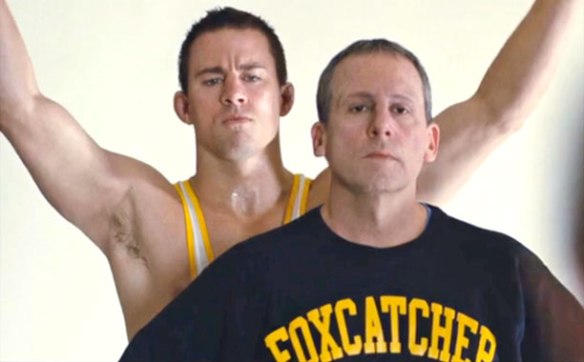
As with Bennett Miller’s two previous features, Capote and MoneyballFoxcatcher is based on a true story and filmed with a restrained, melancholy stillness. The main crux of the plot is that du Pont uses his vast wealth to lure gold-medal-winning wrestling brothers Mark and Dave Schultz (Channing Tatum and Mark Ruffalo, respectively) to his compound to train for the 1988 Olympics in Seoul.

Continue reading

REVIEW: Selma

Selma movie

Selma
Directed by: Ava DuVernay
Written by: Paul Webb
Starring: David Oyelowo, Carmen Ejogo, Tom Wilkinson and Oprah Winfrey

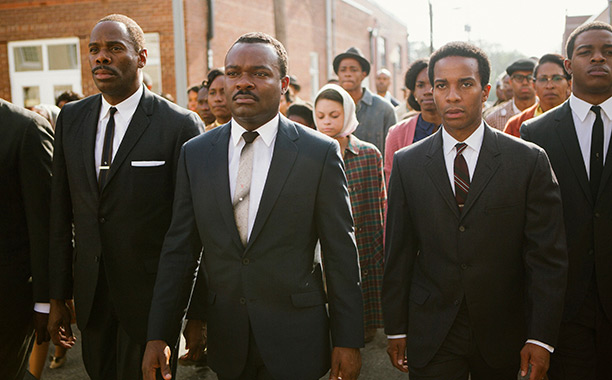
Selma, Ava DuVernay’s stirring, forceful chronicle of the campaign for equal voting rights in Alabama, is one of the great political dramas in recent years.  Its greatness lies in its compassionate and nuanced portrayal of that struggle on all levels, from frustrated but determined residents of that Southern town to the activists who flocked there hoping to force a reluctant president to act.

The horrifying scenes of police brutality during Bloody Sunday that were broadcasted on TVs around the world are ferociously recreated here, and informed by the raw, intimate stories of the brave men and women involved in that march.  DuVernay wrests those historical images from the past and creates a totally immersive and shocking sequence here.   The Edmund Pettus Bridge becomes shrouded in a thick cloud of tear gas as police smash, whip and otherwise brutalize the peaceful demonstrators.

Continue reading

Our Favorite Movies of 2014

under the skin

1. Under the SkinMusic video veteran Jonathan Glazer proved to be 2014’s most indelible image-maker. The director’s follow-up to 2004’s underrated Birth proved to be even more audacious a statement, a cult classic in the making. Teaming with wiz-kid multi-instrumentalist Mica Levi and DP Daniel Lantin, Glazer’s masterpiece is about being outside one’s own environment, prowling through a nocturnal cityscape trying to feign connection. Seen through the eyes of Scarlett Johansson’s stalking, seductive alien, the everyday feels extraordinary. Familiar environments (the beach, a shopping mall, a nightclub) appear ominous; sounds, such as a baby’s distressed cries, or a group of excited women on their way to party, seem strange and terrifying. The first half, especially, is an ambitious depiction of a de-realization experience; the world is three-steps ahead, everything is out of touch, the body and mind forever trapped in an inexplicable waking dream.

It’s easy to get caught up in the score and visuals of Under the Skin, but there is a story that emerges here with any number of ostensible interpretations. Glazer’s film forgoes the didacticism often associated with science fiction, though, preferring to keep his images impressionistic and the story shrouded in ambiguity. In turn, his movie is one of the most moving and deeply empathetic works to come from the genre. Although unquestionably feminist, it has numerous pervasive ideas: systemic dehumanization, the effects of loneliness, the futility of attempting to understand the external world and the self. And for a guy who has only made three features, all of this is handled with remarkable assurance—taking pages from the handbooks of Kubrick, Grandrieux, and Roeg, Under the Skin somehow remains entirely its own beast. One can only imagine where a talent as formidable and evolving as Glazer will go next. But if his latest ends up being a career-best, his one major contribution to cinema, it’s surely enough to label him one of the greats.

Continue reading

Short Takes: Into the Woods, Wild & The Babadook

into-the-woods3

Into the Woods – Rob Marshall’s screen adaptation of the stage musical Into the Woods does one very smart thing: it lets the Stephen Sondheim music take precedence over its ridiculously compacted story.  It does other smart things too, like casting Meryl Streep and Emily Blunt as, respectively, a bitter witch and a baker’s wife trying to lift her curse so she and her husband can have a baby.

It’s hard to engage with the movie as a whole though, because although it has a few great scenes, it’s wildly inconsistent.  The more than two-and-a-half hour play is cut down to about two here, but the story still packs in an overabundance of fairy tale mainstays.  Key plot points, and several character deaths, either happen off screen or are too rushed to have any real resonance.  Still, when Marshall lets scenes play out with several characters in the same location instead of cutting sporadically between story lines, the movie version is occasionally thrilling.  Grade: C

Continue reading

REVIEW: Big Eyes

bigeyes1

Big Eyes
Directed by: Tim Burton
Written by: Scott Alexander and Larry Karaszewski
Starring: Amy Adams, Christoph Waltz, Krysten Ritter and Jason Schwartzman

Is it art or is it trash?

Tim Burton’s latest poses this hyperbolic question about the paintings of Margaret Keane several times, but he isn’t (I’m sorry) too keen on exploring it.  Instead, he renders the answer unimportant and focuses on a more generic conflict: Keane (Amy Adams) finding the courage to fight her husband Walter (Christoph Waltz) for the right to her artwork after years of letting him take credit for it so it would sell. Walter uses traditional 1960s gender roles against his wife so he can pretend her work is his, at the same time pretending like he’s doing her a favor by getting her paintings out to the public.  That doesn’t sound more generic, but when the movie introduces questions that would make it more interesting and then ignores them, the narrative’s single-mindedness becomes annoying.

Burton also doesn’t allow Keane to grapple with anything that would make her character anything other than a saint.  There’s a brief shot where she reads a brutal pan by a New York Times critic (Terence Stamp), and shame convincingly washes over Adams’ face for a split second before it cuts away to Walter’s theatrical rampage about the article.  The inspiration for her lawsuit against Walter is her joining the Jehovah’s Witnesses, but the script doesn’t delve into it beyond a couple of simple verses; it becomes a way to take the story to its anti-climatic courtroom climax, and little else.

Continue reading

Our Favorite Performances of 2014

Abuse of Weakness Isabelle Huppert

1. Isabelle Huppert- Abuse of Weakness- To stare into the deep recesses of Isabelle Huppert’s face as her character tries to regain control of her life and body after a stroke is to watch screen acting of the highest order.  Huppert’s intensely physical performance as Maud captures the minutiae of her character’s physical affliction while also creating a portrait of a frustrated director whose inspiration is sparked by a known con man.  In realizing Catherine Breillat’s semi-autobiographical vision, Huppert nearly swallows the movie whole.

Gone Girl

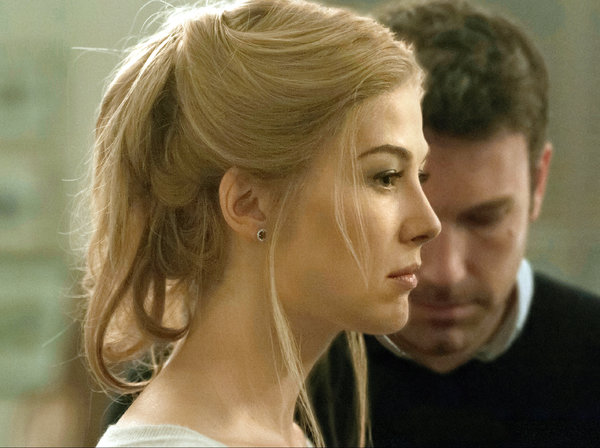
2. Rosamund Pike- Gone Girl-  Gone Girl spends a large chunk of its run-time cruelly answering the opening and closing questions posed by Amy Dunne’s husband Nick: “What are you thinking? How are you feeling? What have we done to each other? What will we do?” Amy is the year’s most sinister enigma, and the calculated chill that Rosamund Pike brings to the role jolts David Fincher and Gillian Flynn’s vision to intoxicating, grotesque life.  Whether she’s rolling her eyes through one of her parents’ book release parties or [REDACTED] Neil Patrick Harris’ character, Pike tears through the role, the movie and Nick Dunne (Ben Affleck) with menacing precision. This was the most on-the-button casting choice of the year.

Continue reading

Short Takes: The Homesman, Theory of Everything, Happy Christmas & more

The Homesman

The Homesman – Three women driven mad by life on the American frontier are transported hundreds of miles to be cared for by Meryl Streep; that is the set-up of Tommy Lee Jones’ strange, melancholy mid-Western The Homesman.  Jones and Hilary Swank co-star as the unlikely duo driving the women from Nebraska to Iowa.  She is Mary Bee Cuddy, a tough but lonely woman who steps up to transport the women when none of their husbands will, and he is George Briggs, the man she rescues from a hanging after making him swear to help her.

Jones’ vision of the frontier is a fairly common one, the smallness of their wagon is conveyed through steady, distant shots that show a stark, endless flatland, and bursts of violence impede their progress.   The movie’s only encounter with Native Americans is a squeamish one, but it’s built more on Briggs’ fear of the unknown rather than giving in to more racist Western tendencies that seek to justify that fear.  When he defiles a burial site to steal a buffalo skin blanket, Cuddy is appropriately outraged.

The most interesting thing about The Homesman is its attempt at an overt feminist narrative, which keep it afloat over some awkward pacing issues; Cuddy rescues Briggs, and her distress is internalized, and unable to be saved. One of the women’s madness is linked directly to the repeated sexual assaults she suffered from her husband, and the movie treats them all seriously instead of using them as background noise.  There is a shot at a saloon with prostitutes decorating the background while men speak and play poker, but it’s the only time the movie fully succumbs to more misogynistic genre trappings.  Grade: C+

Continue reading

REVIEW: Goodbye to Language 3D

auldog

Goodbye to Language 3D
Directed by: Jean-Luc Godard
Written by: Jean-Luc Godard
Starring: Héloise Godet, Kamel Abdeli, Richard Chevallier and Zoé Bruneau

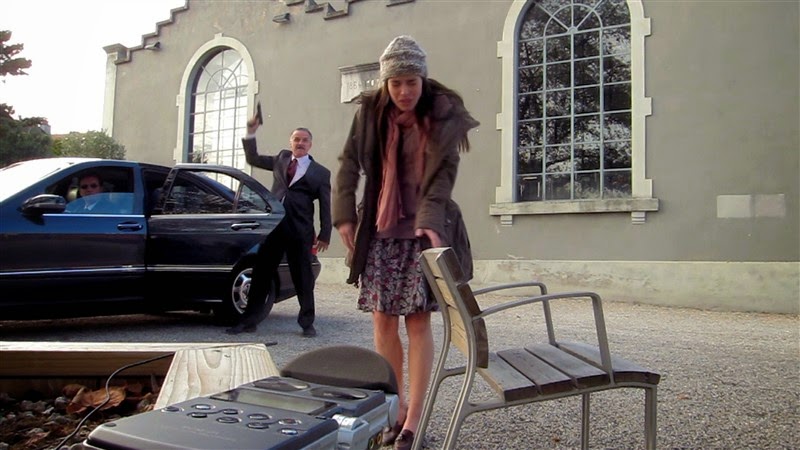
Goodbye to Language is an intimidating assault on the senses, a free-form barrage of intense political and philosophical musings combined with the most jaw-dropping and maddening use of 3D imagery I’ve ever seen. It doesn’t feel right writing about Jean-Luc Godard’s 43rd feature after only seeing it once, but one viewing is likely all I will have for the foreseeable future because of the singular way it needs to be seen.

Godard’s use of 3D has been heralded far and wide since the movie’s debut at Cannes earlier this year.  In two similarly jaw-dropping sequences, the shot begins normally, then splits two images as a man and a woman separate and then reunites them again.  Though those are the two images that immediately illustrate Goodbye to Language’s singularity, much of Godard’s focus in this movie, at least visually, is on a dog.  His dog, named Roxy.

In typical dog fashion, Roxy wanders through countryside, sleeps on couches and writhes in the snow.  The couple that shares the movie if rarely the screen with him are often just as naked, though Godard chronicles them clinically rather than lovingly. He never holds onto any single shot, song or visual tone for very long; in addition to standard color images, Roxy (and the others) are sporadically black and white, hyper-saturated or grainy.
Goodbye to Language

On almost every level, Goodbye to Language 3D is a collage of miscommunication. As Richard Brody noted in the New Yorker (and as title indicates), the big idea in the movie is Godard’s own use of 3D. The two shots I mentioned earlier are indeed earth-shattering, but the simpler shots, of a woman washing her hands in a leafy tub, or a man’s head being pushed into bloody water by a similar hand, have a depth and clarity that is itself awe-inspiring.  Other images, like distorted shots of autumn trees or a speeding car speedometer foregrounded in front of a dark highway, may twist and annihilate your eyes.

Goodbye to Language’s breadth of artistic and historical references would be dense and overwhelming in a movie three times its length, let alone one that is only 71 minutes.  There are musings about capitalism, philosophy and sex in the digital age, Mary Shelly (who pops up in a reenactment) and Hitler (who doesn’t); a couple also discusses gender equality while the man grasps his wife’s bare hips and takes a shit.  Though many of those discussions become a disorienting blur, especially after only one viewing, the images are burned directly onto my brain, and it took about 20 minutes for my eyes to totally readjust afterward.  I’d love to see it again some day.

Grade: A