CANNES REVIEW: Killing Them Softly

Killing Them Softly
Directed by: Andrew Dominik
Written by: Andrew Dominik (screenplay), George V. Higgins (novel)
Starring: Brad Pitt, Scott McNairy, Ray Liotta and Richard Jenkins

Killing Them Softly is a blunt critique of modern American society set against the backdrop of the 2008 elections.  It takes place inside an organized crime syndicate whose true power is never really revealed.  What is revealed is that Brad Pitt is an enforcer, and that he is very good with a shotgun and telling people he’s going to kill them.

This movie is directed by Andrew Dominik, who also collaborated with Pitt in the much better 2007 movie The Assassination of Jesse James by the Coward Robert Ford.  Their latest endeavor is too vague to be revelatory and enjoys showing violence too much to say something with it.  It is highly stylized and wonderfully filmed, but ultimately empty.  It hinges on Pitt’s on-screen charisma, which is as in tact and tongue-in-cheek as always.

James Gandolfini, Richard Jenkins and especially Ray Liotta provide terrific supporting characters in an otherwise weak men’s club of a cast.  Liotta takes one of the most brutal beatings in recent movie memory after it is suspected that he set up the robbery of one of his own illegal poker games.  In fact, it was two beginning lowlifes (Scott McNairy and Ben Mendelsohn) looking for a quick pay day, as it often is in these kinds of movies.

Injecting snippets from coverage of the 2008 elections does little to heighten the story above its own self-made constraints.  Once the initial robbery occurs and the major characters are set up, it turns into Brad Pitt killing the various people involved with reckless abandon.  The only time the political angle pays off is in the terrific last conversation between Pitt and Richard Jenkins, where they discuss his payment for all the killing. Sure this scene ties together plot strands rather recklessly, but the whole thing seems thrown together rather recklessly.

Grade: C-

If you’re interested in watching free movies online, and you like searching for films in different genres, or by their director, then you may be interested in streaming from LOVEFiLM.  LOVEFiLM offers various services for you to tailor the deal to your requirements.  Sign up for a free trial to find out more information.
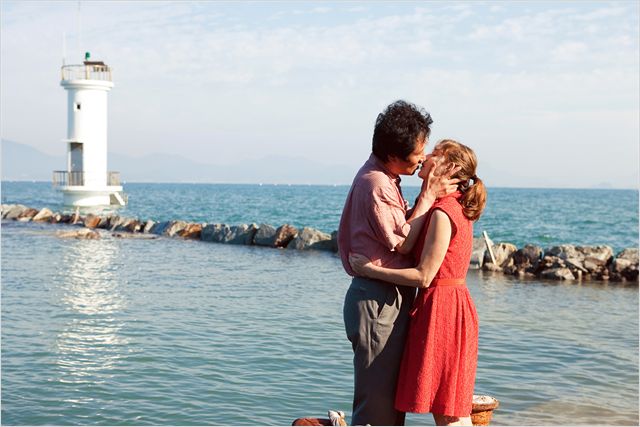
CANNES REVIEW: In Another Country

In Another Country
Directed by: Hong Sang-soo
Written by: Hong Sang-soo (screenplay)
Starring: Isabelle Huppert and Yu Jun-Sang

With all the serious, morbid narratives taking root of the festival imagination in places like Cannes, it’s refreshing to see an exceptional movie with a light touch and a very warm sense of humor.  In Another Country, from Korean director Hong Sang-soo, is exactly that.  It is the story of stories, an examination of how a narrative takes form and is altered and rearranged until it is the most effective.

A barely-seen Korean woman dictates these stories into a notepad.  All of them star roughly the same cast of characters, though their roles and importance often change.  Isabelle Huppert plays the main woman in all of them, always a wayward traveler in Korea looking around for a lighthouse and meaning.  There is also the woman she is staying with, an attractive young lifeguard and various other acquaintances along the way.

Continue reading

CANNES REVIEW: Amour

Amour
Directed by: Michael Haneke
Written by: Michael Haneke (screenplay)
Starring: Jean-Louis Trintignant, Emmanuelle Riva, Isabelle Huppert and William Shimmell

Michael Haneke’s latest film is a good poster child for why mainstream movie audiences fear and avoid many foreign films; it is quiet, slow and relentlessly depressing.  After winning the Palme d’Or in 2009 for The White Ribbon, Haneke officially established himself as a “Cannes auteur,” a director whose latest work would forever and always have a place in the festival’s cannon.

Amour is wondrously, deliberately hopeless.  Its depiction of an elderly woman’s slow, painful crawl toward death after suffering a series of strokes is not peppered with melodrama or any sort of dramatic flourish.  Haneke seems to think this would make the situation too comfortable, too much like a movie.  The goal of this film is to show the situation in as realistic light as possible, but from a removed distance.

Continue reading

CANNES REVIEW: Beasts of the Southern Wild

Beasts of the Southern Wild
Directed by: Benh Zeitin
Written by: Benh Zeitlin & Lucy Alibar
Starring: Quvenzhané Wallis, Dwight Henry, Levy Easterly and Lowell Landes

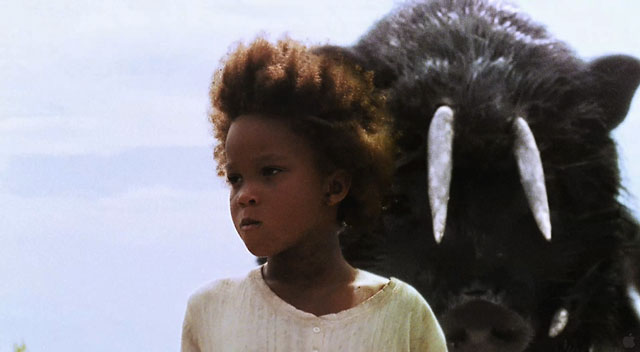
Let’s get this out of the way early: Beasts of the Southern Wild is one of the best films in recent years, and it is one of the greatest encapsulations of childhood consciousness that I’ve ever seen on a screen.  It captures a specific American subculture in the Louisiana bayou so effortlessly that its moments of fantasy should feel out of place, but because it is filtered through the eyes of such a poignant and ferocious young girl, everything flows together wonderfully.

That child is Hushpuppy (Quvenzhané Wallis), the daughter of a sick, widowed father  (Dwight Henry) who conjures up visions of gigantic beasts from folk lore to explain the destruction of her home and family.  She howls for her mother and glares at her dad when he yells at her, a wild thing in the vein of Max.

Continue reading

CANNES REVIEW: Rust & Bone

Rust & Bone
Directed by: Jacques Audiard
Written by: Jacques Audiard & Thomas Bidegain  (screenplay), Craig Davidson (story)
Starring: Marion Cotillard, Matthias Schoenaerts, Céline Sallette and Bouli Lanners

The French drama Rust & Bone, from equally French director Jacques Audiard, assembles some of the most talented people in all filmmaking departments together to tell an emotionally and physically violent story about love and survival.  It could’ve so easily been Oscar bait if the writing and the performances weren’t so emotionally uncompromising.

Audiard made a huge splash in many film circles  in 2009 and 2010 with A Prophet, a  violent and uncompromising vision set at the genre crossroads of organized crime and prison films.  Rust & Bone, while still concerned with the loss of humanity and the repression of violent impulses, tells a decidedly weirder story about a homeless father and son and a whale trainer.

Continue reading

CANNES REVIEW: Moonrise Kingdom

Moonrise Kingdom
Directed by: Wes Anderson
Written by: Wes Anderson & Roman Coppola (screenplay)
Starring: Jared Gilman, Kara Hayward, Bill Murray and Edward Norton

Like every Wes Anderson film, Moonrise Kingdom is an aesthetically beautiful comedy fueled by angst and injected with off-beat charm.  Stylistically it is a definite building block off of his stop-motion rendition of Fantastic Mr. Fox,  and in many ways seems more like an animated film than that one.

Part of the appeal of Mr. Fox, as Owen Gleiberman pointed out in his review, was that Anderson had always seemed to be a director of animation and using the puppets and stop-motion animation had allowed him to finally make a great movie.  While The Royal Tenenbaums is still a beautifully rendered portrait of a family, I otherwise agree with Gleiberman.

Continue reading

REVIEW: Dark Shadows

Dark Shadows
Directed by: Tim Burton
Written by: Seth Grahame-Smith (screenplay), John August & Seth Grahame-Smith (story), Dan Curtis (TV series)
Starring: Johnny Depp, Eva Green, Michelle Pfeiffer and Helena Bonham Carter

Dark Shadows is a film inhabited by the Gothic art direction that has become Tim Burton’s staple in addition to the comic macabre his pale people act out.  Lately Johnny Depp has been the pale muse front and center in Burton’s productions, becoming just as much a staple of his work as those faded worlds. This latest collaboration is nothing really new for either of them; a vampire invading the gloriously tie-dyed era of the 1970s is a perfect example of a Gothic force imposing itself on a world of color.

The crux of the story is fairly simple.  Barnabas Collins (Depp) is turned into a vampire and imprisoned by the witch Angelique (Eva Green) after she kills the other woman he loved.  His suffering is extended for all eternity, so when he emerges from that chained-up coffin nearly 200 years later, he is a very bloodthirsty fish-out-of-water.  He meets up with the present-day Collins family, who happen to live in the same menacing, faded mansion as he did.

Upon arriving he meets the drunken butler (Jackie Earle Haley) and the grouchy matriarch Elizabeth (Michelle Pfeiffer).  He explains his situation to her, she agrees to hide it, and they tell the rest of the family that he is a distant cousin.  Dark Shadows is based on a television show, though Burton leaves his distinct visual mark on the material.  He has always been more gifted at creating worlds than telling stories in them, and he does his best with the sloppy, seemingly aimless screenplay by Seth Grahame-Smith.  Accenting the comedy was the right way to go here, and Dark Shadows is often very funny.  Depp and Green both give inspired, over-the-top performances as they continue their centuries-long magic duel in the era of Vietnam and hippies.

There is a fantasy much darker than the supernatural one operating beneath the surface of this latest Burton/Depp concoction, though.  The most troubling thing about Dark Shadows is not its sloppy storytelling but its disguised contempt for its plentiful female characters.  Angelique’s thirst for revenge is borne out of that male fantasy that a woman becomes so obsessed with him that she turns delusional and incoherent without his presence.  Then, of course, she must be scolded into submission or death.

This principle is also true for Helena Bonham Carter’s character, the psychiatrist Dr. Julia Hoffman.  She is a boozing, pill-popping psychiatrist who throws herself at Barnabus simply because he pays her one simple compliment.  As in Sweeney Todd, Bonham Carter’s character comes up short in her director husband’s increasingly cruel roles for her.

It’s hard to take such a lightheartedly demented film like Dark Shadows so seriously, but its troubling misogyny travels with Barnabus from the dark ages as well.  There are quips early on by Elizabeth and the new maid Victoria (Bella Heathcote) about women being vastly superior to men, but it’s not long until Barnabus arrives and they all more or less succumb to his various charms.

For a PG-13 film, the amount of sex and death that is hinted at or partially shown is somewhat startling.  In such a finely veneered world it can almost seem barbaric, and yet when Angelique and Barnabus actually do have “sex” they remain fully clothed as they toss each other around the room.  Burton remains in frantic close-up trying to avoid what must be the studio’s worst fear: actually showing something.  He breaks his tradition of well-composed shots because this movie is afraid of the sex it so blatantly wants us to know is going on.  In this respect it resembles the Twilight films more than anything, even if its vampire is more of the Nosferatu variety.

Grade: C-

REVIEW: A Separation

A Separation
Directed by: Asghar Farhadi
Written by: Asghar Farhadi (screenplay)
Starring: Peyman Moadi, Leila Hatami, Sareh Bayat and Shahab Hosseini

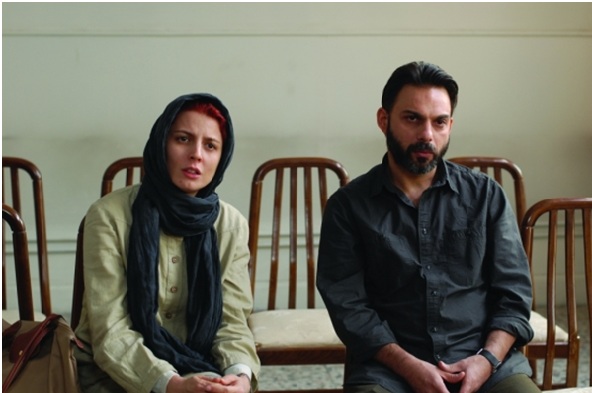
Muslim culture, to put it mildly, is not something familiar to most Americans, and post-9/11 fears have done little to educate.  Asghar Farhadi’s A Separation is a tense, masterful film set in modern day Iran, and totally immersed in the often-feared culture of that “Other.”  Farhadi’s grasp of middle and lower class Iranian life is key to transporting us to this world. The focus is not on the explanation of the culture, though; above all else, A Separation is a study of family and religious ties, mostly their intersections and compromises with each other.

It begins with Nader (Peyman Moadi) and Simin (Leila Hatami) facing the camera speaking to an unseen judge.  She is asking for a divorce and custody of their daughter so she can move out of Iran; he only agrees to the first.  Putting us in the perspective of the judge encourages us to take sides, as does the rest of the movie.  Farhadi, on the other hand, deliberately avoids this.

Continue reading

REVIEW: The Raven

The Raven
Directed by: James McTeigue
Written by: Ben Livingston and Hannah Shakespeare (screenplay)
Starring: John Cusack, Luke Evans, Alice Eve and Brendan Gleeson

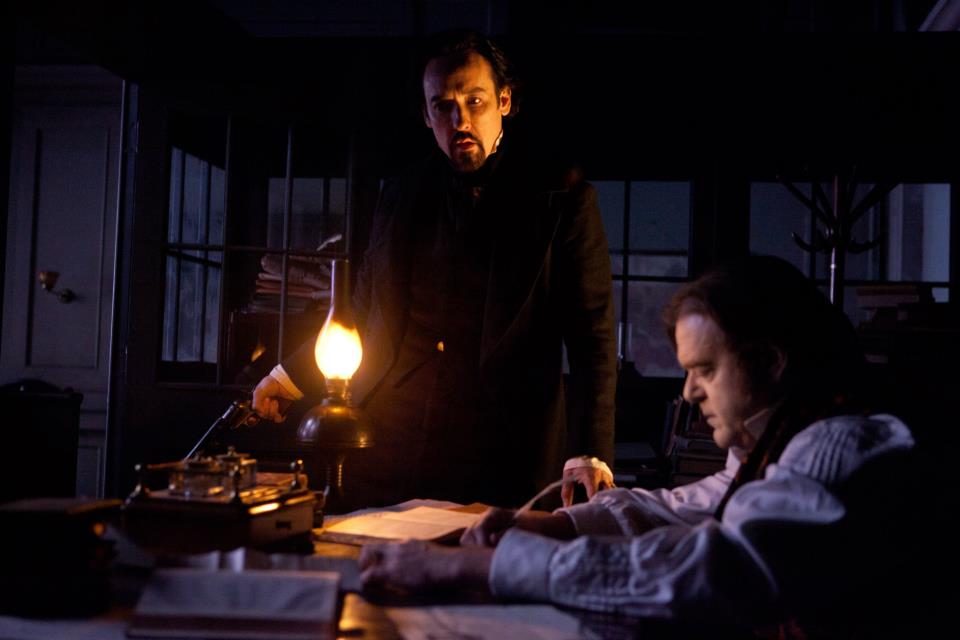
Edgar Allan Poe was an alcoholic, as many fine writers were.  Perhaps the most admirable thing about James McTeigue’s The Raven, an intensely fictionalized history of his final days, is that it does not shy away from that.  Poe (John Cusack) is thrown out of a bar early on for picking a fight with the wrong people after being unable to pay for any brandy of his own.

Cusack’s take on Poe is as over-dramatic as the rest of the movie, and this bastardization of the twisted writers’ stories seems more fit for someone like Nicolas Cage.  The Raven is a horror murder mystery more in the vein of Saw than in period drama.  A serial killer is prowling the streets of Baltimore leaving elaborate recreations of deaths from Poe’s stories.  Stock characters like the moral crusading detective (Luke Evans), the damsel in distress (Alice Eve) and her controlling father (Brendan Gleeson) form around Poe to create a story as uninteresting as it is gory.

Like the Saw films, we are given tedious narrative and our patience is rewarded every so often with a horrific murder.  A Poe story like The Pit and the Pendulum, whose protagonist’s internal torment and experience is the key driving force of the narrative, is made into nothing more than a gory spectacle.  The only pleasure I got out of this movie was remembering many of those older, better stories.

McTeigue is not a bad director.  The recreation of the party fromMasque of the Red Deathis a glamorous spectacle, inter-cut with a masked rider on a horse bathed in fog inching closer and closer to the doomed occasion.  Instead of killing everyone at the party, though, Poe’s love interest is kidnapped.

It’s this kind of watering down and altering that makes The Raven a pure exercise in kitsch.  If not for the presence of Poe and his work, this would be a run-of-the-mill kidnapping procedural, which is mostly still is.  Period clothing and gore also attempts to disguise the mundane story, but to no avail.  The stupidity of this mystery’s solution is no surprise, but it would be more excusable if it were a little more fun.

Grade: D

REVIEW: The Avengers

The Avengers
Directed by: Joss Whedon
Written by: Joss Whedon (screenplay), Zak Penn & Joss Whedon (story) Stan Lee & Jack Kirby (characters)
Starring: Robert Downey Jr., Chris Evans, Mark Ruffalo and Chris Hemsworth

Like all mega-blockbusters, the most interesting talking points about The Avengers will be financial ones.  It is the latest in a long line of super-hero behemoths, although it was engineered to be the king of those giants.  For the past few summers, Paramount Studios has carefully built up to this Marvel grand opus of crime fighting, releasing an individual movie for almost all of the principle characters in this film.  It started with Iron Man in 2008 and ended last summer with Captain America, raking in millions upon millions along the way.

None of the entries in The Avengers franchise are complete movie-making disasters.  In fact, they are almost all deliberately average, crafted more with marketing and merchandising in mind.  Of course the super hero universes that Stan Lee created are endlessly ripe for film adaptation, and recent American movie summers would be nothing without those mutant and intellectual do-gooders.

Continue reading