Short takes: Straight Outta Compton, The Gift, Mission: Impossible 5 & more

Straight Outta Compton

Straight Outta Compton – F. Gary Gray’s N.W.A. biopic is an occasionally thrilling chronicle of the rise of the West Coast hip hop group that sadly devolves into brand management.  That’s to be expected when the film’s producers, Dr. Dre and Ice Cube, are also two of its subjects.  Straight Outta Compton is a wonderful showcase for its three core actors (Corey Hawkins as Dre, O’Shea Jackson Jr. as his father Ice Cube and especially Jason Mitchell as Eazy-E), but it could have been so much more.

Compton’s focus on police brutality is incredibly relevant, and the early scenes where the artists are subjected to violent, unwarranted stops by law enforcement are among its most powerful.  N.W.A.’s concert in Detroit, where they perform “Fuck tha Police” after being intimidated by officers before taking the stage, is filmed with undeniable urgency and energy, as is the follow-up where undercover officers charge the stage and arrest the group.

Like the other concert performance scenes, the energy of the crowd is contagious, and the movie’s biggest shortcoming is in its failure to address the female half of those excited crowds. N.W.A.’s misogyny is largely unconfronted, as is Dr. Dre’s abusive history with women.  This  has already been written about at length by people with more authority on the subject than me, but the watered down history of the movie’s second half is noticeable and hurts it.  Gray’s direction is beautiful and powerful in equal measure, and the sweeping images of ’80s and ’90s Compton — dirt bikes cruising down the street in the sunset, decked-out old cars bumping to music in the neon-colored streets, gangs uniting against police violence.  I can’t help but think there was more to tell here, though; that an unrestrained history, or even a 5-hour miniseries, would have done the story more justice.  Grade: C+

Continue reading

Short takes: Southpaw, Saint Laurent, Inside Out & more

Southpaw

Southpaw– Jake Gyllenhaal gives a tremendous performance in Southpaw, but just like his turn in last year’s Nightcrawler it’s buried in a bland movie.  The grand scale and energy of Antoine Fuqua’s direction and Gyllenhaal’s ferocious intensity in the role of boxer Bobby Hope are almost enough to carry the movie past a mountain of cliches and a predictable story.  The script, by Kurt Sutter, is driven by big emotions rather than narrative logic.  It starts out with Hope in the prime of his career: he’s undefeated, has millions of dollars and a loving family.  He loses it all when his wife (Rachel McAdams) is gunned down during a brawl he’s involved in at a charity event.

Sadly, the movie can’t recover from her absence any more than Hope can.  After her death his entire fortune seems to evaporate, and he’s rushed back into the ring by a manager (Curtis Jackson, aka 50 Cent) who only wants more money.  Hope snaps during that rebound match, is suspended from fighting and ultimately loses custody of his daughter.  He eventually stumbles into the small, antique gym of Tick Willis (a fantastic Forest Whitaker), who just so happens to be a world-class trainer.  By the end, he’s landed back into the ring with the same man he was fighting when his wife died.  If you’re wondering how this all escalated so quickly, you’re not alone.  Southpaw is too focused on plowing through plot points to the Big Finish that it never fully connects. Grade: C-

Continue reading

REVIEW: Trainwreck

trainwreck

Trianwreck
Directed by: Judd Apatow
Written by: Amy Schumer
Starring: Amy Schumer, Bill Hader, Brie Larson and Tilda Swinton

When Amy Schumer wants you to laugh, she widens her eyes, puts her hand on her chest and looks around the room, her expression saying “What?  Was it something I said?”  Her punchlines are moments of intentional ignorance, her self-proclaimed “dumb white girl” persona. She is a ruthless interrogator of body image and her own sex life, finding humor in the ways they both clash with the relentless standards of Vogue and Cosmopolitan.  Her material on race, on the other hand, can come off as unintentionally ignorant and cruel.  That’s why I was grateful for her Comedy Central show Inside Amy Schumer, because while she is often a very funny teller, her comedic persona lends itself much better to showing.

With Trainwreck, which Schumer wrote and stars in, that persona is evolved into something fully, often uncomfortably human.  Her character, Amy Townsend, is a writer for a straight dude lifestyle magazine, not unlike Lena Dunham’s short-lived gig at GQ in the third season of her HBO show Girls.  Both the show and the movie have a hilariously warped view of the office culture at these publications, though Girls is decidedly nicer and focuses more on Dunham’s character’s inability to thrive in such an environment.  Amy does thrive in this knowingly stupid world, where articles like “You’re not gay, she’s just boring,” are routine pitches in an afternoon meeting.

Continue reading

REVIEW: Jurassic World

Jurassic World 3

Jurassic World
Directed by: Colin Trevorrow
Written by: Rick Jaffa, Amanda Silver, Colin Trevorrow and Derek Connolly (screenplay), Rick Jaffa and Amanda Silver (story), Michael Crichton (characters)
Starring: Chris Pratt, Bryce Dallas Howard, Vincent D’Onofrio and Ty Simpkins

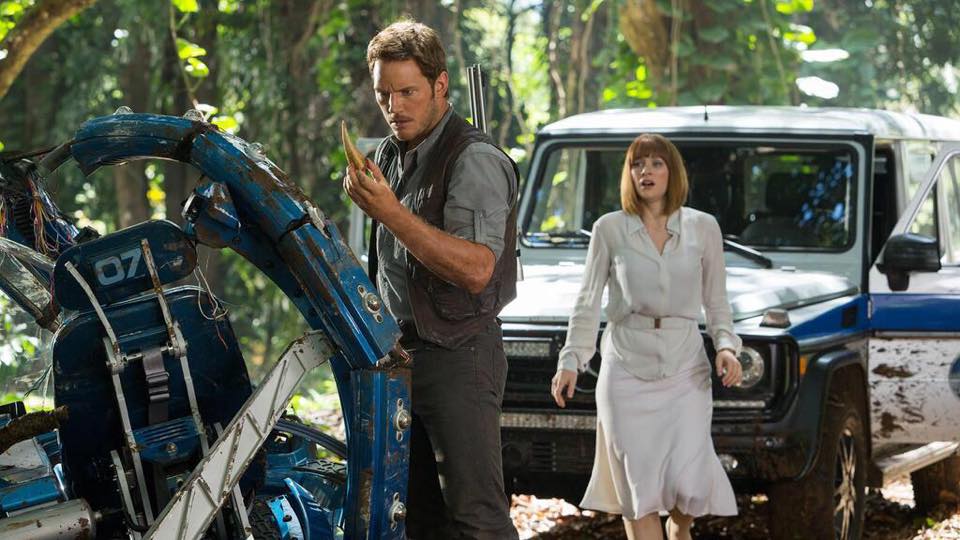
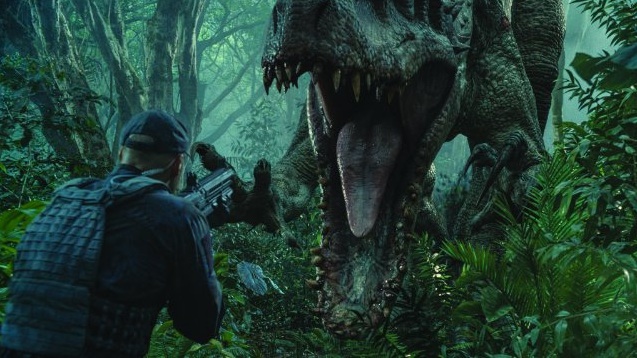
In the latest Jurassic film installment, not only are these fools still cloning dinosaurs and then subsequently shooting at and running terrified from them, but they are doing it all on the ruins of the place where the same damn thing happened in 1993.  Jurassic World’s meta cynicism is almost as unrelenting as the violently earnest, flat characters; sometimes the clash between the two is entertaining, and other times it’s annoying.  The dino-revival turned slaughterhouse from the first film is now a happy-go-lucky theme park, tacked-on corporate sponsorships and hordes of vacationing families included.  It’s a shinier gloss to distract from the fact that these creatures are still more than capable of getting loose and eating everyone.

Director Colin Trevorrow has made a summer spectacle that seems mad about being one.  The most memorable shot in the movie is not of velociraptors doing battle with a ferocious new hybrid dinosaur but of one of a T-Rex being obstructed by smartphones.  These people are just here to get their photos, and the grinning corporate suits working behind the scenes are making bigger and more dangerous spectacles for them to Instagram.

Jurassic World 2

At first, Jurassic World is an amusing critique of corporate culture (with built in product placement, of course).  It descends into predictable madness when a big carnivorous dinosaur escapes, but what caught me off guard was just how sadistic Trevorrow’s movie actually becomes.  Obviously, the two wide-eyed young brothers who we follow from the beginning will be fine.  Chris Pratt, the movie’s overly stoic moral compass, will be fine.  Bryce Dallas Howard, who if she was allowed to take off her ridiculously high heels in the middle of the jungle might actually have been able to save everyone, will be fine.

The movie seems to go out of its way to show everyone else suffer, though.  There’s an extended sequence where the brothers’ babysitter gets picked up by a flying creature, dropped in a pool and then eaten by a gigantic sea monster.  In this same scene we see a brief shot of a tiny triceratops plucked away from a shrieking child by the airborne reptiles.  It’s off-putting and mean-spirited, and the sanitized PG-13 rating only accentuates that.

Trevorrow is not as good at sick, sinister entertainments as David Fincher, so Jurassic World feels more like an angry mash-up of blockbuster movie elements than an actual movie. Its unending sly winks at itself are amusing at first and then eye-roll inducing, and it’s hard to sympathize with terrified people running from dinosaurs when it doesn’t make you like any of them beforehand.  The velociraptors have a more sympathetic and endearing character arc than anything else in the movie, which made me wish the franchise had just done away with humans altogether for this installment.  Rise of the Planet of the Raptors, please.

Grade: C-

REVIEW: Aloha

Aloha 1

Aloha
Directed by: Cameron Crowe
Written by: Cameron Crowe
Starring: Bradley Cooper, Emma Stone, Rachel McAdams and Bill Murray

I wish I could say that I was dragged to the theater kicking and screaming to see Aloha, or that I had lost a bet or been dared by someone to sit through it.  Alas, I paid $8.50 for a matinee ticket and watched all of it it on my own free will, and I have to live with that decision.

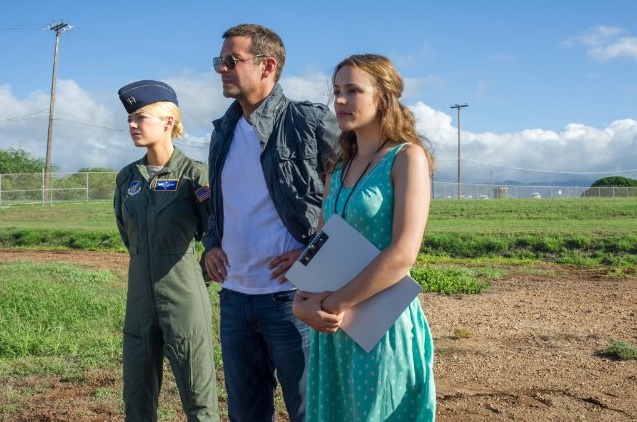
Outside of being a cloying, uninteresting romance, Cameron Crowe’s film is so narratively fractured that it often feels incoherent.  Is Brian Gilcrest, a military contractor played by Bradley Cooper, world-weary and depressed or is he chipper and earnest?  He switches between these two extremes from scene to scene, which makes him much more exciting than any of the one-dimensional support around him.  Almost all of them are repeatedly defined by a single characteristic, like nervously moving their hands, never talking or, most offensively, being “one-quarter Hawaiian.”

Continue reading

REVIEW: Far From the Madding Crowd

Far From the Madding Crowd 3

Far From the Madding Crowd
Directed by: Thomas Vinterberg
Written by: David Nicholls (screenplay), Thomas Hardy (book)
Starring: Carey Mulligan, Matthias Schoenaerts, Michael Sheen and Tom Sturridge

Thomas Vinterberg’s adaptation of Far From the Madding Crowd is often too shackled to its narrative to truly resonate.  It seems forced and prodded along every step of the way, and almost nothing seems to spring out of the story’s perceived humanity.  It’s only fitting that Madding Crowd’s most beautiful, haunting moment involves animals; a dog chasing a herd of sheep over a cliff and to their death, with an overhead shot lit by the rising sun catching their needless tumble.

Their shepherd’s (Matthias Schoenaerts) subsequent burst of rage seems to reverberate through the the top of that cliff, and it resonates more than nearly any other emotion on display for the rest of the movie.  It’s too bad, because Madding Crowd’s cast truly gives it their all.  Carey Mulligan’s performance as Bathsheba Everdene occasionally manages to convey a sense of inner life, of a stubbornly independent farmer grappling with a trio of attractive suitors.  In addition to Schoenaerts’ farmhand Gabriel Oak, there is a wealthy, middle aged next-door neighbor (Michael Sheen) and a blunt, charming-on-the-surface soldier Francis Troy (Tom Sturridge).

Far From the Madding Crowd

Oaks and Troy rarely share the screen, but they are the two main contenders in the quiet war for Bathsheba’s affection.  Though the men all come from different social ranks, those ranks do not dictate which of them Bathsheba must marry.  If that were the case, William Boldwood (Sheen) would naturally win over the other two.  Madding Crowd draws much of its drama from Bathsheba’s reluctance to want to marry at all, and Boldwood never really stands a chance.

Sheen plays him that way, too.  He has a look of crippling self-doubt nearly every time he talks to Bathsheba, and he’s framed at an awkward distance from the action, not wanting to be pulled into it. His performance is a good example of how the movie fails to convey the full depth of its characters’ feelings.  Boldwood ultimately sacrifices his freedom for Bathsheba; (spoilers ahead) he shoots Troy as he grabs her and demands that she obey him.  There is a quick shot showing a prison door close on him and a brief scene that shows dresses and gifts in his house with her first name and his last name stitched on them.

Had Vinterberg embraced the melodrama at the heart of Madding Crowd instead of opting for a more restrained adaptation, scenes like those could have been devastating instead of throwaways.  Instead, it’s a tedious movie sprinkled with visually sumptuous moments, like the first time we see Oaks see Bathsheba, bending over backwards to go under low-hanging branches while on her horse.  The way she’s framed by the trees she seems to be floating across the screen; a few minutes later he’s asking her to marry him and she laughs.

I wish the movie had more scenes like this, ones filled with a genuine longing.  There’s a rich emotional history etched on Mulligan’s face, and she conveys joy, desire and regret over the course of a single smirk.  The same could be said of Schoenaerts’ stare; sadly they’re both trapped in a movie where none of that ultimately matters.

Grade: C-

REVIEW: Mad Max: Fury Road

maxresdefault

Mad Max: Fury Road
Directed by: George Miller
Written by: George Miller, Brendan McCarthy and Nick Lathouris
Starring: Tom Hardy, Charlize Theron, Nicholas Hoult and Hugh Keays-Byrne

George Miller’s return to the world of Mad Max is as deranged as it is awe-inspiring. For nearly two hours, Fury Road wreaks havoc on the post-apocalyptic Australian Outback and the leftover civilization that inhabits it. Metal and sand collide and erupt endlessly, though the greatest fire may be the one burning in the eyes of the movie’s hero.

I’m not talking about Max.  The Australian policeman brought to gritty life by Mel Gibson in Miller’s earlier films is here played by Tom Hardy, whose preferred method of communication for much of the movie is grunting and pointing.  Hardy shares the action hero spotlight with Charlize Theron, whose ferocious portrayal of the Imperator Furiosa practically ignites the screen.

Continue reading

REVIEW: What We Do in the Shadows

What-We-Do-in-the-Shadows 3 What We Do in the Shadows
Directed by: Jemaine Clement and Taika Waititi
Written by: Jemaine Clement and Taika Waititi
Starring: Jemaine Clement, Taika Waititi, Jonathan Brugh and Cori Gonzalez-Macuer

The staying power of the “mockumentary” never ceases to amaze. Right when the genre seems to have been flogged to death, something new emerges to inject more life. What We Do in the Shadows, the new film from co-directors Jemaine Clement (Flight of the Conchords) and Taika Waitit, is its latest triumph. Lying close to the sweet-natured deadpan films of Christopher Guest, its innumerable successes come from, among other things, a clear love and dedication to the form. The directors, who also star in the movie, shrewdly take on everything from hokey History Channel infotainment to MTV reality shows (The Real World and True Life, especially).

There is nary a second that isn’t filled with some sort of visual gag, sharp quotable or savvy edit – and almost every decision is a success. Viago (Taika Waitit) is a modest vampire living in a New Zealand estate with his three flatmates Petyr (Ben Fransham), Deacon (Jonathan Brugh) and Vladislav (Jemaine Clement). The four have consented to a documentary crew following them around in the months leading up to the Unholy Masquerade – the big annual event for all things evil.

Viago is the kind romantic, yearning for another opportunity with a lost love; Deacon, an ex-Nazi vampire, is the “badboy” of the group; Vladislav is an ages-old pervert who used to torture innocents by, literally, poking them; and Petyr is the 8,000 year-old monster downstairs, kept locked away and out of sight (and resembling a certain Murnau creation). When not drinking the blood of humans (Viago notes, the unfortunate part of being a vampire), the guys are content on leading a relatively low-key existence. Immortality, they concede, certainly doesn’t mean one is excused from doing the dishes and sweeping the hallway. What We Do in the Shadows Waitit and Clement constantly play on the vampire mythos clashing against (or, rather, adapting to) modern-day banalities. In a scene near the beginning, the guys roughly sketch each other on sheets of paper to deal with the serious problem of having no reflections while getting ready to go out. Once out on the town, they must be invited in to the clubs, which results in begging the bouncers for entry. The hurdles in getting a victim back to their place seem endless, and when they actually do manage a mild success, it’s often fumbled through their clumsiness and rusty tactics.

Deacon, fortunately, has a servant named Jackie (Jackie Van Beek) that, in addition to doing upkeep work, assists them with collecting victims, in the hopes of being turned into a vampire herself. When she brings two “virgins” back to their house, the plan backfires, and one of them, Nick (Cori Gonzalez-Macuer), is turned into a bloodsucker and new member of the family. From that point on, the happy house shifts into a power struggle between the old vampires and the new – the dynamic compromised by Nick bringing in a human friend, Stu (Stuart Rutherford), and bragging about his new vampire abilities at the bar (“I’m the guy from ‘Twilight’”).

Nick resembles that disingenuous housemate all-too-familiar on reality shows; the one who gets his rocks off from heavy drama, consistently (and, sometimes, unintentionally) stirring up trouble. And this certainly isn’t the only way the film resembles reality television – it includes a re-enactment, an intervention, a montage of trying on clothes and talking-head confessionals. Divulging some of the best gags would be doing a major disservice to the film, which is best served cold, but the highlights are numerous – and many indulge a keen familiarity with the most pervasive documentary tropes.

The movie is brisk, and almost exhaustingly clever. If not all the jokes land (and a few don’t), it has more than enough to cover for the occasional lag into uninspired territory. Its charm is rooted in a script that pays loving tribute to vampire lore and cringe comedy (In an interview with The Dissolve, Clement and Wahiti cite This Is Spinal Tap as a major inspiration), and a cast of uncommonly likeable characters. Those familiar with Clement’s television show Flight of the Conchords will already be accustomed to the actor/director’s brand of Kiwi-comedy, mastered by this point, drawing laughs most often from naivety and awkward situations. What We Do In The Shadows is more of the same, but done so well it feels brand new again.

Grade: B
REVIEW: While We’re Young

while-were-young

While We’re Young
Directed by: Noah Baumbach
Written by: Noah Baumbach
Starring: Ben Stiller, Naomi Watts, Adam Driver, Amanda Seyfried

“Enough about ethics, what about me?”

This line in Noah Baumbach’s latest movie comes toward the end, when the middle-aged documentary filmmaker played by Ben Stiller, reaches the end of an annoyingly grandiose diatribe against every other character in the movie and their perceived moral betrayals. It’s delivered, as much of the rest of the movie is, somewhere between satire and sincerity.  That’s to say, While We’re Young is much more of a return to form for Baumbach than the joyous outburst of his last film, 2013’s Frances Ha.

While We’re Young is Baumbach’s sometimes sharp, sometimes eye-roll-inducing look at generational gaps and overlaps.  Josh (Stiller) and Cornelia (Naomi Watts) are in their 40s, have no kids and are very defensive about it.  They’re losing their friends to parenthood, so when Josh meets Jamie (Adam Driver) and Darby (Amanda Seyfried, a young couple in one of his film classes, they go on a double date and he and his wife quickly latch onto them.

Continue reading

Short Takes: It Follows, Insurgent & Hard to Be a God

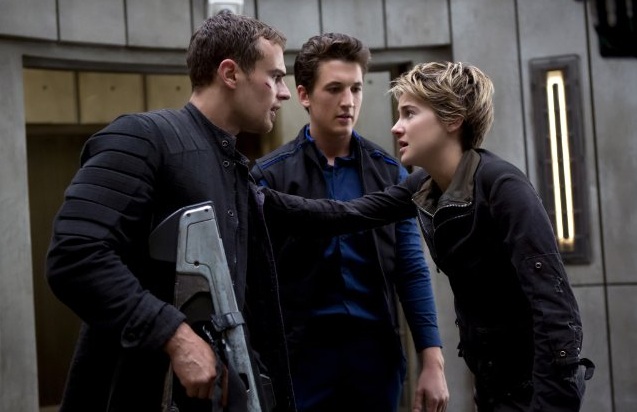
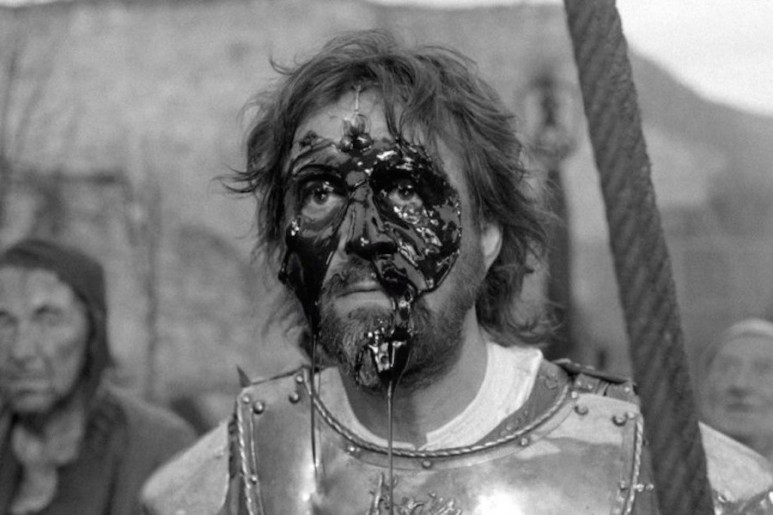
It Follows It Follows — Writer/director David Robert Mitchell proves himself a horror movie natural with It Follows, a terrifying “Sex = Death” thriller.  The overwhelming sensory experience on display in this movie is enough to distract from the thinness of its premise, which revolves around a young woman named Jay (the excellent Maika Monroe) being inadvertently passed a curse that has a shape-shifting ghost stalk her.  The curse is transmitted sexually, and whoever is the most recent recipient needs to pass it on before the ghost catches up with them.  It’s the slowness of the specter that is truly chilling, especially when combined with Dissasterpeace’s relentless, pulsating score. The movie initially toys with misogynistic audience expectations, sacrificing a barely-clothed young woman after watching her being stalked and then having Jay’s date drug her and tie her up in her underwear after sex to “warn” her about the ghost.  Predatory men may not be the culprits on screen this time around, but Mitchell’s camera still uncomfortably fetishizes the young female characters’ bodies in those scenes.  Thankfully the movie moves past it, though, and unfolds in ways that are wickedly entertaining and genuinely scary. Grade: B- Insurgent 2 Insurgent — The second entry in the Divergent series feels more alive than the stale, uneven first one.  Insurgent trades in the half-assed, uninteresting world-building of the series debut for a story that is often visceral and compelling, as teen messiah Tris (Shailene Woodley) continues to fight back against the totalitarian, Kate Winslet-led regime.  It helps greatly that Winslet actually looks like she wants to be here this time around, and the distilled chill of her performance blends well with the raw energy Woodley brings to her own role. Much of this installment revolves around Tris assembling a rebel army and completing a self-sacrificing series of grueling challenges for the dictator’s benefit (don’t call them Hunger Games).  Director Robert Schwentke brings an urgency to the action sequences that is more compelling than anything else I’ve seen in a recent teen dystopia movie, though Insurgent’s world ultimately feels just as generic and unimaginative as that of its predecessor and those in The Hunger Games and The Giver. Grade: C+ Hard to Be a God Hard to Be a God — It is a great testament to this movie’s power to say that I now feel desensitized to the grossness of human body fluids.  Hard to Be a God, a decades-long passion project of the late Russian director Aleksey German, is the filthiest feeling movie I’ve seen in years, maybe ever.  Set on Araknar, a planet similar to Earth that is experiencing its own Middle Ages, Hard to Be a God tells the story of scientists from our planet who were sent there to study it and then become deities. If the movie had not explained that in its opening narration, I’m not sure I would have picked that all up, though.  German’s camera is so embedded in the feelings of this world, of its eternal wetness and clogged sinuses, that narrative all but disappears.  Araknar is in the midst of a violent rebellion where all intellectuals are being publicly executed. The movie’s black-and-white images are jaw-dropping and disgusting at the same time; from the get-go, German’s bizarre three-hour epic of depravity is thick with sludge, snot and shit.  It captures human cruelty in a ferociously close proximity and with such an abundance of mind-twisting visual information that it’s exhausting to sit through and process in one viewing.  I’d watch it again in a heartbeat, though. Grade: A-