BEST PICTURE NOMINEE: Django Unchained

url

Django Unchained
Directed by: Quentin Tarantino
Written by: Quentin Tarantino (screenplay)
Starring: Jamie Foxx, Christoph Waltz, Leonardo DiCaprio and Kerry Washington

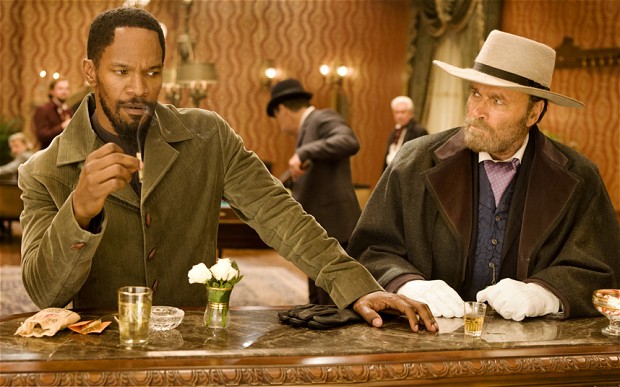
Django, like the ‘D’ at the beginning of his name, is silent.  This is no small feat, given that he is the main character in a Quentin Tarantino movie, and should be stopping to yak at any given opportunity, preferably before a burst of ultra-violence.

Of course there is plenty of bloodshed in Django Unchained, so much in fact that it paints a white plantation red, mostly with the blood of its owner and his employees.  It is Tarantino’s second historical revenge fantasy in a row, following the revisionist WWII epic Inglourious Basterds.  Here, though, he crucially refuses to revise the horrors of American slavery, and depicts them in ways that are startling and horrific.  The blood from the shootouts may be gratuitous and expressionistic, but it’s the beating, dog mauling and whipping that feel brutally real even if the movie they are in is often highly stylized.

Continue reading

BEST PICTURE NOMINEE: Life of Pi

life_of_pi_still

Life of Pi
Directed by: Ang Lee
Written by: David Magee (screenplay), Yann Martel (book)
Starring: Suraj Sharma, Irrfan Khan, Rafe Spall and Gérard Depardieu

Because of the horrendously vague marketing campaign, the only draw to Life of Pi for me was the Ang Lee directing credit.  Though Lee’s directing career includes some misses (Taking Woodstock, Hulk) he is a master storyteller and when he’s on (Brokeback Mountain, The Ice Storm) few contemporary filmmakers can touch him.

Life of Pi is neither masterwork nor miss.  It is, however, a stunningly gorgeous movie about survival at sea, and all the problems and symbolism that entails.  An inquisitive young boy named Pi (Suraj Sharman) is moving away from his home in India with his family to escape mounting political tensions.  The ship is caught in a storm and sinks.  Pi and four animals from his family’s zoo stowaway on a life boat and drift across the Pacific.

Continue reading

BEST PICTURE NOMINEE: Beasts of the Southern Wild

Beasts of the Southern Wild - 6

Beasts of the Southern Wild
Directed by: Benh Zeitlin
Written by: Benh Zeitlin & Lucy Alibar
Starring: Quvenzhané Wallis, Dwight Henry, Levy Easterly and Lowell Landes

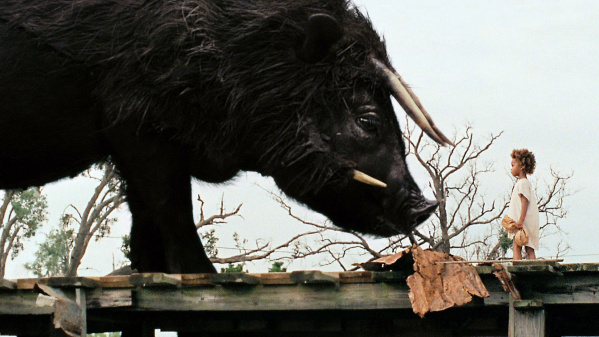
Since Beasts of the Southern Wild was my pick for the best movie of 2012, I thought I would revisit it here since my original review was an ecstatic, somewhat over-the-top reaction from the Cannes Film Festival.  Having seen the film twice now, I still maintain that it is a masterpiece, and one of the best translations of childhood consciousness that I’ve ever seen in a movie.

Many of the criticisms of Benh Zeitlin’s debut feature revolve around its treatment of race as it relates to poverty.  The harshest (and most recent) of these comes from Richard Brody of The New Yorker, who wrote:

The movie itself is this year’s The Help, a romanticized and mythologized vision of poor Southern blacks (in this case, a father and daughter in a Louisiana bayou community called the Bathtub) that also sentimentalizes the very notion of self-help (“The Self-Help”) in a story that spotlights a tough, poetic, independent-spirited child facing dangers in aquatic adventures.

Continue reading

BEST PICTURE NOMINEE: Zero Dark Thirty

DARK-THIRTY-3

Zero Dark Thirty
Directed by: Kathryn Bigelow
Written by: Mark Boal (screenplay)
Starring: Jessica Chastain, Jason Clarke, Jennifer Ehle and Joel Edgerton

In 2008’s The Hurt Locker, director Kathryn Bigelow and screenwriter Mark Boal created a searingly suspenseful modern war movie about a bomb diffuser addicted to the rush of potential detonation, which became a history-making Oscar and critical darling in the process. It was a grimy and unsanitized piece of work, more obsessed with masculinity on the edge than serving up an overt political agenda.

Zero Dark Thirty is almost clinical by comparison, if no less nerve-wracking.  In chronicling the obsessive decade-long manhunt for Osama bin Laden, Boal and Bigelow re-examine the American psyche on a much broader scope.  Again they try to keep an agenda out of it and simply dramatize the facts, but the sensitivity and  weight of those findings make it impossible to avoid controversy.

Continue reading

REVIEW: Les Miserables

MISERABLES-articleLarge-v3

Les Misérables
Directed by: Tom Hooper
Written by: William Nicholson (screenplay), Herbert Kretzmer (lyrics), Victor Hugo (novel)
Starring: Hugh Jackman, Russell Crowe, Anne Hathaway and Amanda Seyfried

When I originally saw Les Misérables, I was so disheartened and uninspired  that I didn’t even want to write down any thoughts about it.  Anne Hathaway was great, yes.  At times the raw combination of extended takes done in close-up and live singing from the performers was thrilling.  But the movie was bloated, sloppy and completely overdone.

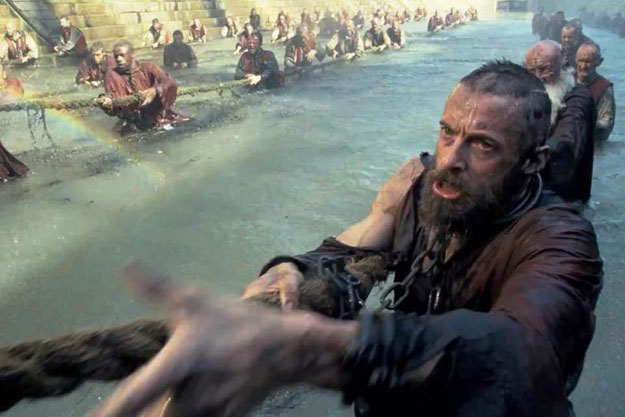
Having not seen the stage musical or read Victor Hugo’s gargantuan novel, I came to the material with completely fresh eyes.  It begins with a sweeping, artificial-looking descent into a 19th century French work camp, where Jean Valjean (Hugh Jackman) is completing a 20 year work sentence for stealing a loaf of bread for his family.  He is overseen by Javert (Russell Crowe), a ruthless, incredibly narrow character whose sole pursuit throughout the movie is to show up conveniently at any given scenario where Valjean is present and make him squirm.

The movie hinges on their incredibly poorly realized relationship and countless manipulative emotional tangents.  Les Misérables seems to operate with the understanding that it deserves every wrenching, song-driven outburst without the slightest bit of narrative coherence.  More so than director Tom Hooper’s previous Oscar-baiting effort The King’s Speech, it is a deliberate ploy to earn trophies with period costume design and unearned emotional response.

As grimy and desperate as Jackman appears and as surprisingly good as Crowe’s singing voice is, the movie is punishing.  It peaks less than an hour into its two-and-a-half hour run time with Hathaway’s take on I Dreamed a Dream,” where her downtrodden prostitute Fantine weeps for her ruined life after she’s sold her hair and teeth to support her daughter.  Shot in a single take like several of the other numbers, it is a very good illustration of what Hooper occasionally does very well and often does very poorly with this material.  The close-up of Hathaway’s face is effective precisely because it seems unable to contain her emotion, and because her singing is raw.

les-miserables-trailer-uk

Jackman’s Valjean, on the other hand, does not have the luxury of being an effective character in close-up.  He is often on the move evading the authorities or trying to rescue and care for Fantine’s daughter Cosette (Isabelle Allen as a young girl and Amanda Seyfried as a young woman), but the constraints Hooper placed on the musical demand that he must capture the singing live, and gets the camera in obsessively close to highlight just how live and strained his performers are.

This would be an admirable effort if the movie wasn’t such a blatant grab at awards.  Despite the desperate hearts at its core, it is exhausting not because the story is effective but because it isn’t.  It jumps ahead years at a time, stopping for revolution and love but never expanding or really caring about them.  The music often adds nothing to a scene, and despite coherent, elaborate costume choices and set design it never transports you.  Above all else, Les Misérables is the triumph of artifice over feeling and entitlement over storytelling.

Grade: D

REVIEW: Promised Land

promisedland_620x350

Promised Land
Directed by: Gus Van Sant
Written by: John Krasinski & Matt Damon (screenplay), Dave Eggers (story)
Starring: Matt Damon, Frances McDormand, John Krasinski and Rosemarie DeWitt

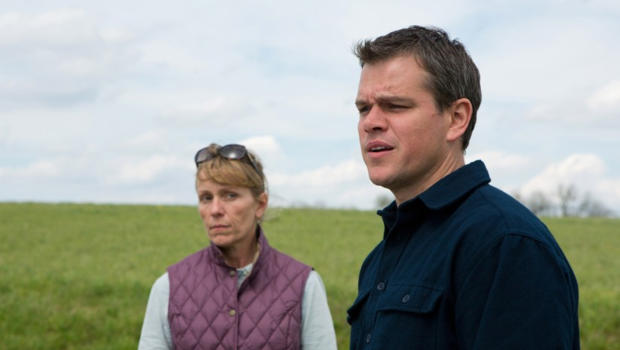
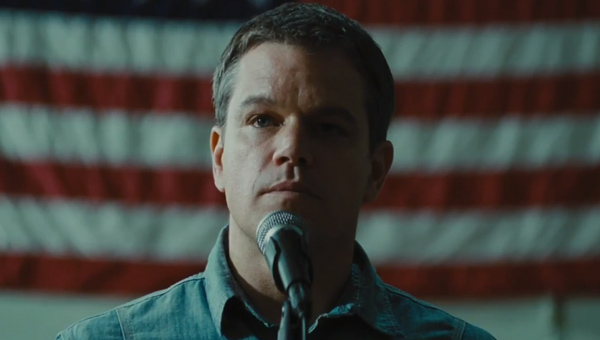
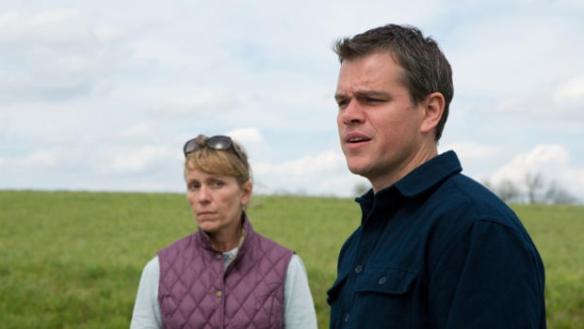
Promised Land is a message movie about fracking just like it was marketed, but exactly what that message ends up being is somewhat surprising.  It’s more about the fading myth of small town life than it is about grandiose environmentalism, and its biggest asset is surely the atmosphere of the rural Pennsylvania town that representatives (Matt Damon and Frances McDormand) from the big, bad, generically-titled corporation Global descend upon to pluck up land on the cheap for digging.

There isn’t much blood in Gus Van Sant’s latest film, though, but there is quite a bit of swindling.  Damon and McDormand are two screen presences often associated with kindheartedness, which they subvert here in the way that they intend to manipulate the poverty of the town by putting on a smile and exaggerating the numbers.  One of the best scenes in the movie comes toward the beginning, when they enter a convenience store on the outskirts of their target town to try and attempt to dress the part (they buy flannel shirts).

What Promised Land does exceptionally well is embed us in the ebb and flow of small town life with tactful, precise observations.  From a bar competition where outdrinking the bartender earns free drinks for everyone to holding town hall meetings in a gymnasium before the varsity basketball game, Van Sant expertly illustrates not just modern rural America, but also the presence outsiders have on it.

promised-land-movie

Steven (Damon) spends most of the movie trying to use the town’s charms and habits against it.  This becomes more evident when an environmentalist (John Krasinski, who co-wrote the script with Damon) shows up to vie for the town’s affections before the town votes on whether or not to support Global’s fracking invasion.  The script mostly avoids grandstanding and preaching, and though it is clearly against the controversial drilling practice, the allure of money in tough economic times is undeniable.

Because the movie’s stance on the issue evolves and expands with Steven, it’s mostly about reconciling what he does for a living with whether or not he can live with himself.  The answer to that questions is fairly obvious if you’ve seen a movie before, but for the most part it avoids manipulating emotion and condescending to intelligence like its main characters do.

Van Sant is good at balancing the naturalistic acting from all the performers with his knack for visual detours to give us a break from their talking.  He is a director who, like Steven Soderbergh, oscillates between bigger, studio-backed endeavors like Milk and Good Will Hunting to lower budget indies like Elephant and Paranoid ParkPromised Land, with its big marquee names and its overtly didactic premise, is definitely more of the former.

This isn’t to say that should be held against this movie.  Van Sant has made great movies of all sizes, which makes his directorial touch somewhat illusive.  Here it can be found in the time lapses in a diner and the slow motion pan of a little league pitcher to reveal Global’s logo on the back of his uniform.  Promised Land is not a great movie, but it is assured and at times surprising in its tackling of the issue at its center.

Grade: C+
REVIEW: Django Unchained

Django Unchained movie still

Django Unchained
Directed by: Quentin Tarantino
Written by: Quentin Tarantino (screenplay)
Starring: Jamie Foxx, Christoph Waltz, Leonardo DiCaprio and Kerry Washington

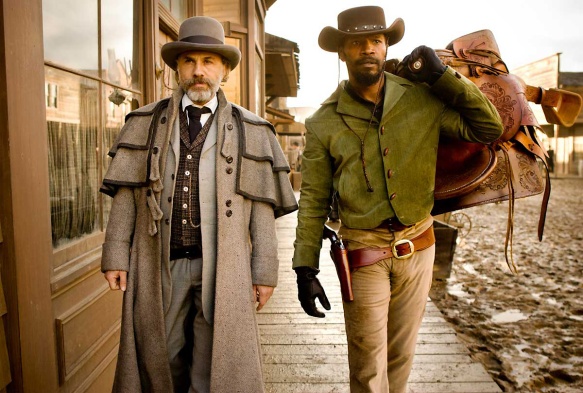
Django, like the ‘D’ at the beginning of his name, is silent.  This is no small feat, given that he is the main character in a Quentin Tarantino movie, and should be stopping to yak at any given opportunity, preferably before a burst of ultra-violence.

Of course there is plenty of bloodshed in Django Unchained, so much in fact that it paints a white plantation red, mostly with the blood of its owner and his employees.  It is Tarantino’s second historical revenge fantasy in a row, following the revisionist WWII epic Inglourious Basterds.  Here, though, he crucially refuses to revise the horrors of American slavery, and depicts them in ways that are startling and horrific.  The blood from the shootouts may be gratuitous and expressionistic, but it’s the beating, dog mauling and whipping that feel brutally real even if the movie they are in is often highly stylized.

Continue reading

REVIEW: Silver Linings Playbook

silver-linings-playbook-review

Silver Linings Playbook
Directed by: David O. Russell
Written by: David O. Russell (screenplay), Matthew Quick (novel)
Starring: Bradley Cooper, Jennifer Lawrence, Robert De Niro and Jacki Weaver

Silver Linings Playbook ends on the thrillingly odd culmination of a dance competition and an NFL football game, the result of a high stakes parlay bet between an obsessive compulsive Philadelphia Eagles fan (Robert De Niro) and a rival gambler who favors the Dallas Cowboys (Paul Herman).  It is a fitting conclusion given that the rest of the movie, for all its seeming narrative conformity, is a rampant, lively piece of work that does what it wants, when it wants.

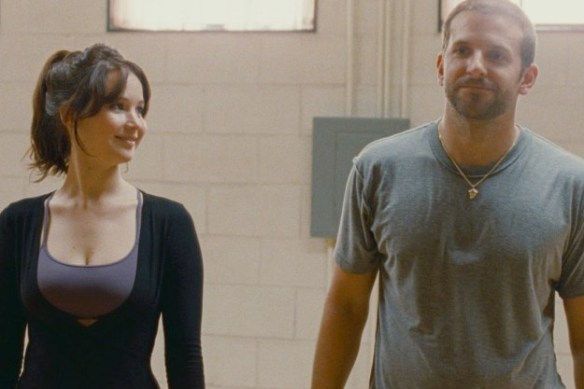
Part of the reason for this is that its two main characters, two damaged, mentally unstable people played by Bradley Cooper and Jennifer Lawrence, do that as well and director David O. Russell is just trying to keep up with them. It could also be the other way around, though.  Russell has such a lively way with camera movement and atmosphere that the constant sense of motion and organized chaos seems exhausting. For the most part the performers, especially Lawrence, are more than up to the task.  She makes Tiffany such a force of nature that the miscasting of Bradley Cooper is barely noticeable.

Like in Russell’s last movie, The Fighter, this is more of an ensemble effort than based off of a single performance.  It is about Pat Jr. (Cooper) recovering from a mental breakdown after catching his wife cheating and beating the other guy within an inch of his life, but it is also about his dad (De Niro) and mom (Jacki Weaver) coming to terms with his condition.  It forces an American family to confront mental illness, a bold thing to do in a country that increasingly resists that confrontation to its own detriment.

Continue reading

REVIEW: Jack Reacher

jack-reacher07

Jack Reacher
Directed by: Christopher McQuarrie
Written by: Christopher McQuarrie (screenplay), Lee Child (novel)
Starring: Tom Cruise, Rosamund Pike, Richard Jenkins and Werner Herzog

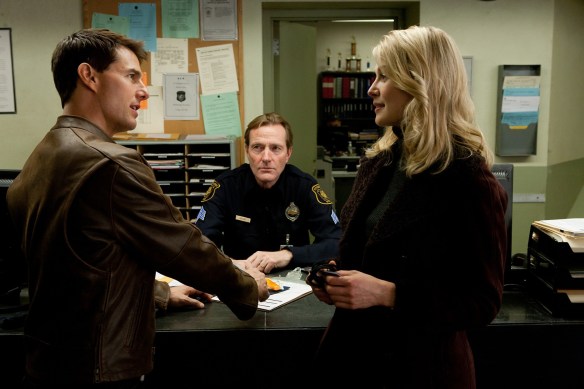
Tom Cruise, despite his kooky off-screen shenanigans, is a reliably lively screen presence.  He is a relentlessly physical actor, which is why franchises like Mission: Impossible have become his bread and butter.  With Jack Reacher he attempts, with varying degrees of success, to heighten his on-screen persona into that of a morally vague vigilante.

Reacher is a solid R-rated (or at least it should be) detective story based on a popular series by Lee Child.  Christopher McQuarrie, who adapted the script as well as directed, has some nice action set pieces to work with, but the movie is mostly built around making the star look good.  Action stars like Cruise, like the many cars his character here drives, are fast becoming vintage in the CGI era.  Here he is a blunt, no-nonsense “drifter,” a man who comes to the aid of those who need him and deals out justice how he sees fit.

Continue reading

REVIEW: The Kid With a Bike

kid with a  bike

The Kid With a Bike
Directed by: Jean-Pierre Dardenne & Luc Dardenne
Written by: Jean-Pierre Dardenne & Luc Dardenne
Starring: Thomas Doret, Cécile de France, Jérémie Renier and Egon Di Mateo

The Kid With a Bike is the first encounter I’ve had with Jean-Pierre and Luc Dardenne, the Belgian auteurs who seem to take the art house world by storm with each new movie.  This film, their latest, is an emotionally rich story of Cyril (Thomas Doret), a young foster child trying to find his way in a world with increasingly closed doors.

As there often is in movies like this, one person is shamelessly on Cyril’s side even though he is stubborn and rage-filled.  Samantha (the fantastic Cécile de France) is at the same medical clinic that Cyril storms through in an attempt to evade officials from the foster home he has escaped from.  He clings to her with such force that it takes two men to pry him off of her, though she makes no concerted effort to help them.  “You can hold me, but not that tight,” she says to him.

Continue reading