REVIEW: Hell or High Water

hell-or-high-water

Hell or High Water
Directed by: David Mackenzie
Written by: Taylor Sheridan
Starring: Jeff Bridges, Chris Pine, Ben Foster and Gil Birmingham

The West Texas of David Mackenzie’s Hell or High Water is a series of near ghost towns that seem frozen in time.  Its restaurants, stores and, most crucially, banks are all but empty, save for the employees.  The movie’s only hints at modernity are the frequent references to the 2008 financial crisis, as two brothers (Chris Pine and Ben Foster) drive from town to town robbing those nearly empty banks, they pass many a billboard telling them how to relieve debt.

Mackenzie is not subtle about the hitting home the economic turmoil that pushes Toby (Pine) to ask his wild, recently-released-from prison brother Tanner (Foster) to help him with the robberies.  Toby is trying to raise enough money to pay off the debt he owes the bank to save their family ranch and establish a trust for his sons.  The brothers don’t go for the vaults when they hit the banks, or take packets of money that are more easily traced.  They go for small bills, which means they have to pull off several robberies to earn enough money.  It also means they aren’t big time enough to draw the attention of the FBI, and are instead pursued by a pair of Texas Rangers, the soon-to-be-retired Marcus Hamilton (Jeff Bridges) and his younger but no less world-weary partner Alberto Parker (Gil Birmingham).

Continue reading

REVIEW: Suicide Squad

Suicide Squad 3

Suicide Squad
Directed by: David Ayer
Written by: David Ayer
Starring: Will Smith, Jared Leto, Margot Robbie and Viola Davis

For more than a year, Jared Leto’s antics to show how he prepared for the role of The Joker have dominated the discussion of Suicide Squad. To discuss the movie was to discuss how he sent used condoms, anal beads or a dead hog to cast mates.  The marketing hype behind his capital P Performance was nauseating and annoying, and pretty (sorry) laughable given how much screen time he has.

Leto’s take on the Clown Prince of Crime takes up 10 minutes of Suicide Squad, if that.  He appears mostly in the flashbacks for Harley Quinn (Margot Robbie), a former psychiatrist he twisted into joining his criminal dealings.  They are a pair of insane lovers, guided by raw impulse and a gleeful desire to create anarchy. Leto’s performance conveys this well enough, though it’s far from the most memorable take on this character.  His Joker has a deep, focused stare that is often overcome with a broad, silver-toothed grin.  Robbie fares much better as Quinn, a chaotic swirl of baseball bat swinging and demented giggling.  She is a menacing, dominating screen presence, something director David Ayer utilizes well throughout the movie.

Continue reading

REVIEW: Weiner

Weiner movie

Weiner
Directed by: Josh Kriegman & Elyse Steinberg
Written by: Eli B. Despres, Josh Kriegman & Elyse Steinberg

Why was Anthony Weiner destroyed? If you followed the headlines behind the former New York Congressman and mayoral candidate, you know an embarrassing photo of his bulging underwear was accidentally shared on his Twitter account, which led to more embarrassing photos and online encounters he had with random women.  But why was he so destroyed?

In Weiner, an extraordinary documentary from Josh Kriegman and Elyse Steinberg, the answer seems to be that he didn’t feel permanent shame for the sexting scandal.  It was his refusal to abandon public life, and to try to move forward in an age where a person’s every act, especially their mistakes, can be archived and dug up online. He’s a relentless, impulsive narcissist, yes, but also an confrontational idealist.  It’s what makes him both a good public speaker and a bad public figure.

Continue reading

Short takes: Neighbors 2, A Bigger Splash & Money Monster

Neighbors 2 sorority rising

Neighbors 2: Sorority Rising — Neighbors 2 is not as consistently funny as Nicholas Stoller’s surprisingly hilarious original, though it does take admirable strides to be more inclusive and address some of the issues that held the first one back.  Sorority Rising goes out of its way early on to confront some of the homophobia that plagued the first movie, with one of the frat bros (Dave Franco) getting engaged and booting his former leader Teddy (Zac Efron) out of their apartment.  Teddy is having a hard time adjusting to life outside of college, especially with the extensive criminal record his feud with former neighbors Mac and Kelly (Seth Rogen and Rose Byrne).  He fills the void (and a half-hearted desire for revenge) by helping a group of freshman women (led by Chloe Grace Moretz) start up a sorority in the same house.  That backfires when the sisters get weirded out by Teddy and kick him out of, and Sorority Rising really kicks into gear when he decides to team up with Mac and Kelly.

The women’s desire to start their own sorority is spurned by the gross sexism of the established Greek system, which only allows frats to throw parties.  Those parties largely revolve around debasing women, which makes the sisters’ struggle for independence much more sympathetic than the frat brother’s struggles in the first movie.  Their generational feud with Mac and Kelly is more poignant, if not as funny, than the first.  Sorority Rising is lacking in the manic energy and vibrant set pieces that helped the original overshadow its shoddy story.  There is one notable exception: a hilarious weed heist that Mac, Teddy, Kelly and a couple of their friends stage at football tailgate.  Teddy gyrates around on a stage to distract the sorority sisters while the others grab the drugs, and the resulting chase when they catch them mid-theft gives the movie a much needed spark.  Though there aren’t enough scenes like that, much of what worked in Neighbors still works well enough here, namely Rogen and Byrne’s comedic and romantic chemistry and Efron’s raw, warm physicality.  Grade: C+

Continue reading

Short takes: Captain America: Civil War, Green Room & more

Captain America Civil War

Captain America: Civil War — The third Captain America film is a stagnant if serviceable summer blockbuster buoyed by the introduction of two promising characters.  The first is Black Panther (Chadwick Boseman), a sleek, nimble force of nature who slashes his way into the film hoping to avenge a fallen loved one.   The other is Spider-Man (Tom Holland), making yet another debut after Sony and Marvel reached a deal that allows him to finally appear in the Avengers storyline.   Holland injects the web-slinging teen with a contagious earnestness, and Marisa Tomei’s brief appearance as Aunt May makes the upcoming standalone film even more promising.

Sadly, Civil War offers glimpses at more interesting movies and never really becomes one.  Focused on a feud between the title character (Chris Evans) and Iron Man (Robert Downey Jr.), the movie starts off as an exploration and critique of the massive casualty counts caused by the heroes’ world saving in the Avengers movies.  The United Nations wants to reign them in and regulate them; Iron Man agrees, Captain America does not.  Other familiar faces from the Marvel Cinematic Universe pop up to choose their respective sides, including Black Widow (Scarlett Johansson), Ant-Man (Paul Rudd) and Hawkeye (Jeremy Renner).

Continue reading

REVIEW: The Invitation

The Invitation

The Invitation
Directed by: Karyn Kusama
Written by: Phil Hay & Matt Manfredi
Starring: Logan Marshall-Green, Emayatzy Corinealdi, Michiel Huisman and Tammy Blanchard

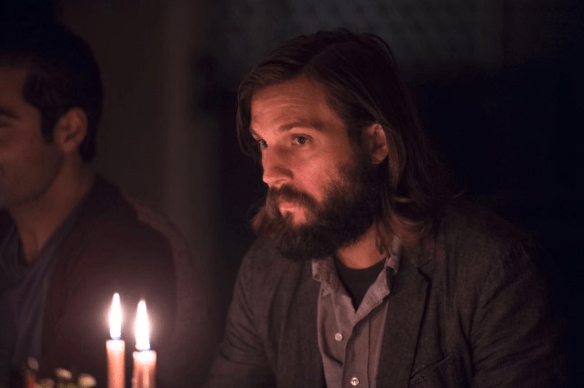
Will wants to believe something is wrong.  From the moment he arrives at his ex-wife’s sleek home overlooking Los Angeles, everything seems a bit out of place.  It’s not just what Eden (Tammy Blanchard) and her new husband David (Michiel Huisman) are hiding, it’s what they’re telling everyone.  This is the first time Will (Logan Marshall-Green) has visited the home in two years, since tragedy did irreparable damage to he and Edie’s relationship.  He is still shaken up by it, but she seems much more composed.

Eden’s newfound serenity is eerie and disingenuous.  In The Invitation’s well-placed flashback sequences, triggered by Will’s memories of particular rooms in the home, she’s frantic and violent in the aftermath of the tragic event.   Now she slinks through the same home like Lana Del Rey with a less well guarded secret. What are she and David hiding, exactly? They reveal quite a bit, like how they went to Mexico and learned to purge themselves of guilt and sadness with a mysterious organization.   Everyone at the dinner party, which includes Will’s new girlfriend Kira (Emaytzy Corinealdi), five of he and Eden’s mutual friends and two that she and David know for this cult-like healing group, is shown a kind of recruitment video for the group.  In it, a calmly assured man hovers over a dying woman, explaining how the others in the room are absorbing her spirit as she passes away.

Continue reading

My 2016 Oscar predictions

Spotlight

Best Picture: The Big Short, Bridge of Spies, Brooklyn, Mad Max: Fury Road, The Martian, The Revenant, Room, Spotlight

  • Will Win: Spotlight. I think (and hope) a lot of the hype behind The Revenant is empty in this category.
  • Should Win: Mad Max: Fury Road is my top pick in this category, though Brooklyn, Bridge of Spies and Spotlight are all worthy contenders.
  • Left out: I was tempted to put “Not Carol” eight times for the list of nominees.  I’d have also included either Magic Mike XXL, Diary of a Teenage Girl, Results or Unfriended in this category instead of Room, The Martian, The Revenant and The Big Short.  (The Big Short is solid, for the record. I just think the others I mentioned are better). 

Continue reading

REVIEW: The Witch

The Witch 3

The Witch
Directed by: Robert Eggers
Written by: Robert Eggers
Starring: Anya Taylor-Joy, Ralph Ineson, Kate Dickie and Harvey Scrimshaw

The most terrifying thing about The Witch is the unrelenting sense of hopelessness that pervades nearly every moment.  A self-proclaimed “New England folktale” set on a small farm in 1630, Robert Eggers’ immersive debut feature seems to curse its young protagonist and the rest of her Puritan family from the beginning.

Thomasin (Anya Taylor-Joy) is the eldest of her parents’ five children, a teenager who is old enough to look after her siblings but too young to earn their respect.  Her father William (Ralph Ineson) moves the family out of a settlement over a religious disagreement with the other townspeople.  The family sets up a small, isolated farm on the edge of a forest, and their arrival is marked almost immediately by devastation. While Thomasin watches over her newborn brother, the baby mysteriously vanishes when she covers her eyes during a game of peekaboo.  A close-up showing her smile turn to horrified confusion after she removes her hands from her face and sees an empty blanket is one of the movie’s many indelible images.

Continue reading

Short takes: Hail, Caesar!, 45 Years and Anomalisa

Hail Caesar 2

Hail, Caesar! — Joel and Ethan Coen’s Hail, Caesar! is a detective story set amid the extravagant musicals and melodramas of a ’50s Hollywood studio.  The “detective,” Eddie Mannix (Josh Brolin), is actually a fixer for Capitol Studios.  He’s out to find Baird Whitlock (George Clooney), the star of the studio’s latest epic (also titled Hail, Caesar!).  Whitlock is drugged and abducted from Capitol before his crucial closing monologue scene.  His location is just one of the many things on Mannix’s plate; he’s also balancing intrusive twin gossip columnists (both played by Tilda Swinton), an actor who can’t really act (a scene stealing Alden Ehrenreich) and an actress (Scarlett Johansson) who the studio wants to make marry for a third time so she doesn’t have a child out of wedlock and ruin her image.

The Coens stage Mannix’s search for Whitlock not as something urgent but as something that will likely sort itself out.  (Minor spoilers ahead) Whitlock’s abduction is an inside job staged by writers looking to stage a revolt in the studio to make more money.  In a lavish mansion overlooking the ocean, they explain to him how they’re using him to seize the means of production from the studio heads.  Whitlock later explains to Mannix that they taught him about Kapital (“with a K” he makes sure to add).

Hail, Caesar!’s script is as sharp as anything the Coens have done, but it also basks in the glories of old Hollywood productions.  Long stretches of the movie abandon the central plot altogether to revel in some fantastic set-pieces; these include a show-stopping tap-dance sequence in a sailor musical (led by the effortlessly charming Channing Tatum) and a synchronized swimming number for a mermaid film that is shot almost entirely from above.  In this way it reminded me of Paul Thomas Anderson’s recent film Inherent Vice, another recent detective story that conjures up a mood of mystery rather than focusing on the process of solving one.  Hail, Caesar! ends on a similar note as the Coens’ previous film Inside Llewyn Davis, leading right back to its beginning and suggesting that the protagonist is doomed to repeat the entire thing over again the next day.   Grade: B+

Continue reading

REVIEW: The Revenant

The Revenant 4

The Revenant
Directed by: Alejandro González Iñárritu
Written by: Mark L. Smith & Alejandro González Iñárritu (screenplay), Michael Punke (novel)
Starring: Leonardo DiCaprio, Tom Hardy, Domhnall Gleeson and Will Poulter

Leonardo DiCaprio endures such an excruciating array of torments in Alejandro González Iñárritu’s The Revenant that by the time he guts a dead horse, strips naked and climbs inside it to keep warm for the night, I couldn’t help but laugh in pity.  The movie, set in an unspecified area of the American frontier in the 1820s, is a series of grueling endurance tests for his character Hugh Glass, and its payoff is a brawl that paints the snow red and fills it with chunks of skin and bone.

The Revenant is a predictable, hyper-masculine revenge story told with a brutal beauty. Glass is helping navigate a group of fellow frontiersman after their hunting expedition, though the movie wastes no time before pummeling the group with violence.  As they rest in the woods, a Native American tribe surrounds them and attacks;  arrows pierce throats, bullets rip through bodies. Much of the scene unfolds in a single take. The camera follows a person, usually until they die, and then picks another.  Unlike Birdman, Iñárritu’s underwhelming showbiz satire that was filmed as if it were all a single shot, The Revenant’s visual design enhances the movie’s other elements instead of overwhelming them.

Continue reading