REVIEW: Don Jon

Joseph-Gordon-Levitt-Is-Don-Jon-604-1

Don Jon
Directed by: Joseph Gordon-Levitt
Written by: Joseph Gordon-Levitt
Starring: Joseph Gordon-Levitt, Scarlett Johansson, Julianne Moore and Tony Danza

For the first half of Don Jon I was prepared to write it off as a gross, occasionally charming debut feature, but the destabilizing element introduced in the second half (Julianne Moore) throws the movie completely off the beaten path in the best possible way.  Before Moore’s character Esther enters the picture it came dangerously close to reveling in the kind of misogyny that it attempts to send up.

At first, there is just Jon (Joseph Gordon-Levitt) and, as he says, his body, his pad, his ride, his family, his church, his boys, his girls and his porn.  The flashy montages of gyrating asses and blowjob lips quickly show which of those takes precedence in his life.  And, like the main character of (500) Days of Summer’s misreading of The Graduate, he is woefully misguided about the reality of the situation (he thinks it’s real).

Continue reading

Our Favorite Movies of the 2000s

It has been a few years since the end of the 2000s, which gives a crucial amount of distance when examining that decade in movies.  It has also given us time to watch quite a few more that we either hadn’t seen (Dogville) or hadn’t had enough time to see again (A Serious Man).  When looking back I (Matt) realized that my new choices were almost completely different or rearranged in order, not to mention my rapidly changing taste and appreciation of movies.  Here is a new list, compiled by me and our new writer, Sam Tunningley.

mulholland-drive

1. Mulholland Dr. (2001)- Mulholland Dr.’s appeal is made of the very things that tend to overwhelm and frustrate most who try to approach it. It can seem opaque in many moments, maybe even incomprehensible to some by the end, and it is one of the most brazenly personal and bizarre films to be marketed through a major studio. Lynch almost always uses dream logic as a guiding force through his work, and the narrative here is no different, simultaneously having one foot in lucidity and one foot in abstractedness. It is a puzzle film where the solution is not sought through explanatory means—rather, it is the fine details, such as the rich hues of its interiors or the Jitterbug sequence that opens it, that are key to unraveling its mystery. This is not so much meant to frustrate or provoke than it is to demonstrate film’s capacity for recreating dreams. It gives us broken desires in Hollywood and terrifying visions behind a diner through a stream of imagery that can turn from seductive to otherworldly to outright horrifying. The performances (Watts, in particular) lunge from intentionally artificial to bracingly real, masterfully taking on the wide and exhausting emotional terrain of the director’s vision. It is a perfect rendering of the dreamy universe that Lynch has been working toward his entire career, a perfect realization of the material by all involved, a flurry of abstract imagery and complex emotions—a perfect movie.

Continue reading

REVIEW: Stories We Tell

k-bigpic

Stories We Tell  
Directed by: Sarah Polley
Written by: Sarah Polley

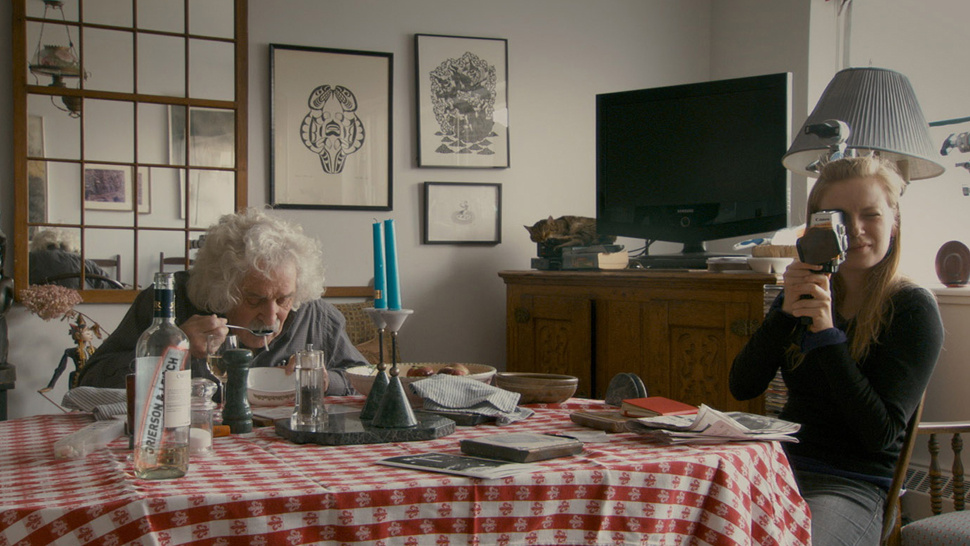
Hopefully you go into Sarah Polley’s Stories We Tell knowing nothing about what happens. In the interest of preserving that for you, do not read past this sentence unless you’ve seen this beguiling meta-documentary.

Stories We Tell is filmmaking of a very personal nature while also being a relentless interrogation of the documentary form.  Polley interviews her friends and family about her deceased mother, filming her process as part of the process.  Along the way she acknowledges the impossibility of objectivity while attempting to achieve it, and throws in some aesthetic twists too.

Continue reading

REVIEW: The Act of Killing

the_act_of_killing_691330a

The Act of Killing
Directed by: Joshua Oppenheimer (director), Christine Cynn & Anonymous (co-directors)

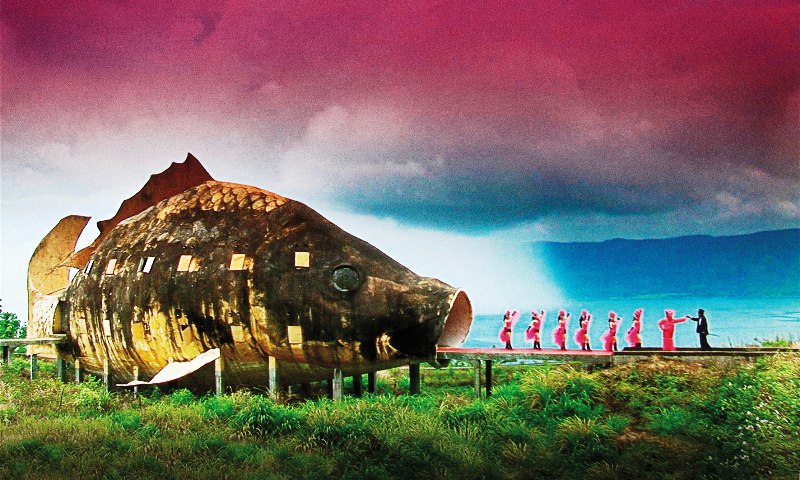
More than 20 of the names on the end credits of The Act of Killing read “Anonymous,” including one of the co-directors.  That the former death squad members at the movie’s center openly admit to and brag about torture, murder and rape makes that anonymity darkly tongue-and-cheek.

The U.S.-backed killing of millions of Indonesians during a military overthrow of their democratic government was never investigated, and many of the death squad members are still viewed as heroes after almost 40 years.  The atrocities they committed in the mid-’60s are not only openly discussed in this documentary, but reenacted.  Director Joshua Oppenheimer spent roughly eight years interviewing and filming this process after provoking them to do it.

Continue reading

REVIEW: Blue Jasmine

Comedy-or-Drama

Blue Jasmine
Directed by: Woody Allen
Written by: Woody Allen
Starring: Cate Blanchett, Sally Hawkins, Bobby Cannavale and Alec Baldwin

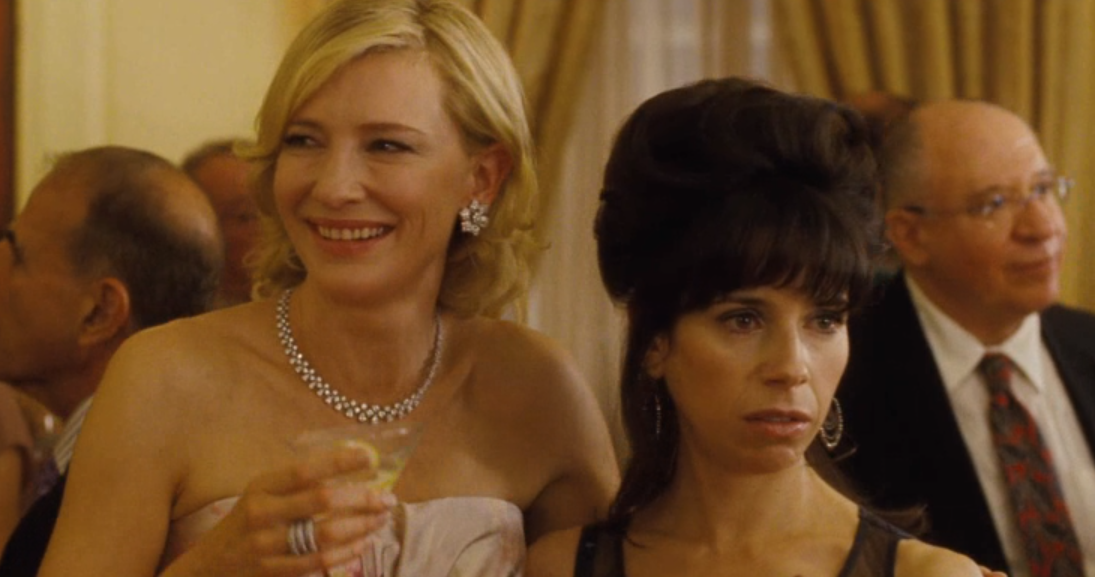
Two sisters; one a blonde suffering from crippling depression and the other a brunette with a fatigued understanding of how to help her.  That’s the premise of Woody Allen’s latest, a bruising and mostly unsparing look at a woman who hides serious problems behind bourgeois privilege.

From that description alone, it should be fairly easy to tell just how heavily Blue Jasmine draws from 2011’s Melancholia, which is for me one of the defining films of this decade so far.  It’s clear in both films that the protagonists are surrogates of their respective directors, but Allen doesn’t have the film’s world mirror his protagonist or create a distinct editing rhythm that conveys her depression.  His movie rests on the more than capable shoulders of Cate Blanchett and Sally Hawkins, who deliver two distinct but masterful performances here.

Continue reading

REVIEW: The Butler

Picture 10

The Butler
Directed by: Lee Daniels
Written by: Danny Strong
Starring: Forest Whitaker, Oprah Winfrey, David Oyelowo and Yaya Alafia

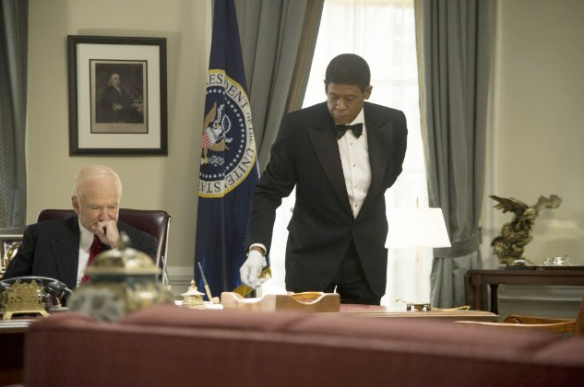
There seems to be a much bigger movie lurking behind this version of The Butler (I refuse to type out Lee Daniels’ The Butler every time so deal with it).  With so many celebrity cameos as presidents and first ladies, it must have been a hell of a thing to cut into something that Harvey Weinstein would release.  Robin Williams gets maybe five minutes of screen time as Dwight D. Eisenhower, and Jane Fonda has only one major scene for her much-hyped turn as Nancy Reagan.

And yet, for all the wishing and hoping that there was more, what’s here is powerful enough on its own.  The Butler is the story of the mid-twentieth century that the movies (and Mad Men) never really have the balls to tackle.  It is that of the ideological and generational feud between black domestic workers and their Freedom Riding children.  Lee Daniels and screenwriter Danny Strong have created a sporadic epic that, despite its flaws, packs quite the punch.

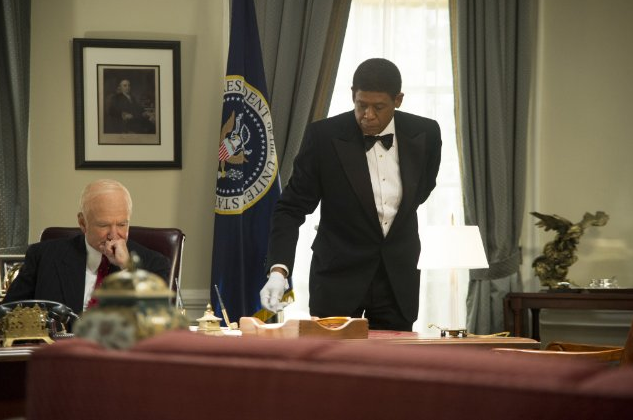
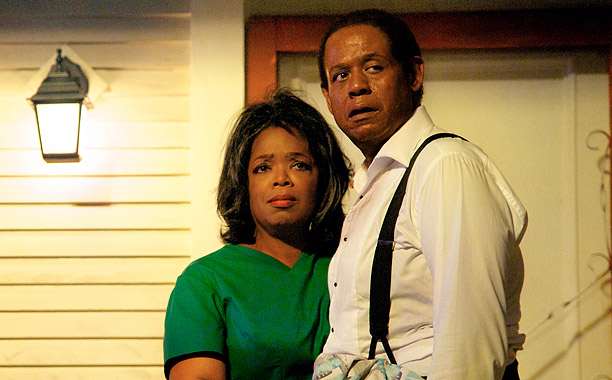
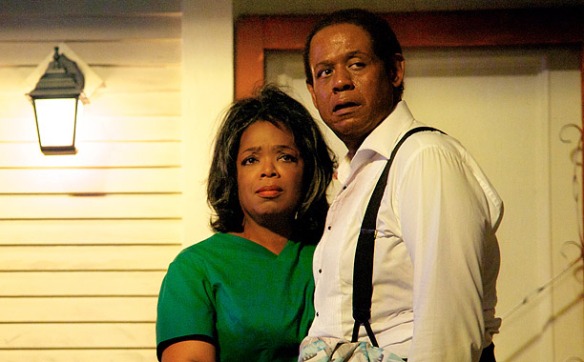
Their movie is not just the story of any black family, though. Cecil Gaines (Forest Whitaker) is a servant of presidents and, as his wife (Oprah Winfrey) likes to brag, sworn to secrecy about what he hears.   His life is based on Eugene Allen, a butler during eight administrations in the White House.  Cecil provides a middle-class living for his family, which also includes sons Louis (David Oyelowo) and Charlie (played as a child by Isaac White and as an adult by Elijah Kelley).

Louis grows up to be heavily involved in the civil rights movement when he goes to college in Tennessee.  The lunch counter sit-in he takes part in with other activists is the movie’s most grueling, effective sequence.  Daniels places the camera at the center of the impossibly brave young men and women as they are shoved, degraded and eventually arrested.  He brings the movement to vivid life through Louis’ character, and Oyelowo is terrific in the role.  Louis’ fraught relationship with Cecil provides the movie with its theme, and Daniels certainly doesn’t waste any of the movie’s 132 minutes.

In fact, I would almost have preferred The Butler as a miniseries or, at the least, as a three- or four-hour movie.  While everything here makes perfect sense, it’s amazing how much emotion Daniels is able to draw out of the movie when it zips through most of its history like a fifth grader trying to rush his homework.  The famous names that dot the marquee (except Whitaker and Whinfrey) seem like marketing pawns, though Alan Rickman is enjoyably out of place as Ronald Reagan.
THE BUTLER

The Butler is most rushed in the beginning, when Cecil is a young boy working on a plantation where, in the span of two minutes, he hears his mother being raped and sees his father murdered by the same man.  The punch of this sequence comes when it becomes clear he can just leave, he’s not a slave.  Daniels orchestrates this scene with no sense of place, it could have happened a hundred years ago or fifty.  This suggests that institutional racism is its own form of slavery, something that the rest of the movie echoes.

From that plantation, Cecil makes his way into servitude, which is the occupation he builds his working life around.  As he says several times in the movie, he has one face for his family and friends, and another while serving white people.  Though the racial policies of each president changes, Cecil still serves them the same.  There is no triumphant comeuppance to Richard Nixon when says he wants to “gut” black power groups.

Whitaker is very good at channeling the conflicting pulls inside Cecil.  As angry as he gets when Louis shames him for his job, he always seems to absorb it as if it’s true.  Winfrey, who is certainly the biggest celebrity draw to the movie, is also quite good as his wife.  This story shows us that they’ve built a life together, one that exists outside the movement even though it intersects with it unavoidably.  While Louis becomes deeply rooted in the civil rights movement, their other son fights in Vietnam.  All the while, Cecil must “appear invisible” to the commander-in-chief who oversees it all.

Because of its attempt at a total illustration of African American experience in this era and not just the struggles, The Butler becomes a blatant confrontation against every white-washed movie about racism, most importantly 2011’s The Help. As self-serious as the movie may sound, it is often fairly light on its feet (Liev Schreiber’s Lyndon B. Johnson rants while taking a shit).  This is, after all, the same director who brought us the wonderfully trashy detective story The Paperboy last year.  In both movies Daniels brings a playful, cinematic sense of the sixties while also honestly illustrating the not-so-invisible racial dividers embedded in this country’s DNA.  That this movie actually has a chance of reaching a mainstream audience, though, makes it all the more thrilling.

Grade: B-
REVIEW: The Canyons

canyons1

The Canyons
Directed by: Paul Schrader
Written by: Bret Easton Ellis (screenplay)
Starring: Lindsay Lohan, James Deen, Nolan Gerard Funk and Amanda Brooks

“When’s the last time you saw a movie in a theater?” Lindsay Lohan’s character Tara asks her friend while at lunch.  “When’s the last time you saw a movie you really thought meant something to you?”

Those lines are the best way to start sorting through The Canyons, a lurid, somewhat successful collaboration between director Paul Schrader, writer Bret Easton Ellis and Lohan that would be somewhat meaningful in a theater but is also available On Demand. Even when it veers into groan-inducing territory on the screenplay front, the seductively dark rhythm of Schrader’s Hollywood sustains it.

So too does Lohan’s performance, an irresistible blend of wheezy, drug-addled femme fatale and the more realistic effects of narcotic use (a la her insanely publicized personal life).   It’s impossible to separate life from her acting career, which is why it’s so easy to see why she would be so drawn to a movie like this, where smartphones are weaponized and someone is always watching.

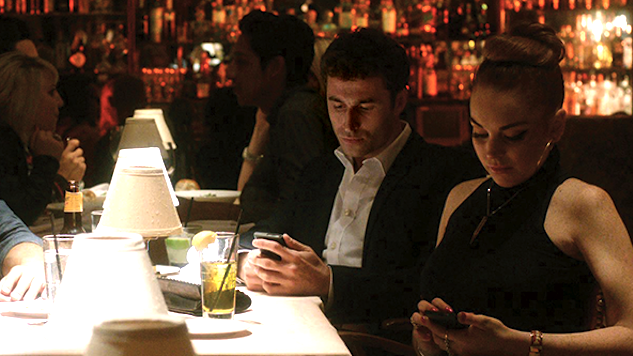
It’s clear from the beginning Tara is in the midst of a very unhealthy relationship with Christian (porn star James Deen) and his phone, which he uses to acquire a third and sometimes fourth person for their sexual escapades.  Christian is Patrick Batemen with a touch more douche bag than psycho.  His character is almost relentlessly one-dimensional, and Deen’s performance follows suit.  He is a vindictive, controlling trust-fund baby who dabbles in low-budget slasher film production.

As a favor to Tara and his assistant Gina, he gives a big role in his latest film to Ryan (Nolan Gerard Funk).  Ryan and Tara are in love, which combined with Christian’s crazy gives The Canyons half-hearted dramatic purpose.  All of the characters are toxic, though, and it’s impossible and often frustrating to be on anyone’s side.  They are so toxic, in fact, that this Hollywood comes with a radioactive glow.  Even the trees and bushes glow in broad daylight, and almost every transition from outside to inside seems like a descent into a neon underworld.

the_canyons_1

It’s unclear whether the world mirrors their poisonous personalities, or if they are a by-product of it.  Each sex scene feels unclean, and when Christian finally descends into violence, he ultimately becomes, intentionally, the cheap schlock that he produces.  Deen fills him with the same unsympathetic arrogance that Christian Bale did for Batemen in the film version of American Psycho, though without the gleeful, uninhibited insanity.

Ellis’ screenplay often makes a mockery out of conversation and etiquette.  The story is book-ended by two very awkward double dates, which are the weakest in the movie by far because Schrader doesn’t seem to know exactly what to do with the dialogue.  In the first he cuts between all four of the principle characters, but the pacing and the timing of the looks is sloppy even if the conversation is somewhat intense.  The second, though, is just sloppily-written exposition that tidies up the movie way too quickly.

It’s that kind of hit-and-miss that makes this such an interesting collaboration, though.  Some of the best scenes show Ellis’ characters deliberately confronting the accusations of sexism that his previous work, notably American Psycho, has garnered.  One of these is the movie’s climax, a techno-colored foursome where Tara turns Christian’s misogynistic voyeurism against him.

This scene somewhat dismantles a few others that would have made The Canyons fairly homophobic.  Christian, for all his macho ridicule against Ryan “going gay” to get ahead or to keep a job, is all too eager to go down on another guy in the heat of the moment.

This is what cinema has become, Schrader seems to be saying with these deranged, narcissistic fools and their phones.  Shots of abandoned multiplexes begin and end the movie and also serve as backdrops for the beginning of each day in the story.  That makes The Canyons by far the most ironic movie to utilize the “Watch It While It’s In Theaters” online rental  trend.  Everything about it oozes with a pessimism for mainstream movie making; even the title suggests that calling it the Hollywood Hills is unearned optimism.

Grade: C+

REVIEW: Fruitvale Station

Picture 11Fruitvale Station
Directed by: Ryan Coogler
Written by: Ryan Coogler (screenplay)
Starring: Michael B. Jordan, Melonie Diaz, Octavia Spencer and Ariana Neal

Even if Fruitvale Station doesn’t end up being the best movie of the year, it is by far one of the most important and powerful.  First-time feature writer/director Ryan Coogler takes an incident in Oakland where a young black man was needlessly shot by a police officer on New Year’s Day 2009, and chronicles his last day leading up to that killing.

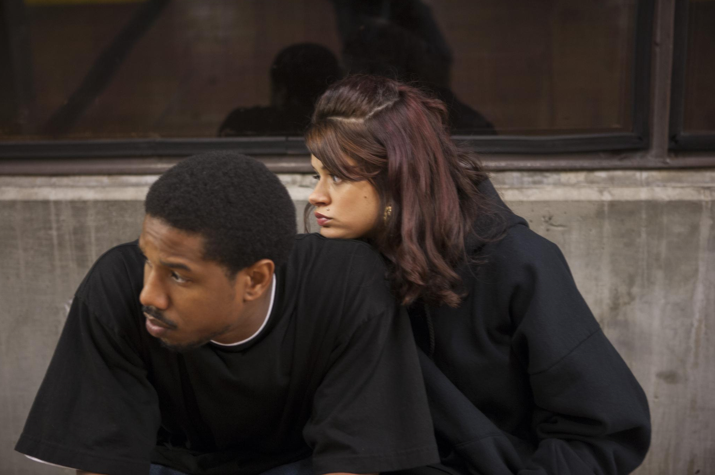
Along the way he has created a movie that quietly does what few mainstream releases do: honestly depict black life in America without a white tour guide.  His camera follows Oscar Grant (Michael B. Jordan), often literally, as he buys crab for his mother’s birthday, fights with his girlfriend and picks up his daughter from daycare.

The first half is sometimes needlessly artsy, with contemplative shots of Oscar sitting by the seashore or mourning the death of a pit bull that he sees get hit by a car.  These events in Oscar’s life were made up for the movie, much like many of the bank scenes in Sidney Lumet’s Dog Day Afternoon. Coogler’s artistic license by no means detracts from the movie’s power, but the scenes where Oscar is with his family are much more beautiful then those needless existential detours.

A shadow is cast over all of those happy moments, though, because the grainy footage of police shooting Oscar is shown before the fiction begins.  Fruitvale Station is a movie spawned from YouTube, just the like the protests and riots that followed Oscar’s on-camera shooting.  The lived-in aesthetic reminded me of great working class British filmmakers like Mike Leigh or Andrea Arnold, though Coogler adds more stylistic elements (slow motion, flashback) than those directors often do.

Drawing comparisons to those great directors after only one feature is a high compliment, though, and one that Coogler and his exceptional ensemble cast earn.  Dramatizing every day life is a difficult task, but Coogler’s script gives weight to every interaction without overbearing.  There are moments where the foreshadowing is too heavy (“You should take the train,” Oscar’s mother tells him), but when the incident finally arrives the pacing and abruptness and immediacy of the camera movements is emotionally overwhelming.

Fruitvale has an added impact because of the recent acquittal of Florida neighborhood watchman George Zimmerman, who followed unarmed 17-year-old Trayvon Martin and shot him following an alleged confrontation.  I have not had the experience of being suspicious simply because of my race, but incidents like that and the one depicted here outrage me.  I grew up in a small town in Michigan where to this day you can still see Confederate flags flying if you drive around long enough.

-1

Whenever I hear people talk about incidents like this and say that race has nothing to do with it I think about those flags and the way I saw the one or two black students in my high school ostracized.  It is exactly that kind of suspicion that leads to deaths like this.  Black men are seen as inerently dangerous, though it’s the cop or the neighborhood watchman who often has the gun.

Oscar, crucially, is not portrayed as a saintly figure or a martyr.  His death resonates as even more senseless because his life seems so normal.  Had Coogler kept the movie even more embedded in his relationships with people the movie would have been very near perfect.  He avoids melodramatic close-ups or showy camera techniques in the shooting’s aftermath, though Octavia Spencer is still heartbreaking as Oscar’s mother.

When the movie abruptly cuts to black after his daughter asks where he is, the traditional “true story” text updates kick in along with real footage of her and other protestors outside Fruitvale Station.  The cop who shot him was sentenced to two years for involuntary manslaughter and got out in 11 months.  He said he mistook his gun for his taser, though why you’d need to tase a man who’s handcuffed and has another officer pushing down on his head and taunting him is beyond me.

Grade: B+

REVIEW: The Conjuring

the_conjuring_01_640x360

The Conjuring
Directed by: James Wan
Written by: Chad Hayes & Carey Hayes (screenplay)
Starring: Vera Farmiga, Patrick Wilson, Lili Taylor and Ron Livingston

The Conjuring is a legitimately frightening movie without taking the gory (i.e. easy) way out.  It is at once an ode to ’70s horror like The Exorcist or Suspiria and a clever subversion of the modern “found footage” sub-genre.  The movie is so well-edited and pieced together that other people in the theater I was in shrieked and squirmed in an almost equally convincing manner as the characters.

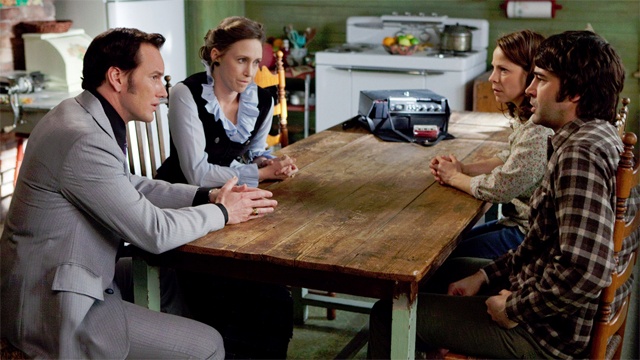
There are two main families at play here, though the Perrons do a bulk of the screaming.  They are a beacon of working class stability, and director James Wan makes it quite clear from the beginning how temporary that is for them as they take up residence in a secluded old house.  He stalks the parents and their five daughters through the moving-in process, giving us a sense of their familial rituals while also hinting at how the script (by Chad and Carey Hayes) will later use that against them.  ,

Continue reading

ARCHIVE REVIEW: This Is Not a Film

this_is_not_a_film_1322235989_crop_550x375

This Is Not a Film
Directed by: Jafar Panahi & Mojtaba Mirtahmasb
Starring: Jafar Panahi

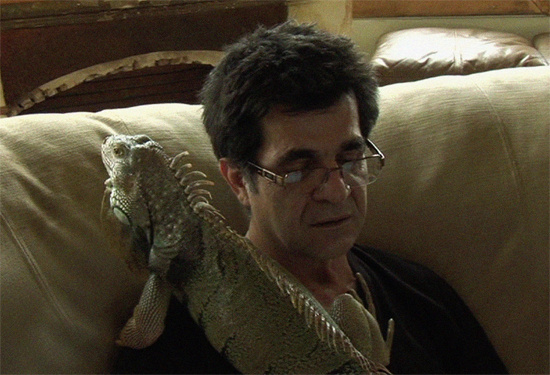
Jafar Panahi is an Iranian filmmaker who was put under house arrest in 2010 and barred from making films for the next 20 years because the government deemed his work “propaganda.”  In this extraordinary exercise in silent protest, he documents a day in his life under house arrest while simultaneously illustrating the suffocating effect that a theocratic government has on art.

That’s quite a feat for a 75 minute movie that features just three people and a pet lizard on screen.  There is never any effort to sustain a narrative or in any way create to create illusion through technique.  Panahi’s friend and co-director Mojtaba Mirtahmasb is not a director, and largely just stands and zooms from one spot unless instructed by Panahi to move somewhere else.  It is in that forced lack of a narrative that the movie’s intentions begin to mirror the situation Panahi has been forced into, though.  He stages a couple scenes from an unmade screenplay, only to stop in the middle of it, frustrated that explaining a film takes away from the very essence of the art.

Continue reading