Short Takes: Amazing Spider-Man 2, Grand Budapest Hotel & more

906429 - The Amazing Spider-Man 2

The Amazing Spider-Man 2- Peter Parker is much more interesting than Spider-Man in this sequel to a reboot.  In fact, Parker (Andrew Garfield) and his on-again, off-again soul mate Gwen Stacy (Emma Stone) seem to be acting out a completely different movie, a romance with genuine warmth and feeling.  The rest of the movie is a straightforward superhero mash-up, with generically assembled fight sequences and standard villain templates (maniacal corporate brat, vengeful outcast, Russian gangster).  It’s fairly easy to see where director Marc Webb’s heart was while making this mega-budget spectacle, but there are too many movies here trying to cram into one. Grade: C

Continue reading

REVIEW: The Other Woman

the-other-woman-2

The Other Woman
Directed by: Nick Cassavetes
Written by: Melissa Stack
Starring: Cameron Diaz, Leslie Mann, Kate Upton and Nikolaj Coster-Waldau

The Other Woman’s flaws are large and predictable, but though the movie is slight it is also slightly enjoyable.  It feels like an adult version of the forgettable 2006 teen comedy John Tucker Must Die, where high schoolers who are dating the same dude plot to destroy his life.

Here, two mistresses (Cameron Diaz and Kate Upton) and a wife (Leslie Mann) bond over a plan to take down the charming monster who is deceiving them all (Nikolaj Coster-Waldau).   This is a faux girl power narrative that fails to realize everything its female characters do is a reaction to a male catalyst.  Their lives are virtually non-existent outside of their relationship to Jaime Lannister.

Although Melissa Stack’s script has a few zingers that stick (“Cry on the inside like a winner” comes to mind), director Nick Cassavetes keeps the pacing awkwardly slow.  The first half of the movie is filled with unnecessary scenes that fail to achieve the laughs they’re going for.  This is mostly because Cassavetes, while sometimes adept at creating atmosphere, doesn’t have very good comic timing.

The New Yorker’s Richard Brody also noted this in his review:

In “The Other Woman,” Leslie Mann has an extraordinary showcase and she uses it flamboyantly, with an amazingly inventive range of inflections and line readings. She’s a major comic actor, but Nick Cassavetes does her no favors; his vague framings and ping-pong editing leach the immediacy from her performance.

The contagious energy and charisma of Mann and many of the other performers make the movie bearable, even if their characters mostly come off as a smorgasbord of rom-com caricatures.  It’s an empty confection of wealthy, privileged people attacking each other; its locales, generically sleek renderings of the Bahamas, the Hamptons and New York City, are more the point than a good laugh or a genuine human connection.

Grade: D+

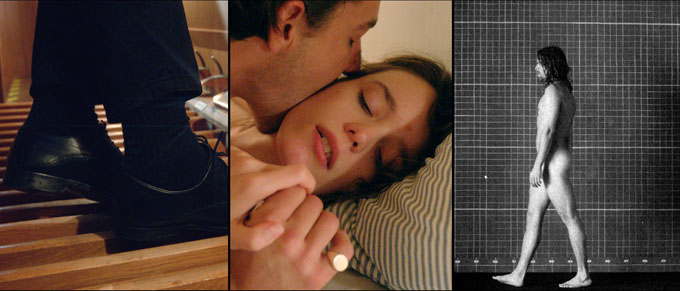
REVIEW: Under the Skin

scarjo2

Under the Skin
Directed by: Jonathan Glazer
Written by: Walter Campbell (screenplay),  Michel Faber (novel)
Starring: Scarlett Johansson 

In Under the Skin, Scarlett Johansson plays a wolf that doesn’t quite know how to wear sheep’s clothing.  She is an alien prowling Glasgow and the surrounding Scottish countryside in a white van, seducing and luring unsuspecting men to their death.

Jonathan Glazer’s third feature, based on Michel Faber’s novel, is a gender inverse on a fairly common horror/thriller premise.  The story is told in long, bleak stretches, the camera accentuating the way the creature attempts to move and act human.  Johansson’s performance is crucial to this strategy.  She nails the way the alien flips an “on” switch to turn a dead-eyed stare into a warm, welcoming woman when she spots prey.  Glazer hints at an eroticism with his camera movement that the actress deliberately pushes away.

The most sexually tinged scenes are the bloodless killings.  ScarJo’s victims, blinded by lust, pursue her into what transforms into a totally black stage.  They each leave a string of clothes as they lurch across it, but the men sink into the floor and become trapped.  The rest of Scotland isn’t much more colorful save for a reliably flashy night club.

Despite the color palette, this is Glazer’s most visually accomplished and altogether thrilling film to date.  When I watched it I had no idea that many of the interactions that the alien has with men were filmed using civilians and a hidden camera.  There is a cool, confident stillness to the images that rejects that often on-the-fly filmmaking aesthetic.  The performances, on the other hand, seem unforced and genuinely spontaneous.

Glazer and screenwriter Walter Campbell capture the alien predator’s bizarre point of view by making it clear that she is trying to fit in but can’t.  The result is an odd uncanny valley effect that Johansson’s star power only enhances.  This is evidenced in fairly standard alien movie scenes, like when she tries to eat human food and vomits it up, but also in her everyday movement and posture.  Under the Skin would be nothing without her blank yet inquisitive stares.

under-the-skin-scarlett-johaasdnsson

The alien eventually begins to unravel during this vague man-harvesting mission.  In one of the most haunting and moving scenes I’ve seen in recent months, she stops to talk to a very deformed, quiet man on a rainy night.  She treats him as she does any of the other victims, but the script lingers on their interaction more.  She asks him if he gets lonely, then grabs his hand and caresses her face and neck with it.  The man’s darting eyes and nervous, muttered reactions are heartbreaking.

After this interaction, she lets the man leave her den, naked and wondering where he is.  He’s eventually collected and (presumably) killed by one of the undeveloped, motorcycle-riding henchmen who (presumably) clean up after her.  After that she wanders and begins trying more and more human things, including eating, riding the bus and sex.  The movie rejects any notion of redemption or change, though. It bounces humanity and their emotions off its central character instead of forcing her to become one of us.

Grade: B

REVIEW: The Unknown Known

unknown known

The Unknown Known
Directed by: Errol Morris
Starring: Donald Rumsfeld and Errol Morris

The latest Errol Morris documentary, about the political life and times of Donald Rumsfeld, is an intentionally infuriating and vague work.  With the former Secretary of Defense’s onslaught of non-answers, excuses, digressions and nervous smirks, Morris depicts a genuine heart of dishonesty and blithe unawareness.

The Unknown Known is not about a documentarian skewering one of the most notorious figures of the George W. Bush years, which is why I think many will be perplexed at how free Rumsfeld is to run away with many of the questions.  The structure of the documentary almost seems to play with that audience expectation, beginning with the 2003 invasion of Iraq and then switching to Rumsfeld’s political career before returning to that post-9/11 time period.

Continue reading

REVIEW: Captain America: The Winter Soldier

Captain America Winter Soldier 2

Captain America: The Winter Soldier
Directed by: Anthony Russo and Joe Russo
Written by: Christopher Maruks and Stephen McFeely (screenplay), Ed Brubaker (story), Joe Simon and Jack Kirby (comic book)
Starring: Chris Evans, Scarlett Johansson, Samuel L. Jackson and Robert Redford

Even with an admittedly heavy case of Marvel fatigue, I enjoyed the second installment in Captain America’s part of the franchise.  There was an edge and spontaneity to both the story and its telling that made it feel like more than just an obligatory stepping stone to another Avengers.  Hell, I enjoyed this one more than The Avengers. 

The Winter Soldier centers on an internal struggle involving mass surveillance and gigantic drones.  None of the characters are who they initially appear to be, except of course the good Captain (Chris Evans).  He is the one consistent element in a story with twists that are often obvious but never obnoxious.  (Spoilers) Yes, a major character who dies didn’t actually die.  Yes, with just seconds left, the world is saved again.

Continue reading

REVIEW: Nymphomaniac

nymphomaniac Nymphomaniac
Directed by: Lars von Trier
Written by: Lars von Trier
Starring: Charlotte Gainsbourg, Stellan Skarsgard, Stacy Martin and Shia LeBeouf

Disclaimer: Plenty of spoilers throughout

In Nymphomaniac, Lars von Trier attempts to out-provoke himself (no simple task) while relentlessly interrogating his reasons for doing it.  Over the span of the movie’s four hours, Joe, the self-described nymphomaniac of the title, tells her painful and sometimes painfully funny story to the analytical virgin Seligman (Stellan Skarsgard), a man who finds her beaten up and unconscious in an alley.  The result is a pseudo-philosophical troll by turns exhilarating and tedious, something von Trier has fittingly labeled “Digressionism.”

Joe, played as a middle-aged woman by Charlotte Gainsbourg and as a young adult by Stacy Martin, seeks to provoke reactions out of Seligman in the same way that the director does from his audience.  Seligman’s often-pompous asides and analogies rarely enhance the meaning of Joe’s tale, and his assumed validity is often as annoying as it is comical.  These scenes function as both a framing device for the narrative and an often ruthless directorial self-critique.

Continue reading

REVIEW: Noah

NOAH

Noah
Directed by: Darren Aronofsky
Written by: Darren Aronofsky and Ari Handel
Starring: Russell Crowe, Jennifer Connelly, Emma Watson and Ray Winstone

Noah is a baffling movie on many levels, but rarely is it very interesting.  Director Darren Aronofsky’s artistic sensibility either got lost in the material or the studio put too many restrictions for him to really run wild with it.  The end result is an often absurdly straightforward installment of White People Reenact the Bible (with giant rock monster angels).

To the movie’s credit, Aronofsky makes no effort to subdue the torment a man like Noah (Russell Crowe) both faces and inflicts when tasked with keeping animals and his family alive while everyone else on Earth drowns.  Crowe gives it his all as well, though he and the rest of the cast (except Anthony Hopkins) play the material with a self-seriousness that is often suffocating.  When the movie was allowed to breathe visually, like in a couple of time-lapse tracking shots that follow animals as they fly and slither, it was briefly exhilarating.

Continue reading

Short Takes: 300: Rise of an Empire, RoboCop, The Wind Rises

eva-green-300-rise-of-an-empire-01-2700x1143_1387439509

300: Rise of an Empire- An unnecessary sequel to an unnecessary graphic novel adaptation. 300: Rise of an Empire didn’t have a lot to live up to and was much better off for it.  How many macho action flicks feature a female character who is so in control and more fully clothed than male eye candy?

Eva Green’s villainous military commander aside, this is the same slow-motion bloodbath that the original was.  The movie’s visual tint doesn’t save the bland, uninspired action sequences and the relentlessly stupid dialogue and story. Had they followed through on the (dare I say?) feminist undertones of Green’s character and given her an actual arc, this may have been a much more interesting movie. Grade: D+

Continue reading

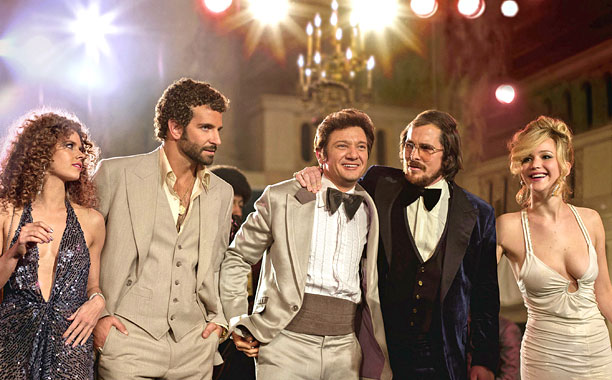
BEST PICTURE NOMINEE: American Hustle

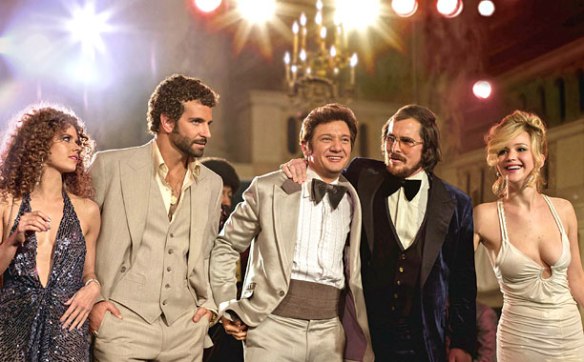
Christian Bale;Jeremy Renner;Bradley Cooper

American Hustle
Directed by: David O. Russell
Written by: Eric Singer & David O. Russell
Starring: Christian Bale, Amy Adams, Bradley Cooper and Jennifer Lawrence

Two cartoonishly ’70s-looking men stand in an art gallery gazing at a Rembrandt painting, or at least what one of them thinks is a Rembrandt painting.  The other guy, a con man played by Christian Bale, explains with his thick Brooklyn accent that it’s a fake.

“The guy who made this was so good, that it’s real to everybody.  Now, who’s the master: the painter or the forger?” he asks.

It’s as if director David O. Russell is speaking through Irving Rosenfeld (Bale) at this moment, pondering the question a little too sincerely.  American Hustle, his sleek and contagiously energetic latest endeavor, is also somewhat of a forgery. It’s being released nationwide the week before The Wolf of Wall Street, and I’m curious to see which one is more widely praised, the original Scorsese or this loving knockoff.

The frantic voice-over, the constant bombardment of tracking shots mixed with sporadic cutting, the amazing use of rock music- all of the staples from Scorsese’s signature crime films are here.  With his previous two features, The Fighter and last year’s Silver Linings Playbook, Russell tackled two very different genres (boxing movie and romantic comedy) in his own consistently thrilling and fresh way.  Although American Hustle is a much more complicated and sleek film, it feels like a step backward of sorts simply because its stylistic influence is blatant and overused.

It even plays rough and rowdy with history and the time period the same way that Scorsese does in movies like Goodfellas. Turning the Abscam corruption sting case from the late ’70s and early ’80s into such a wildly funny and drugged-out con job makes it decidedly less self-serious then a true life government operation movie like, say, Argo.  It barely shows the congressmen caught up in the mob corruption, but rather the push and pull of the government agents and the criminals they enlist (entrap) to help them.

american-hustle-2

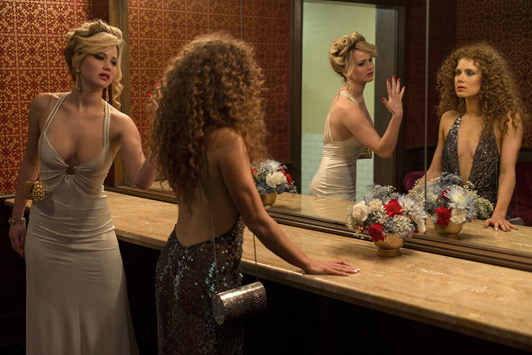
Everyone in this movie is stupid in their own way, except maybe Amy Adams’ character, who is just unlucky.  She is the one who takes the fraudulent money from an FBI agent (Bradley Cooper), which in turn pulls Rosenfeld, her lover, in to help fry bigger fish.

Rosenfeld is a repulsive slob in the beginning of the movie, and is only sympathetic when it becomes clear to him that everyone is just as crooked as him.  The government “good guys” are basically running a post-Watergate publicity stunt and one of the “bad guys,” Camden, New Jersey mayor Carmine Polito (Jeremy Renner), has a dimwitted, illegal way of trying to jump-start a sluggish economy.  As it becomes clear that everyone in the movie is, in their way, conning someone, Rosenfeld starts to feel the burn as the net they are casting continues to widen and involve much bigger fish.

He is matched blow for blow in hairdo grotesqueness by Cooper’s agent Richie DiMaso, a perversely ambitious hothead and drug addict.  Both of these performances feel slimy, and both actors capture the disingenuous core of each of the men.  Russell has a way of bottling a unique kind of lightning from this very diverse group of performers, which in addition to Adams and Renner also includes an explosive turn by Jennifer Lawrence.  As Rosenfeld’s wife, she reveals herself to be the biggest manipulator of the bunch even though she has no initial involvement in the caper.

That is the point Russell seems to be getting at.  Tacking a grandiose and vague title like American Hustle onto the story means he’s showing us that all Americans are hustlers, whether they’re in front of the camera, behind it or watching the final product in a theater.  The movie is almost aggressively sloppy, diluting this simple theme well past two hours.  Even when it’s redundant it’s never dull, though as far as self-conscious Scorsese knockoffs go, I’m still partial to Boogie Nights.

Grade: C
BEST PICTURE NOMINEE: 12 Years a Slave

TWELVE YEARS A SLAVE

12 Years a Slave
Directed by: Steve McQueen
Written by: John Ridley (screenplay), Solomon Northup (memoir)
Starring: Chiwetel Ejiofer, Michael Fassbender, Lupita Nyong’o and Sarah Paulson

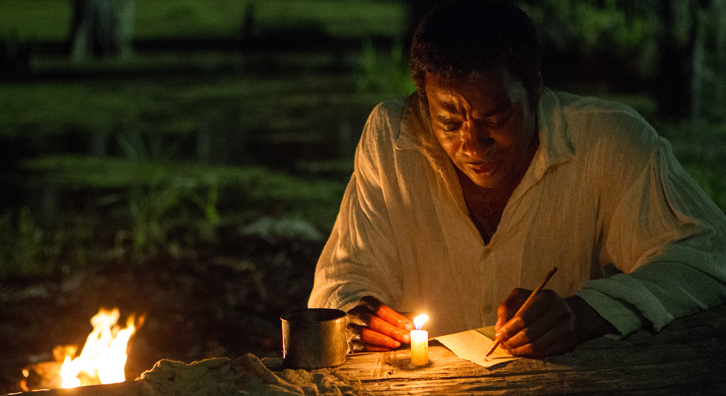
Connecting 12 Years a Slave immediately to its Oscar buzz because of when a studio chose to release it would be a disservice to it.  To put it simply, this is the most powerful film about American slavery that I’ve ever seen, and diminishing that accomplishment by asking if the white male establishment of the Academy can handle it enough to award it with anything is at the bottom of my list.

Steve McQueen’s previous two features, Hunger and Shame, were visually brilliant, but at times lacking a crucial human element.  This was especially true of Shame, whose miserabalism was supposed to be its own profound reward but ultimately registered as empty.  There is obviously a great deal of suffering in 12 Years a Slave, but also an intense humanity.

Continue reading