Our Favorite Movies of 2011

1. The Tree of Life– Terrence Malick’s epic tone poem weaves in and out of the life of a typical American family in 1950s Texas, zig-zagging between the creation of the universe and the afterlife in the process.  By placing the location of his own childhood at the center of these celestial events, he puts a very personal spin on his warring perceptions of creation; the way of nature and the way of grace.  As his camera weaves in and out of the O’Brien family’s lives (a three son household run by Brad Pitt’s nature and Jessica Chastain’s grace), the element of visual improvisation makes their everyday life and afterlife beautiful.  Even if you hated it, you’ll never forget it. Read our review.

2. Certified Copy- Unexpected in every way, the romance film by Iranian director Abbas Kiarostami follows two strangers as they meet up in Tuscany one afternoon and divulge into their passionate opinions on art, originality, philosophy and love. Over the course of a single afternoon, their relationship takes twists and turns, leaving the audience in awe of the puzzle laid out before them and clinging to the aesthetic beauty of its settings and characters to reveal clues. Sophisticated filmmaking technique brilliantly interlaces heavy academic, multilingual conversation with a flowing narrative to sculpt this as one of the most unique and thought-provoking films of the year. Read our review.

Continue reading

REVIEW: Martha Marcy May Marlene

Martha Marcy May Marlene
Directed by: Sean Durkin
Written by: Sean Durkin (screenplay)
Starring: Elizabeth Olsen, John Hawkes, Sarah Paulson and Hugh Dancy

Many prominent American indies have started to favor the Before/After plot device.  Blue Valentine and the more recent We Need To Talk About Kevin are both examples of that style being used as a substitution for substance.  Sean Durkin’s debut feature Martha Marcy May Marlene shows that device finally being used in excruciatingly well-done ways.

Along with Margin Call, this film about a young woman traumatized by her time in a cult marks the best American writer/director debut of 2011.  Durkin’s films is decidedly less slick than J.C. Chandor’s drama about the financial collapse in 2008, but they both become unflinchingly honest if very different portraits of American identity.  The point of relation in this film comes from Martha (Elizabeth Olsen), whose strength after escaping the cult seems impossibly strong.

Continue reading

Our Favorite Performances of 2011

1. Kirsten DunstMelancholia– In Lars von Trier’s apocalyptic new film, Dunst creates one of cinema’s most fully realized portraits of numbing depression.  In all of her performances, Dunst has shown a skill sometimes greater than the films she is in.  Here, she takes the role of Justine, a woman who self-destructs on her wedding night and takes shelter with her sister as the planet Melancholia goes on a collision course with Earth.  Key Scene: In the deepest part of her depression, Justine even needs help getting down to the dinner table.  Her sister Claire (Charlotte Gainsbourg) made meatloaf, her favorite dish.  When Justine tastes it, her face crumbles, and she says it tastes like ash.  That’s all that will be left of the planet in a couple days, and she can’t wait.

Continue reading

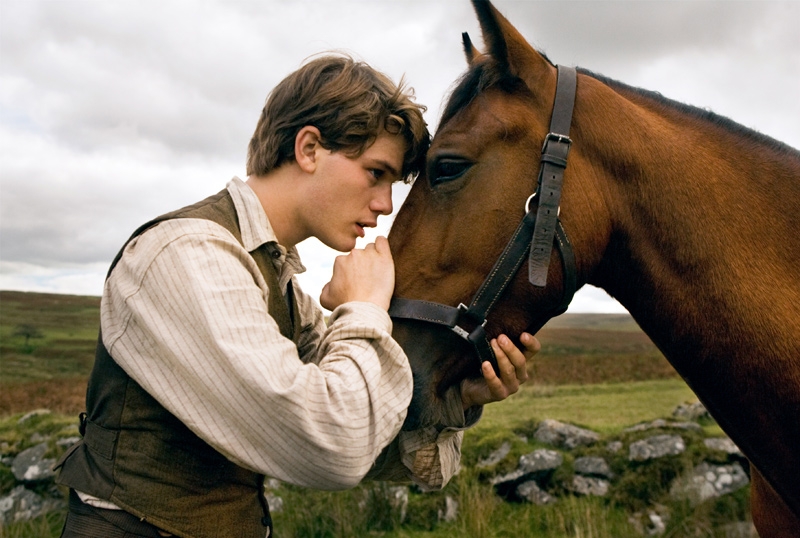
REVIEW: War Horse

War Horse
Directed by: Steven Spielberg
Written by: Lee Hall and Richard Curtis (screenplay), Michael Morpurgo (novel)
Starring: Jeremy Irvine, Peter Mullan, Emily Watson and Niels Arestrup

In his second movie of 2011 (released only a few days after The Adventures of Tintin), Steven Spielberg has made one of the most quietly beautiful films of the year and his career.  War Horse may lack the grand narrative spectacle that follows much of his other work, Tintin included, but its imagery is truly captivating.

From the pensive beginning and ending on the same British farm to the desecrated terrain of World War I battlefields, Spielberg films War Horse with the kind of steady hand that only experience can bring.  Instead of embracing new motion capture animation technology like he did with Tintin, here he meticulously recreates explosive battles without using special effects.  As if that weren’t enough, he has placed a horse at the center of his story, and it does not talk like it might in an animated film.

Continue reading