
1. Moonlight- “Who is you?”
The question seems to knock Chiron backward. That’s because when it’s asked toward the end of Barry Jenkins’ moving, intimate epic, everything that preceded it seems to wash over him at once. Told in three stages of his life — as a young boy, a teenager and an adult — Moonlight charts Chrion’s evolution from a quiet, cripplingly shy child to a more confident adult without losing sight of his pent up frustration and insecurity. Jenkins crafts scenes filled with long, winding conversation where Chiron slowly unfolds his inner desires as well as moments of loud, visual splendor, as in a scene where Chrion’s father figure Juan brings him to the beach. Chiron’s entry into the water is overwhelmed by Nicholas Britell’s stirring, string-heavy score, the camera seemingly placed on the water’s surface as Juan supports Chiron as he floats on his back.
It’s exceedingly rare to see a film like this, a black, queer coming-of-age story that morphs into a beautifully observed romance, get a nationwide release and even an awards push. It’s nice to see the film get this kind of exposure, and hopefully it leads to Jenkins getting more resources for his next endeavor. However, the breathtaking artistry with which he realizes this deeply personal vision transcends whatever awards hype Moonlight might garner. Jenkins charts Chiron’s inner life and emerging queer identity with extraordinary empathy and images of overwhelming power, finding rhyming verbal and visual cues that echo across decades. –Matt
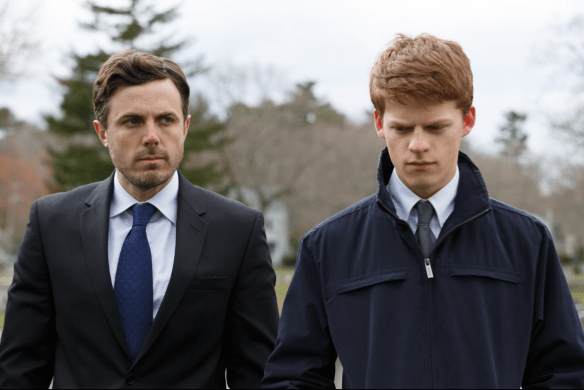
2. Manchester by the Sea- Films often portray grief as a series of steps characters move through to reach the end of a dark tunnel and emerge back into the light. Kenneth Lonergran’s exceptional Manchester by the Sea is one of the few to acknowledge that, sometimes, a tidy reconciliation never arrives. The past continues to haunt and inform the present. Lee Chandler (Casey Affleck) is a janitor living in Massachusetts – he sulks through his work with a dead-eyed stare, sometimes snapping to life at slight transgressions from customers and bar patrons. It is clear he is a man suffering, unable to rectify himself. Chandler is called back to his hometown, Machester-by-the-Sea – a place that holds painful memories – when he is informed his brother Joe has had a heart attack. Joe’s son, Patrick, comes under the temporary guardianship of Lee as the two negotiate the best course of action and form a strained – and often humorous – reconnection.
Lonergran’s 2011 film Margaret was an operatic and ambitious melodrama about a teenager emerging from solipsism in New York City, with narrative threads that piled on and split off in all directions to overwhelming effect. The tangled narrative structure is still here, albeit on a much smaller scale, absent of the escalating drama and more attuned to the ways comedy can coincide with tragedy. Its script is unconcerned with easy resolutions or adhering to formulaic notions of “growth” and “change” – most of the characters here end up much the same as before. As we all often do. -Sam
Continue reading →










 CyniCritics