REVIEW: Aloha

Aloha 1

Aloha
Directed by: Cameron Crowe
Written by: Cameron Crowe
Starring: Bradley Cooper, Emma Stone, Rachel McAdams and Bill Murray

I wish I could say that I was dragged to the theater kicking and screaming to see Aloha, or that I had lost a bet or been dared by someone to sit through it.  Alas, I paid $8.50 for a matinee ticket and watched all of it it on my own free will, and I have to live with that decision.

Outside of being a cloying, uninteresting romance, Cameron Crowe’s film is so narratively fractured that it often feels incoherent.  Is Brian Gilcrest, a military contractor played by Bradley Cooper, world-weary and depressed or is he chipper and earnest?  He switches between these two extremes from scene to scene, which makes him much more exciting than any of the one-dimensional support around him.  Almost all of them are repeatedly defined by a single characteristic, like nervously moving their hands, never talking or, most offensively, being “one-quarter Hawaiian.”

Continue reading

REVIEW: Far From the Madding Crowd

Far From the Madding Crowd 3

Far From the Madding Crowd
Directed by: Thomas Vinterberg
Written by: David Nicholls (screenplay), Thomas Hardy (book)
Starring: Carey Mulligan, Matthias Schoenaerts, Michael Sheen and Tom Sturridge

Thomas Vinterberg’s adaptation of Far From the Madding Crowd is often too shackled to its narrative to truly resonate.  It seems forced and prodded along every step of the way, and almost nothing seems to spring out of the story’s perceived humanity.  It’s only fitting that Madding Crowd’s most beautiful, haunting moment involves animals; a dog chasing a herd of sheep over a cliff and to their death, with an overhead shot lit by the rising sun catching their needless tumble.

Their shepherd’s (Matthias Schoenaerts) subsequent burst of rage seems to reverberate through the the top of that cliff, and it resonates more than nearly any other emotion on display for the rest of the movie.  It’s too bad, because Madding Crowd’s cast truly gives it their all.  Carey Mulligan’s performance as Bathsheba Everdene occasionally manages to convey a sense of inner life, of a stubbornly independent farmer grappling with a trio of attractive suitors.  In addition to Schoenaerts’ farmhand Gabriel Oak, there is a wealthy, middle aged next-door neighbor (Michael Sheen) and a blunt, charming-on-the-surface soldier Francis Troy (Tom Sturridge).

Far From the Madding Crowd

Oaks and Troy rarely share the screen, but they are the two main contenders in the quiet war for Bathsheba’s affection.  Though the men all come from different social ranks, those ranks do not dictate which of them Bathsheba must marry.  If that were the case, William Boldwood (Sheen) would naturally win over the other two.  Madding Crowd draws much of its drama from Bathsheba’s reluctance to want to marry at all, and Boldwood never really stands a chance.

Sheen plays him that way, too.  He has a look of crippling self-doubt nearly every time he talks to Bathsheba, and he’s framed at an awkward distance from the action, not wanting to be pulled into it. His performance is a good example of how the movie fails to convey the full depth of its characters’ feelings.  Boldwood ultimately sacrifices his freedom for Bathsheba; (spoilers ahead) he shoots Troy as he grabs her and demands that she obey him.  There is a quick shot showing a prison door close on him and a brief scene that shows dresses and gifts in his house with her first name and his last name stitched on them.

Had Vinterberg embraced the melodrama at the heart of Madding Crowd instead of opting for a more restrained adaptation, scenes like those could have been devastating instead of throwaways.  Instead, it’s a tedious movie sprinkled with visually sumptuous moments, like the first time we see Oaks see Bathsheba, bending over backwards to go under low-hanging branches while on her horse.  The way she’s framed by the trees she seems to be floating across the screen; a few minutes later he’s asking her to marry him and she laughs.

I wish the movie had more scenes like this, ones filled with a genuine longing.  There’s a rich emotional history etched on Mulligan’s face, and she conveys joy, desire and regret over the course of a single smirk.  The same could be said of Schoenaerts’ stare; sadly they’re both trapped in a movie where none of that ultimately matters.

Grade: C-

Short takes: Avengers: Age of Ultron, Child 44, Age of Adaline & more

The Avengers Age of Ultron

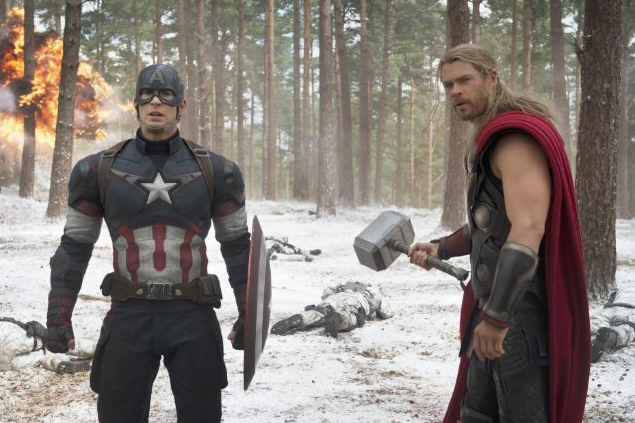
The Avengers: Age of Ultron There are too many Avengers in this latest installment and not enough interesting ones, kind of like Marvel movies.  Joss Whedon did an admirable job of meshing the clumsy super hero universes in the first Avengers, even if the movie itself ultimately felt bland and overdone.  Whedon’s knack for playing off the different screen personas of his stars can’t save the overstretched Age of Ultron, though.  Almost every element of this latest installment, from the story to the obnoxious editing during the action sequences, induces an unpleasant amount of whiplash.  Ultron somehow manages to be both overwhelming and boring; too sanitized and controlled to do anything but occasionally amuse.

Thor, Captain America, Hulk, Iron Man, Black Widow, et al. don’t work nearly as well together on screen as they did the first time, and the verbal wit from the first movie is in much shorter supply.  For every good scene like the one where the other characters try (and fail) to lift Thor’s hammer, there seem to be two or three lengthy, generic combat sequences with the dull turd of a villain.  (I do give James Spader credit for bringing at least some mischief to the voice of the rogue A.I. Ultron, though).  At this point Marvel movies can barely keep my attention as stand-alone installments, so I don’t anticipate my headache getting any better when the next Avengers rolls around. Grade: D+

Continue reading

REVIEW: Mad Max: Fury Road

maxresdefault

Mad Max: Fury Road
Directed by: George Miller
Written by: George Miller, Brendan McCarthy and Nick Lathouris
Starring: Tom Hardy, Charlize Theron, Nicholas Hoult and Hugh Keays-Byrne

George Miller’s return to the world of Mad Max is as deranged as it is awe-inspiring. For nearly two hours, Fury Road wreaks havoc on the post-apocalyptic Australian Outback and the leftover civilization that inhabits it. Metal and sand collide and erupt endlessly, though the greatest fire may be the one burning in the eyes of the movie’s hero.

I’m not talking about Max.  The Australian policeman brought to gritty life by Mel Gibson in Miller’s earlier films is here played by Tom Hardy, whose preferred method of communication for much of the movie is grunting and pointing.  Hardy shares the action hero spotlight with Charlize Theron, whose ferocious portrayal of the Imperator Furiosa practically ignites the screen.

Continue reading

REVIEW: While We’re Young

while-were-young

While We’re Young
Directed by: Noah Baumbach
Written by: Noah Baumbach
Starring: Ben Stiller, Naomi Watts, Adam Driver, Amanda Seyfried

“Enough about ethics, what about me?”

This line in Noah Baumbach’s latest movie comes toward the end, when the middle-aged documentary filmmaker played by Ben Stiller, reaches the end of an annoyingly grandiose diatribe against every other character in the movie and their perceived moral betrayals. It’s delivered, as much of the rest of the movie is, somewhere between satire and sincerity.  That’s to say, While We’re Young is much more of a return to form for Baumbach than the joyous outburst of his last film, 2013’s Frances Ha.

While We’re Young is Baumbach’s sometimes sharp, sometimes eye-roll-inducing look at generational gaps and overlaps.  Josh (Stiller) and Cornelia (Naomi Watts) are in their 40s, have no kids and are very defensive about it.  They’re losing their friends to parenthood, so when Josh meets Jamie (Adam Driver) and Darby (Amanda Seyfried, a young couple in one of his film classes, they go on a double date and he and his wife quickly latch onto them.

Continue reading

Short Takes: It Follows, Insurgent & Hard to Be a God

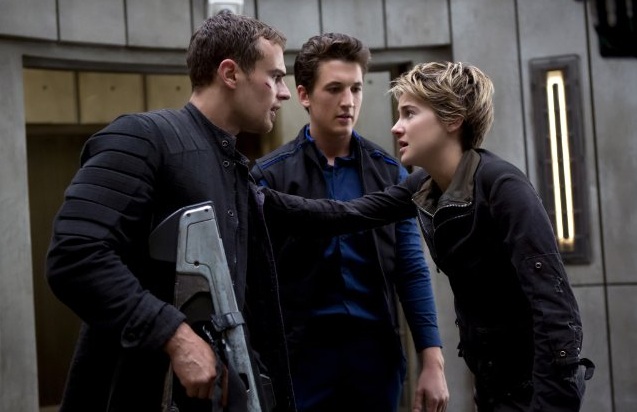
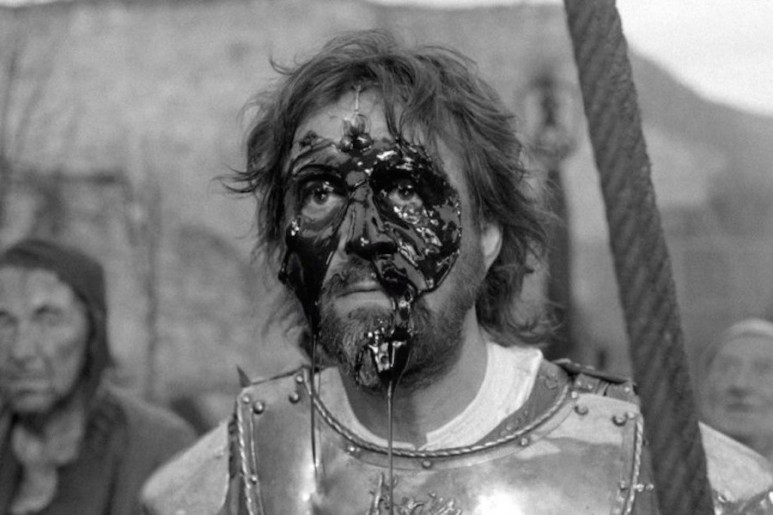
It Follows It Follows — Writer/director David Robert Mitchell proves himself a horror movie natural with It Follows, a terrifying “Sex = Death” thriller.  The overwhelming sensory experience on display in this movie is enough to distract from the thinness of its premise, which revolves around a young woman named Jay (the excellent Maika Monroe) being inadvertently passed a curse that has a shape-shifting ghost stalk her.  The curse is transmitted sexually, and whoever is the most recent recipient needs to pass it on before the ghost catches up with them.  It’s the slowness of the specter that is truly chilling, especially when combined with Dissasterpeace’s relentless, pulsating score. The movie initially toys with misogynistic audience expectations, sacrificing a barely-clothed young woman after watching her being stalked and then having Jay’s date drug her and tie her up in her underwear after sex to “warn” her about the ghost.  Predatory men may not be the culprits on screen this time around, but Mitchell’s camera still uncomfortably fetishizes the young female characters’ bodies in those scenes.  Thankfully the movie moves past it, though, and unfolds in ways that are wickedly entertaining and genuinely scary. Grade: B- Insurgent 2 Insurgent — The second entry in the Divergent series feels more alive than the stale, uneven first one.  Insurgent trades in the half-assed, uninteresting world-building of the series debut for a story that is often visceral and compelling, as teen messiah Tris (Shailene Woodley) continues to fight back against the totalitarian, Kate Winslet-led regime.  It helps greatly that Winslet actually looks like she wants to be here this time around, and the distilled chill of her performance blends well with the raw energy Woodley brings to her own role. Much of this installment revolves around Tris assembling a rebel army and completing a self-sacrificing series of grueling challenges for the dictator’s benefit (don’t call them Hunger Games).  Director Robert Schwentke brings an urgency to the action sequences that is more compelling than anything else I’ve seen in a recent teen dystopia movie, though Insurgent’s world ultimately feels just as generic and unimaginative as that of its predecessor and those in The Hunger Games and The Giver. Grade: C+ Hard to Be a God Hard to Be a God — It is a great testament to this movie’s power to say that I now feel desensitized to the grossness of human body fluids.  Hard to Be a God, a decades-long passion project of the late Russian director Aleksey German, is the filthiest feeling movie I’ve seen in years, maybe ever.  Set on Araknar, a planet similar to Earth that is experiencing its own Middle Ages, Hard to Be a God tells the story of scientists from our planet who were sent there to study it and then become deities. If the movie had not explained that in its opening narration, I’m not sure I would have picked that all up, though.  German’s camera is so embedded in the feelings of this world, of its eternal wetness and clogged sinuses, that narrative all but disappears.  Araknar is in the midst of a violent rebellion where all intellectuals are being publicly executed. The movie’s black-and-white images are jaw-dropping and disgusting at the same time; from the get-go, German’s bizarre three-hour epic of depravity is thick with sludge, snot and shit.  It captures human cruelty in a ferociously close proximity and with such an abundance of mind-twisting visual information that it’s exhausting to sit through and process in one viewing.  I’d watch it again in a heartbeat, though. Grade: A-

REVIEW: Maps to the Stars

Maps_To_The_Stars_Film_still

Maps to the Stars
Directed by: David Cronenberg
Written by: Bruce Wagner
Starring: Julianne Moore, Mia Wasikowska, John Cusack and Evan Bird

Maps to the Stars, David Cronenberg’s latest nightmare, is an emotionally violent, incestuous drama staged in the Hollywood Hills.  Like Paul Schrader’s recent The Canyons, this film’s Los Angeles has a radioactive glow; its bleached-out skies make it impossible to see where the sun is during the day, and neon colors pop during the few night scenes.  Its characters are an equally disturbed group of frigid psychopaths and tortured narcissists.  Some are both.

For how often the movie is dominated by daylight, many of the characters look (and behave) like vampires trapped in the sun, or ants being fried by a magnifying glass.  One of them, Agatha (Mia Wasikowska), even has visible burn marks on her neck and the left side of her face.  Her brother, troubled teen star Benjie Weiss (Evan Bird), is the only noticeably tan one, and he’s also the most well-adjusted to the movie’s world of tormented excess.

Continue reading

Matt’s 2015 Oscar Picks

Best-Boyhood

Best Picture: American Sniper, Birdman, Boyhood, The Grand Budapest Hotel, The Imitation Game, Selma, The Theory of Everything, Whiplash 

  • Will Win: Boyhood.  Maybe I’m being overly optimistic that the Academy will choose this over the stale, one-note satire that is Birdman, but I have a feeling Boyhood’s marketing campaign (“It was 12 years in the making,” and “Nostalgia”) will be irresistible to voters.   It also helps that the movie is pretty great too.  
  • Should Win: Boyhood or Selma.  The only winners that would make me visibly upset are Birdman and The Theory of Everything, though.  
  • Left out: My personal favorite movie of last year, Jean-Luc Godard’s Goodbye to Language, would never, ever be nominated for Best Picture.  Neither would many of my other favorites, like Only Lovers Left Alive, Abuse of Weakness, Thou Wast Mild and Lovely or John Wick.  However, many of my others could have reasonably been nominated here, including Inherent Vice, Gone Girl and The Immigrant. 

Continue reading

REVIEW: Fifty Shades of Grey

FIFTY-SHADES-OF-GREY-2Fifty Shades of Grey
Directed by: Sam Taylor-Johnson
Written by: Kelly Marcel (screenplay), E L James (book)
Starring: Dakota Johnson, Jamie Dornan, Jennifer Ehle and Eloise Mumford

There is not nearly enough sex in this movie.  Or, I guess I should say, not enough fun sex.  The film adaptation of E L James’ kinky, possessive bestseller Fifty Shades of Grey is just as sleek, safe and occasionally steamy as I thought it was going to be.  

It has one scene of standard, well-choreographed heterosexual thrusting, a scene of intensely erotic bedroom foreplay (with ice cubes and Beyonce) and then two audacious but boringly staged BDSM sequences (only one of which has Beyonce).  Its biggest enemy is that it practices the wrong kind of restraint, and avoids engaging with the very thing that sold tens of millions of books and sparked a seemingly endless conversation about inner goddesses and troubling relationship dynamics.

Set mostly in Seattle and Portland and shot with a color palate that both honors its title and imbues the movie with seductive, red and blue-tinted shadows, Fifty Shades is about trying to turn romance into a one-sided business transaction.  Broody billionaire Christian Grey (Jamie Dornan) finds himself enchanted by Anastasia Steele (Dakota Johnson), a soon-to-be-graduating lit student who shows up at his office to interview him about how amazing he is for the school newspaper.

Armed with a nervous demeanor and, like her Twilight ancestor before her, a penchant for gnawing on her lower lip, Anastasia fumbles into the tycoon’s life with enough earnestness to soften even the coldest, most vaguely troubled of hearts.  Christian is so enamored by her that he almost seems willing to give up his singularly dominant sexual lifestyle and try something resembling traditional intimacy.

That’s not to say he still doesn’t want to strap her down in his elaborate, dimly lit sex dungeon, though. Anastasia calls it the Red Room of Pain, though Christian insists it’s much more about pleasure. Like everything else in the movie, this room looks ornate and untouched by human hands. It consists of a mattress and several tables surrounded by a seemingly endless supply of whips, paddles and ropes, none of which are ever really shown being used.When the passion doesn’t involve Christ, you can’t really get away with showing these things being used and keep an R rating, I suppose.  You can see Christian’s hand hover over and select one of the tools, and Ana’s body writhe in anticipation as he approaches, but director Sam Taylor-Johnson relies on implication rather than illustration. Fifty Shades 2 The scenes in this room seem trapped inside a porn that’s never allowed to be truly pornographic.  The camera lavishes attention on Johnson’s breasts and her orgasmic moans, but rarely at the same time that it shows anything sexual happening to her. (Sadly, not nearly the same amount of attention is given to Dornan). Sex and pleasure are isolated here, and rarely do the two meet in the same frame.  Instead, there are cringe-inducing slow motion shots of Christian teasing her with a whip and wide shots of her exposed body prior to experiencing anything.

Taylor-Johnson is at her best as a director when hinting at the story’s kink instead of clumsily trying to film around it to satisfy the MPAA.  From what I have heard and read about the books (I haven’t actually read any of them), she also has no intention of fully succumbing to its depictions of domestic violence and sexual assault. Her movie focuses on laying the groundwork for a troubling relationship and backing away from it more than it romanticizes any of Grey’s behavior.

There are a couple of creepy instances where he shows up unexpectedly to visit Anastasia; she turns the corner at work and he’s standing there with a far away grin, or he texts her about what she’s drinking while she’s at a bar with her mom. Both of these scenes are edited as if they’re in a horror movie and Grey is the smiling, psychotic killer.  Other scenes, where he shoves one of Anastasia’s college classmates who tries to kiss her at a party or probes her about having a boyfriend, chip away at the mystique of his character.  Taylor-Johnson acknowledges his disturbing behavior formally, but then sadly attempts to isolate those moments from the charming, seductive Christian instead of making the character own up to all of his behavior.  At times it seems as if her movie is trying to figure out whether to be seduced or repelled by him, just like Ana.

Seduction wins out in the end, at least until the movie devolves into an incredibly ineffective melodrama in the last few minutes before the sequel-baiting ending. However, the most fascinating thing about Fifty Shades of Grey is how much it holds back, how a major studio dances around a story with numerous sex scenes driven by bondage and sadomasochism. For all its witless, asinine dialogue, it is an oddly engaging two-hour exercise in lip-biting, furrowed eyebrows and exposed armpits.  It could have used a little more Romance, though. Grade: C-
Short Takes: A Most Violent Year, Blackhat & The Imitation Game

A-Most-Violent-Year_612x380

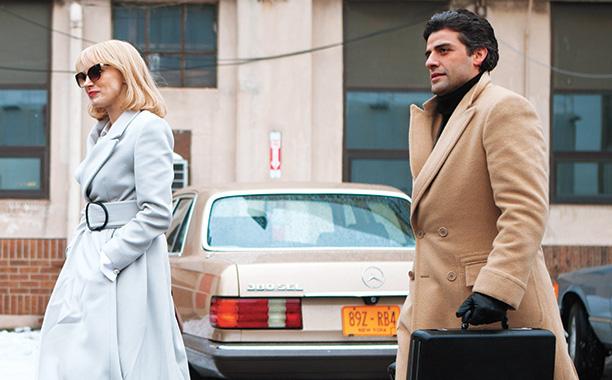
A Most Violent Year – After a somewhat intriguing debut with 2011’s Margin Call,  J.C. Chandor has made two miserably dull follow-up features, All Is Lost and his latest, A Most Violent Year.  That year is 1981, and Chandor’s crime drama chronicles an up-and-coming oil supplier (Oscar Isaac) trying to make it big in New York City without caving in to (too many) illegitimate business practices.

Isaac resembles young Al Pacino in the first two Godfather films in both look and manner here, a high compliment to be sure.  There is a clear spark between him and Jessica Chastain, whose scenery-chewing performance as his wife balances well with his restrained, slow-burning intensity. However, the movie itself drowns in its own austere predictability.  The production design is excellent and absorbing and Bradford Young’s cinematography gives New York an amber, menacing glow, but the movie still never comes alive.  The script is full of vague, uninsightful musings on American life imbued with tired machismo, but it isn’t interested in showing anyone really living. Grade: D+

Continue reading