REVIEW: The Counselor

The-Counselor-Fassbender

The Counselor
Directed by: Ridley Scott
Written by: Cormac McCarthy
Starring: Michael Fassbender, Penélope Cruz, Cameron Diaz and Brad Pitt

Cormac McCarthy never ceases to come up with flinch-inducing ways to kill, or elegant ways to philosophize about it.  In No Country for Old Men, there was the cattle-gun-wielding assassin offset by the world-weary sheriff.  In Blood Meridian, massacre after massacre in a blood-soaked desert and a ranting, apocalyptic Judge.  Then there was the actual apocalypse in The Road, where a man and his son stumble upon a den of cannibals with half-eaten naked people locked in a cellar.  They talk about keeping a moral fire alive in a world made of ash.

The Counselor is McCarthy’s first outing as a screenwriter, but it is filled with the kind of boundless evil and morally compromised good of his novels.  The rich language in the movie may be off-putting to many viewers, just as it was in David Cronenberg’s adaptation of Cosmopolis.   Though these are commercial movies, they have very distinct and unsentimental voices behind them that illustrate a worldview beyond realism.

If McCarthy is a man obsessed with chronicling the poetry of violence, he is also equally obsessed with doing so on the U.S./Mexico border.  There are also stops in places like Boise and London here, but most of the plot is rooted along that tumultuous cultural and economical dividing line.

Continue reading

REVIEW: Captain Phillips

Captain Phillips

Captain Phillips
Directed by: Paul Greengrass
Written by: Billy Ray (screenplay), Richard Phillips (book)
Starring: Tom Hanks, Barkhad Abdi, Barkhad Abdirahman and Faysal Ahmed

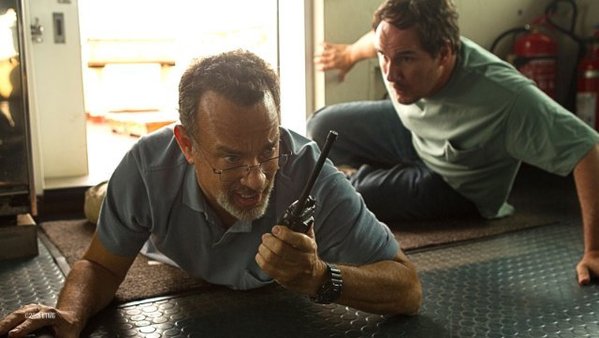
The final scenes in Captain Phillips are some of the most disturbing and haunting of the year.  They also somewhat erase the good guy/bad guy mentality and replace it with raw humanity. (Spoiler ahead) They involve Richard Phillips (Tom Hanks) screaming his head off while covered in the blood of recently-killed Somali pirates who were holding him hostage.  It is a raw portrayal of trauma, and it resonates more than anything else in this taut if mostly unsubstantial movie.

Like Gravity, Paul Greengrass’ latest film operates on the built-in history audiences have with its Hollywood star.  Hanks doesn’t disappear into the title character as much as he uses his image to enhance the terror of the situation.  It’s the actor we are meant to see struggle with a pirate raid on his cargo ship while traveling off the African coast.  Those last scenes in particular are crucial reminders of that.

That isn’t to say that Greengrass rests on his laurels because he has one of the most famous stars in the world in his movie.  He films Captain Phillips as if it were a documentary, as if the source material (written by the actual captain and adapted by Billy Ray) were an absolute truth.  It is an exhilarating, immersive approach to the material, but also flawed.  Richard Phillips obviously has a very biased account of these actions, and though the movie attempts to offer slight sympathy to the pirates, Phillips’ crew largely comes off as a mindless herd that would be nothing without their captain.

captainphillips1

Once Phillips is taken hostage in the claustrophobic confines of a lifeboat, this ceases to be an issue.  The captain of the Somali pirates, Muse (Barkhad Abdi), becomes less an antagonist than he does a man trapped by a life’s worth of bad options.  In a crucial scene, Phillips ask him why he has to steal and loot, that there must be some other choice in life.  “Maybe in America,” he replies.

The scenes inside that lifeboat are truly riveting.  If the movie had stayed pinned inside that action and not over-indulged the Navy officers attempting to rescue Phillips, it would have been much stronger.  Thankfully the tactical efficiency of the military is offset by moments of moral ambiguity, much like Zero Dark Thirty.

I wish the movie had spent more time with Muse at the end, because although it makes its point by showing officers coldly tell him “your friends are all dead,” it spends much more time with Phillips, who is so traumatized that he can’t even form a coherent sentence.  This is another example of the movie’s flawed, if riveting, subjectivity.  Greengrass and Ray attempt to rise above it in those final scenes, but they partially fall prey to star power, which will likely be the biggest audience (and Oscar) draw to their movie.

Grade: C+

REVIEW: Gravity

gravity movie

Gravity
Directed by: Alfonso Cuarón
Written by: Alfonso Cuarón & Jonás Cuarón
Starring: Sandra Bullock and George Clooney

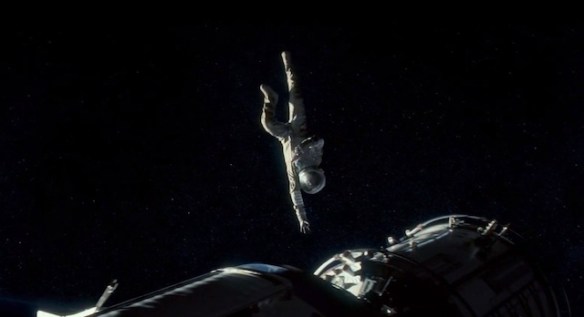
Behold the technical majesty of Alfonso Cuarón’s Gravity.  Watch as debris from a Russian satellite smashes into a repair operation led by an American astronaut team, sending them whizzing, floating and spinning in the beautiful, terrifying abyss.  Watch it and take it in, because that’s what you’re supposed to do.

I thought I did everything I was supposed to do with Gravity.  I saw it in 3D, I saw it in Imax and I saw it with a virtually sold-out crowd.  Why then, was it underwhelming?  There is an answer to that question, and it may be hard to hear for the many who have lauded praise on the film since its triumphant festival circuit.

This is a movie that was made solely for its own tech savvy.  It exists because of its technical mastery, not for any tangible idea.  Cuarón uses every cinematic element at his disposal to sustain uninterrupted awe, and it is one of the few movie-going experiences in recent memory that is truly exhausting.   By the time Ryan Stone (Sandra Bullock) hops from space station to space station and then back to (spoiler) Earth, her weariness is not just her own, but the audience’s as well.
Gravity_SBullock

Bullock carries the movie quite well, and is aided in parts by the effortless charm of George Clooney’s on-screen persona.  For long stretches, though, it’s just her dealing with whatever zero gravity obstacle Cuarón can throw at her.  There is a hefty bit of 3D gimmickry, more than there should be in a prestigious project like this, but for the most part it is effective as a grand aesthetic spectacle.  More troubling than screws and tears floating toward the camera, though, are the number of unnecessary tracking shots of Sandra Bullock’s ass.  The movie even ends on a close up of her heaving, wet-t-shirt-covered breasts.

Why?  Because Gravity is Cuarón’s playground.  The director of such rigorous works as Y tu mamá también and Children of Men has aimed his sights solely on the machinations of pleasure and terror, not as it applies to the characters, but to the audience.  This is movie as roller coaster, and the spectacle is undeniable.  It’s hard to put into words the awe of seeing a space station crumble and explode as the camera stays pinned to a twirling, panicked astronaut.   She then drifts hopelessly into space, as alone as any human could ever be.

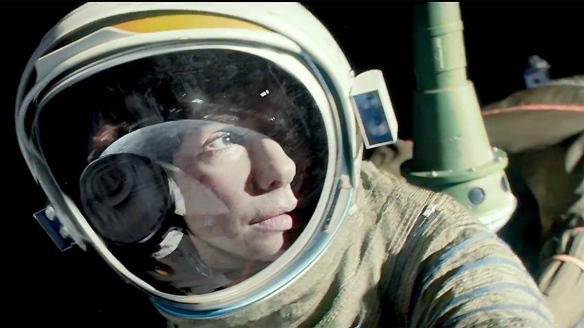
The close-up of Stone’s face that follows that sequence reflects Earth and space while her helmet fogs up.  Even here, the effects do not relent.  There are quiet moments in Gravity that are as visually stunning as the relentless action sequences, but even in those moments the movie felt defined by its technology rather than enhanced by it.

Many have and will likely continue to compare this to Kubrick’s 2001: A Space Odyssey, but that would be extremely misguided.  Gravity attempts to justify its technological means with a human element, and who better to do this than two of Hollywood’s most charming stars?  It is not a cold, calculated examination of a technological takeover, though.  It is a technological takeover, and a beautiful one at that.

Grade: C
REVIEW: Rush

430674-rush-movie-review

Rush
Directed by: Ron Howard
Written by: Peter Morgan
Starring: Chris Hemsworth, Daniel Brühl, Olivia Wilde and Alexandra Maria Lara

Ron Howard is not a director often associated with the word exhilarating.  His diverse directorial efforts are often quite safe and stale; safe enough for Academy voters (A Beautiful Mind, Apollo 13) or stale enough for box office draw (Da Vinci Code, How the Grinch Stole Christmas).  The two sides of Ron Howard, unlike, say, the two sides of Steven Soderbergh or Gus Van Sant, are not interesting enough to really write about.

That being said, Rush is probably the finest film he’s ever made, and by far the most interesting.  He showed an impressive knack for organic suspense and working with actors in 2008’s Frost/Nixon, so much so that Frank Langella’s turn as Richard Nixon is the only thing that people really remember about it.

Continue reading